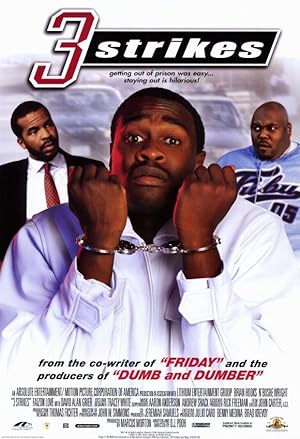
3 Strikes
Brian Hooks plays a character who is just released from jail. And the state adopts a "3 strikes" rule for felons that involves serious penalties. Hooks has 2 strikes, and wants to change his life for the better. When a friend picks him up, they are pulled over, and his friend shoots at police officers, and Hooks escapes. Now Hooks, a wanted man, must clear his name of having nothing to do with the shooting.
Working with a small-scale budget of $6.0M, the film achieved a steady performer with $9.0M in global revenue (+50% profit margin).
Plot Structure
Story beats plotted across runtime


Narrative Arc
Emotional journey through the story's key moments
Story Circle
Blueprint 15-beat structure
Arcplot Score Breakdown
Weighted: Precision (70%) + Arc (15%) + Theme (15%)
3 Strikes (2000) exhibits carefully calibrated story structure, characteristic of DJ Pooh's storytelling approach. This structural analysis examines how the film's 15-point plot structure maps to proven narrative frameworks across 1 hour and 22 minutes. With an Arcplot score of 6.9, the film balances conventional beats with creative variation.
Characters
Cast & narrative archetypes

Rob Douglas
Dahlia
J.J.
Juanita
Tone
Officer Traylor
Main Cast & Characters
Rob Douglas
Played by Brian Hooks
A man on parole trying to stay out of trouble while facing his third strike under California's three-strikes law.
Dahlia
Played by N'Bushe Wright
Rob's girlfriend who wants him to go straight and build a legitimate life together.
J.J.
Played by David Alan Grier
Rob's best friend and partner in misadventures, also dealing with street life complications.
Juanita
Played by Faizon Love
J.J.'s girlfriend who is fed up with his immature behavior and criminal lifestyle.
Tone
Played by De'aundre Bonds
A smooth-talking hustler and friend who gets involved in the chaotic events.
Officer Traylor
Played by Starletta DuPois
An aggressive police officer determined to put Rob away for good.
Structural Analysis
The Status Quo at 1 minutes (1% through the runtime) establishes Rob Douglas is released from prison after serving time for his second strike, determined to stay clean and out of trouble to avoid a life sentence under California's three-strikes law.. Of particular interest, this early placement immediately immerses viewers in the story world.
The inciting incident occurs at 10 minutes when Rob is mistakenly identified as an accomplice when J.J. Robs a Korean store. Despite his innocence, Rob is now wanted by police for a crime that would be his third strike, meaning life in prison.. At 12% through the film, this Disruption aligns precisely with traditional story structure. This beat shifts the emotional landscape, launching the protagonist into the central conflict.
The First Threshold at 21 minutes marks the transition into Act II, occurring at 25% of the runtime. This reveals the protagonist's commitment to Rob makes the active choice to go on the run rather than turn himself in, believing he can't get a fair shake from the system. He crosses into the "fugitive" world, fully committing to evading capture., moving from reaction to action.
At 41 minutes, the Midpoint arrives at 50% of the runtime—precisely centered, creating perfect narrative symmetry. Of particular interest, this crucial beat False defeat: Rob and J.J.'s plan to get evidence of Rob's innocence backfires spectacularly. The stakes raise as police intensify their search, and Rob realizes running is only making things worse. The fun and games are over., fundamentally raising what's at risk. The emotional intensity shifts, dividing the narrative into clear before-and-after phases.
The Collapse moment at 62 minutes (75% through) represents the emotional nadir. Here, All is lost: Rob is cornered by police in a situation that looks hopeless. His relationship with Dahlia appears destroyed, J.J. Has abandoned him, and it seems certain he'll be caught and imprisoned for life for a crime he didn't commit., reveals the protagonist at their lowest point. This beat's placement in the final quarter sets up the climactic reversal.
The Second Threshold at 66 minutes initiates the final act resolution at 80% of the runtime. Rob gains new information or makes a realization that allows him to synthesize what he's learned. He decides to stop running and face the system head-on, combining street smarts with doing the right thing., demonstrating the transformation achieved throughout the journey.
Emotional Journey
3 Strikes's emotional architecture traces a deliberate progression across 15 carefully calibrated beats.
Narrative Framework
This structural analysis employs systematic plot point analysis that identifies crucial turning points. By mapping 3 Strikes against these established plot points, we can identify how DJ Pooh utilizes or subverts traditional narrative conventions. The plot point approach reveals not only adherence to structural principles but also creative choices that distinguish 3 Strikes within the comedy genre.
DJ Pooh's Structural Approach
Among the 2 DJ Pooh films analyzed on Arcplot, the average structural score is 6.8, demonstrating varied approaches to story architecture. 3 Strikes represents one of the director's most structurally precise works. For comparative analysis, explore the complete DJ Pooh filmography.
Comparative Analysis
Additional comedy films include The Bad Guys, Ella Enchanted and The Evening Star. For more DJ Pooh analyses, see The Wash.
Plot Points by Act
Act I
SetupStatus Quo
Rob Douglas is released from prison after serving time for his second strike, determined to stay clean and out of trouble to avoid a life sentence under California's three-strikes law.
Theme
Rob's friend warns him that "one more mistake and you're done for life," establishing the theme of redemption versus recidivism and how the system makes it nearly impossible for ex-cons to stay straight.
Worldbuilding
Rob returns to South Central LA, reconnects with his girlfriend Dahlia and his troublemaking friend J.J., tries to find legitimate work, and navigates the challenges of life as an ex-con with two strikes already on his record.
Disruption
Rob is mistakenly identified as an accomplice when J.J. robs a Korean store. Despite his innocence, Rob is now wanted by police for a crime that would be his third strike, meaning life in prison.
Resistance
Rob debates whether to turn himself in or run. He argues with J.J. about the mess he's gotten him into, considers his options with Dahlia, and wrestles with the injustice of being punished for a crime he didn't commit.
Act II
ConfrontationFirst Threshold
Rob makes the active choice to go on the run rather than turn himself in, believing he can't get a fair shake from the system. He crosses into the "fugitive" world, fully committing to evading capture.
Mirror World
Rob's relationship with Dahlia deepens as she represents the legitimate life and love he could have if he weren't trapped by the three-strikes system. She embodies the theme of redemption and second chances.
Premise
The "promise of the premise" - Rob and J.J. engage in various comedic schemes to evade police while trying to prove Rob's innocence. Fish-out-of-water scenarios, close calls with cops, and absurd situations deliver the comedy the audience came for.
Midpoint
False defeat: Rob and J.J.'s plan to get evidence of Rob's innocence backfires spectacularly. The stakes raise as police intensify their search, and Rob realizes running is only making things worse. The fun and games are over.
Opposition
Pressure mounts as police close in, J.J.'s schemes become more desperate and dangerous, Dahlia grows frustrated with Rob's choices, and Rob's options dwindle. His flaws - trusting J.J., not facing consequences - catch up with him.
Collapse
All is lost: Rob is cornered by police in a situation that looks hopeless. His relationship with Dahlia appears destroyed, J.J. has abandoned him, and it seems certain he'll be caught and imprisoned for life for a crime he didn't commit.
Crisis
Rob hits rock bottom emotionally, processing the loss of his freedom, his future with Dahlia, and his dignity. He reflects on his choices and confronts the harsh reality that the system is rigged against people like him.
Act III
ResolutionSecond Threshold
Rob gains new information or makes a realization that allows him to synthesize what he's learned. He decides to stop running and face the system head-on, combining street smarts with doing the right thing.
Synthesis
The finale: Rob executes his plan to prove his innocence, confronts J.J. about his betrayal, and makes a stand against the injustice of the three-strikes law. He takes responsibility while fighting for the truth.
Transformation
Rob is vindicated and freed from the threat of his third strike. He's reunited with Dahlia, having proven himself worthy of a second chance. The closing image mirrors the opening but shows his transformation from passive victim to active agent of his destiny.