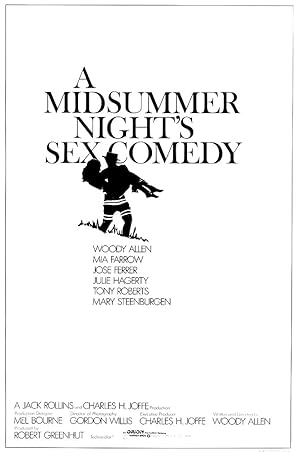
A Midsummer Night's Sex Comedy
Centred around a weekend party at the home of inventor Andrew Hobbs and his wife Adrian, attended by randy doctor Maxwell Jordan, his nurse Dulcy, renowned philosopher Dr.Leopold Sturgis and his fiancée, this is a light comedy concerning their various emotional, intellectual and sexual entanglements, loosely based on Ingmar Bergman's 'Smiles of a Summer Night' .
The film earned $9.1M at the global box office.


Plot Structure
Story beats plotted across runtime


Narrative Arc
Emotional journey through the story's key moments
Story Circle
Blueprint 15-beat structure
Arcplot Score Breakdown
Weighted: Precision (70%) + Arc (15%) + Theme (15%)
A Midsummer Night's Sex Comedy (1982) exemplifies precise plot construction, characteristic of Woody Allen's storytelling approach. This structural analysis examines how the film's 15-point plot structure maps to proven narrative frameworks across 1 hour and 28 minutes. With an Arcplot score of 6.7, the film balances conventional beats with creative variation.
Characters
Cast & narrative archetypes

Andrew

Adrian
Maxwell

Dulcy

Leopold

Ariel
Main Cast & Characters
Andrew
Played by Woody Allen
A sexually frustrated inventor who hosts friends at his country estate for a weekend of romantic complications.
Adrian
Played by Mary Steenburgen
A beautiful, free-spirited artist engaged to the pompous Leopold, but drawn to Andrew and others.
Maxwell
Played by Tony Roberts
A cynical doctor and Andrew's friend, struggling with his own romantic desires and philosophical views.
Dulcy
Played by Julie Hagerty
Maxwell's sensual, earthy wife who openly pursues physical pleasure and flirtation.
Leopold
Played by Jose Ferrer
An arrogant, pompous philosophy professor engaged to Adrian, who pontificates about rationality while being a hypocrite.
Ariel
Played by Mia Farrow
Andrew's neglected wife, a nurse who feels emotionally and sexually disconnected from her husband.
Structural Analysis
The Status Quo at 1 minutes (1% through the runtime) establishes Andrew and Adrian arrive at their country house, establishing their passionless marriage. Andrew tinkers with his eccentric flying contraption while Adrian remains emotionally distant.. Structural examination shows that this early placement immediately immerses viewers in the story world.
The inciting incident occurs at 11 minutes when The three couples arrive at the country estate for the weekend. Andrew is immediately struck by seeing Ariel again, his former flame now engaged to his friend Leopold, stirring old desires.. At 13% through the film, this Disruption is delayed, allowing extended setup of the story world. This beat shifts the emotional landscape, launching the protagonist into the central conflict.
The First Threshold at 22 minutes marks the transition into Act II, occurring at 25% of the runtime. This demonstrates the protagonist's commitment to Andrew actively begins pursuing Ariel in the woods, choosing to act on his desires despite being married. The couples begin to fracture and recombine in new configurations., moving from reaction to action.
At 44 minutes, the Midpoint arrives at 50% of the runtime—precisely centered, creating perfect narrative symmetry. Of particular interest, this crucial beat The romantic pursuits reach a peak of intensity. Andrew believes he's winning Ariel over. Leopold experiences unexpected attraction to Adrian. Everyone seems to be getting what they want, but it's a false victory., fundamentally raising what's at risk. The emotional intensity shifts, dividing the narrative into clear before-and-after phases.
The Collapse moment at 66 minutes (75% through) represents the emotional nadir. Here, Leopold dies suddenly, a shocking "whiff of death" that shatters the frivolous romantic games. His spirit visibly leaves his body in a magical moment, transforming the comedy into something more profound., shows the protagonist at their lowest point. This beat's placement in the final quarter sets up the climactic reversal.
The Second Threshold at 70 minutes initiates the final act resolution at 80% of the runtime. The characters recognize that their own relationships, flawed as they are, are precious. They understand that passion and companionship matter more than perfection. Leopold's death catalyzes acceptance., demonstrating the transformation achieved throughout the journey.
Emotional Journey
A Midsummer Night's Sex Comedy's emotional architecture traces a deliberate progression across 15 carefully calibrated beats.
Narrative Framework
This structural analysis employs a 15-point narrative structure framework that maps key story moments. By mapping A Midsummer Night's Sex Comedy against these established plot points, we can identify how Woody Allen utilizes or subverts traditional narrative conventions. The plot point approach reveals not only adherence to structural principles but also creative choices that distinguish A Midsummer Night's Sex Comedy within the comedy genre.
Woody Allen's Structural Approach
Among the 42 Woody Allen films analyzed on Arcplot, the average structural score is 7.0, demonstrating varied approaches to story architecture. A Midsummer Night's Sex Comedy takes a more unconventional approach compared to the director's typical style. For comparative analysis, explore the complete Woody Allen filmography.
Comparative Analysis
Additional comedy films include The Bad Guys, Ella Enchanted and The Evening Star. For more Woody Allen analyses, see Everyone Says I Love You, Celebrity and Interiors.
Plot Points by Act
Act I
SetupStatus Quo
Andrew and Adrian arrive at their country house, establishing their passionless marriage. Andrew tinkers with his eccentric flying contraption while Adrian remains emotionally distant.
Theme
Discussion of the weekend guests introduces the theme: the tension between rational thought and passionate desire, between spiritual love and physical pleasure.
Worldbuilding
Introduction of all three couples and their relationships: Andrew and Adrian's stale marriage, Leopold the arrogant intellectual engaged to Ariel, and Maxwell the doctor with his young nurse Dulcy. The setup reveals romantic tensions and past connections.
Disruption
The three couples arrive at the country estate for the weekend. Andrew is immediately struck by seeing Ariel again, his former flame now engaged to his friend Leopold, stirring old desires.
Resistance
The couples settle in and romantic complications emerge. Andrew debates pursuing Ariel while married. Leopold pontificates about reason over passion. Maxwell and Dulcy's age-gap relationship is established. The woods become a magical space.
Act II
ConfrontationFirst Threshold
Andrew actively begins pursuing Ariel in the woods, choosing to act on his desires despite being married. The couples begin to fracture and recombine in new configurations.
Mirror World
Maxwell and Dulcy's uninhibited sexual relationship serves as a mirror to the other couples' repressions. They embody the film's thesis about embracing physical passion.
Premise
The romantic roundelay intensifies. Partners switch and pursue each other through the enchanted countryside. Andrew pursues Ariel, Leopold becomes attracted to Adrian, Maxwell romps with Dulcy. Magic and desire intertwine.
Midpoint
The romantic pursuits reach a peak of intensity. Andrew believes he's winning Ariel over. Leopold experiences unexpected attraction to Adrian. Everyone seems to be getting what they want, but it's a false victory.
Opposition
The complications deepen. Jealousies emerge, misunderstandings multiply. Leopold's rationalism is challenged by his desires. Andrew's pursuit of Ariel becomes desperate. The magical elements intensify as reality becomes unstable.
Collapse
Leopold dies suddenly, a shocking "whiff of death" that shatters the frivolous romantic games. His spirit visibly leaves his body in a magical moment, transforming the comedy into something more profound.
Crisis
The characters process Leopold's death and his supernatural transformation into a spirit. The frivolity gives way to contemplation of mortality, love, and what truly matters. Leopold's spirit achieves enlightenment.
Act III
ResolutionSecond Threshold
The characters recognize that their own relationships, flawed as they are, are precious. They understand that passion and companionship matter more than perfection. Leopold's death catalyzes acceptance.
Synthesis
The couples reconfigure into their proper pairings with new understanding. Andrew and Adrian reconcile. Ariel finds peace. Maxwell and Dulcy continue their uninhibited romance. Leopold's spirit finds freedom and transcendence.
Transformation
The final image shows the couples at peace in nature, having accepted both the spiritual and physical aspects of love. Leopold's spirit soars free, suggesting that passion and transcendence are not opposites but complements.