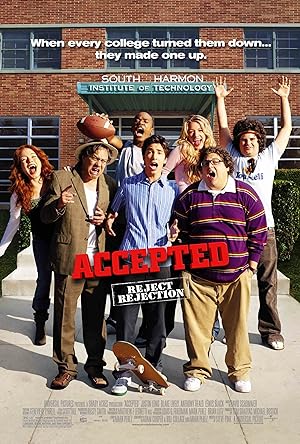
Accepted
After being rejected from every college he applied, Bartleby Gaines decided to create a fictitious university, South Harmon Institute of Technology, with his friends, to fool their parents. But when their deception works too well and every other college rejects starts to apply to his school, B. must find a way to give the education and future his students and friends deserves, including his own, while trying to win the heart of the girl next door.
Working with a mid-range budget of $23.0M, the film achieved a respectable showing with $38.5M in global revenue (+67% profit margin).


Plot Structure
Story beats plotted across runtime


Narrative Arc
Emotional journey through the story's key moments
Story Circle
Blueprint 15-beat structure
Arcplot Score Breakdown
Weighted: Precision (70%) + Arc (15%) + Theme (15%)
Accepted (2006) demonstrates precise plot construction, characteristic of Steve Pink's storytelling approach. This structural analysis examines how the film's 15-point plot structure maps to proven narrative frameworks across 1 hour and 33 minutes. With an Arcplot score of 6.8, the film balances conventional beats with creative variation.
Characters
Cast & narrative archetypes

Bartleby Gaines
Sherman Schrader
Monica Moreland
Rory Thayer
Hands Holloway
Glen
Hoyt Ambrose
Ben Lewis
Main Cast & Characters
Bartleby Gaines
Played by Justin Long
A slacker high school senior who creates a fake college after being rejected from every real university. He's creative, quick-thinking, and reluctant to follow conventional paths.
Sherman Schrader
Played by Jonah Hill
Bartleby's best friend, an anxious and rule-following student who reluctantly joins the fake college scheme. He's loyal but constantly worried about consequences.
Monica Moreland
Played by Blake Lively
Bartleby's girlfriend who gets into Yale but joins South Harmon instead to support him. She's smart, principled, and struggles with choosing between prestige and authenticity.
Rory Thayer
Played by Maria Thayer
A cool, laid-back skateboarder rejected from colleges who becomes one of the first South Harmon students. He embodies the carefree spirit of the fake institution.
Hands Holloway
Played by Columbus Short
A socially awkward student obsessed with rock music and playing guitar. He finds his tribe at South Harmon after rejection from traditional schools.
Glen
Played by Adam Herschman
Bartleby's friend and co-conspirator who helps create the fake college website. He's tech-savvy and enthusiastic about the scheme.
Hoyt Ambrose
Played by Anthony Heald
The arrogant dean of the prestigious Harmon College who looks down on South Harmon. He represents traditional elitism and educational gatekeeping.
Ben Lewis
Played by Lewis Black
A philosophy-minded burnout who becomes an unlikely mentor figure at South Harmon. He challenges students to think differently about education and life.
Structural Analysis
The Status Quo at 1 minutes (1% through the runtime) establishes Bartleby Gaines is a slacker high school senior who doesn't take college applications seriously, coasting through life without direction or ambition while his friends stress about their futures.. Of particular interest, this early placement immediately immerses viewers in the story world.
The inciting incident occurs at 12 minutes when The rejection letters arrive. Bartleby is rejected from every college he applied to, and his parents' disappointment forces him to confront that he has no future plan.. At 13% through the film, this Disruption is delayed, allowing extended setup of the story world. This beat shifts the emotional landscape, launching the protagonist into the central conflict.
The First Threshold at 23 minutes marks the transition into Act II, occurring at 25% of the runtime. This shows the protagonist's commitment to Bartleby and his friends actively choose to commit to the deception, renting an abandoned psychiatric hospital and transforming it into a fake college campus to fool their parents., moving from reaction to action.
At 47 minutes, the Midpoint arrives at 50% of the runtime—precisely centered, creating perfect narrative symmetry. Notably, this crucial beat False victory: South Harmon Institute of Technology is thriving, students are genuinely learning and happy, and Bartleby is finally finding purpose. However, the dean of nearby Harmon College discovers the deception and begins plotting to expose them., fundamentally raising what's at risk. The emotional intensity shifts, dividing the narrative into clear before-and-after phases.
The Collapse moment at 70 minutes (75% through) represents the emotional nadir. Here, The deception is fully exposed. Bartleby's father discovers the truth, Monica feels betrayed by the lies, the students face losing everything they've built, and Bartleby realizes he's let down everyone who believed in him. The dream dies., illustrates the protagonist at their lowest point. This beat's placement in the final quarter sets up the climactic reversal.
The Second Threshold at 75 minutes initiates the final act resolution at 81% of the runtime. Bartleby realizes the fake college created something real - genuine learning and community. He decides to fight for accreditation legitimately, synthesizing the deception with authentic purpose. He chooses to take responsibility and make it real., demonstrating the transformation achieved throughout the journey.
Emotional Journey
Accepted's emotional architecture traces a deliberate progression across 15 carefully calibrated beats.
Narrative Framework
This structural analysis employs a 15-point narrative structure framework that maps key story moments. By mapping Accepted against these established plot points, we can identify how Steve Pink utilizes or subverts traditional narrative conventions. The plot point approach reveals not only adherence to structural principles but also creative choices that distinguish Accepted within the comedy genre.
Steve Pink's Structural Approach
Among the 4 Steve Pink films analyzed on Arcplot, the average structural score is 7.3, reflecting strong command of classical structure. Accepted takes a more unconventional approach compared to the director's typical style. For comparative analysis, explore the complete Steve Pink filmography.
Comparative Analysis
Additional comedy films include The Bad Guys, Ella Enchanted and The Evening Star. For more Steve Pink analyses, see Hot Tub Time Machine, Hot Tub Time Machine 2 and About Last Night.
Plot Points by Act
Act I
SetupStatus Quo
Bartleby Gaines is a slacker high school senior who doesn't take college applications seriously, coasting through life without direction or ambition while his friends stress about their futures.
Theme
Bartleby's father says, "You can't just make stuff up and expect it to work" - establishing the theme about creating your own path versus following conventional expectations.
Worldbuilding
Setup of Bartleby's world: his slacker lifestyle, rejection from every college he applied to, his disappointed parents, and his friends who all got accepted to various schools. His girlfriend Monica breaks up with him over his lack of direction.
Disruption
The rejection letters arrive. Bartleby is rejected from every college he applied to, and his parents' disappointment forces him to confront that he has no future plan.
Resistance
Bartleby debates what to do, initially trying to hide the truth from his parents. He and his friend Sherman conceive the idea of creating a fake college - the South Harmon Institute of Technology (S.H.I.T.) - complete with a fake website and acceptance letter.
Act II
ConfrontationFirst Threshold
Bartleby and his friends actively choose to commit to the deception, renting an abandoned psychiatric hospital and transforming it into a fake college campus to fool their parents.
Mirror World
Bartleby reconnects with his romantic interest and begins building a community of misfit students. The fake college website accidentally accepts hundreds of real rejected students, creating a genuine community that needs him.
Premise
The "promise of the premise" - running a fake college where students can study whatever they want. Bartleby and friends create a progressive educational experience with no grades, no tests, and student-directed learning. The unconventional school actually works and students thrive.
Midpoint
False victory: South Harmon Institute of Technology is thriving, students are genuinely learning and happy, and Bartleby is finally finding purpose. However, the dean of nearby Harmon College discovers the deception and begins plotting to expose them.
Opposition
The dean of Harmon College works to shut down S.H.I.T. The stakes raise as parents get suspicious, accreditation becomes an issue, and the web of lies becomes harder to maintain. Bartleby's lies to Monica strain their relationship.
Collapse
The deception is fully exposed. Bartleby's father discovers the truth, Monica feels betrayed by the lies, the students face losing everything they've built, and Bartleby realizes he's let down everyone who believed in him. The dream dies.
Crisis
Bartleby hits rock bottom, facing the consequences of his deception. He processes his failure and the pain he's caused, contemplating giving up entirely. His friends are angry, his parents are disappointed, and the students are lost.
Act III
ResolutionSecond Threshold
Bartleby realizes the fake college created something real - genuine learning and community. He decides to fight for accreditation legitimately, synthesizing the deception with authentic purpose. He chooses to take responsibility and make it real.
Synthesis
Bartleby and the students present their case to the state education board for real accreditation. They fight for their alternative educational model, demonstrating genuine learning outcomes and arguing for educational innovation. The community comes together authentically.
Transformation
Bartleby has transformed from a directionless slacker into a leader who created something meaningful. S.H.I.T. receives provisional accreditation for one year. He's found purpose, taken responsibility, and proven you can create your own path - legitimately.