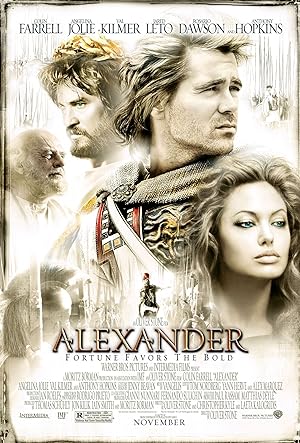
Alexander
Conquering ninety percent of the known world by the age of twenty-five, Alexander the Great (Colin Farrell) led his armies through twenty-two thousand miles of sieges and conquests in just eight years. Coming out of tiny Macedonia, Alexander led his armies against the mighty Persian Empire, drove west to Egypt, and finally made his way east to India. This movie concentrated on those eight years of battles, as well as his relationship with his boyhood friend and battle mate, Hephaistion (Jared Leto). Alexander died young, of illness, at the age of thirty-two. Alexander's conquests paved the way for the spread of Greek culture (facilitating the spread of Christianity centuries later), and removed many of the obstacles that might have prevented the expansion of the Roman Empire. In other words, the world we know today might never have been if not for Alexander's bloody, yet unifying, conquest.
Working with a enormous budget of $155.0M, the film achieved a steady performer with $167.3M in global revenue (+8% profit margin).
6 wins & 19 nominations


Plot Structure
Story beats plotted across runtime


Narrative Arc
Emotional journey through the story's key moments
Story Circle
Blueprint 15-beat structure
Arcplot Score Breakdown
Weighted: Precision (70%) + Arc (15%) + Theme (15%)
Alexander (2004) exhibits precise dramatic framework, characteristic of Oliver Stone's storytelling approach. This structural analysis examines how the film's 15-point plot structure maps to proven narrative frameworks across 2 hours and 56 minutes. With an Arcplot score of 7.0, the film balances conventional beats with creative variation.
Characters
Cast & narrative archetypes

Alexander the Great
Ptolemy
Hephaistion
Olympias
Philip II
Roxane
Cassander
Cleitus
Main Cast & Characters
Alexander the Great
Played by Colin Farrell
Macedonian king who conquered the known world, driven by visions of divine destiny and the need to prove himself beyond his father's shadow.
Ptolemy
Played by Anthony Hopkins
Alexander's trusted general and friend who narrates the story in old age, serving as historian and witness to the conqueror's rise and fall.
Hephaistion
Played by Jared Leto
Alexander's closest companion and likely lover, his most trusted friend who shares his vision and supports him unconditionally until death.
Olympias
Played by Angelina Jolie
Alexander's ambitious and manipulative mother who fills his head with prophecies of greatness and poisons his relationship with his father.
Philip II
Played by Val Kilmer
Alexander's powerful father, King of Macedon, a brilliant military strategist whose shadow Alexander constantly tries to escape.
Roxane
Played by Rosario Dawson
Bactrian princess who becomes Alexander's wife, passionate and jealous, representing the tension between conquest and personal connection.
Cassander
Played by Jonathan Rhys Meyers
Son of Antipater and Alexander's companion who grows increasingly resentful of the king's Eastern policies and autocratic behavior.
Cleitus
Played by Gary Stretch
Veteran Macedonian general who saved Alexander's life at Granicus but openly criticizes his adoption of Persian customs, leading to tragedy.
Structural Analysis
The Status Quo at 2 minutes (1% through the runtime) establishes Ptolemy narrates in old age from Alexandria, establishing Alexander's world-conquering legacy and the mystery of what drove him. The framing device shows the elderly general reflecting on his fallen king.. The analysis reveals that this early placement immediately immerses viewers in the story world.
The inciting incident occurs at 20 minutes when Philip is assassinated at his wedding feast. The violent murder throws Macedonia into chaos and forces the 20-year-old Alexander to seize power immediately or risk losing everything.. At 11% through the film, this Disruption aligns precisely with traditional story structure. This beat shifts the emotional landscape, launching the protagonist into the central conflict.
The First Threshold at 42 minutes marks the transition into Act II, occurring at 24% of the runtime. This indicates the protagonist's commitment to Alexander crosses the Hellespont into Asia, declaring war on the Persian Empire. This irreversible choice launches him from Macedonian king to would-be world conqueror., moving from reaction to action.
At 89 minutes, the Midpoint arrives at 50% of the runtime—precisely centered, creating perfect narrative symmetry. The analysis reveals that this crucial beat Alexander reaches Babylon and is crowned King of Kings. A false victory - he has conquered Persia but realizes conquest alone will never satisfy him. He must push further into the unknown., fundamentally raising what's at risk. The emotional intensity shifts, dividing the narrative into clear before-and-after phases.
The Collapse moment at 132 minutes (75% through) represents the emotional nadir. Here, At the Hyphasis River, Alexander's army refuses to march further. His men mutiny, forcing him to turn back. His dream of reaching the ends of the earth dies, and with it, his sense of divine purpose., shows the protagonist at their lowest point. This beat's placement in the final quarter sets up the climactic reversal.
The Second Threshold at 141 minutes initiates the final act resolution at 80% of the runtime. Alexander is wounded in India and nearly dies. This brush with mortality clarifies that his legacy will be what he built, not how far he marched. He chooses to return to Babylon to consolidate his empire., demonstrating the transformation achieved throughout the journey.
Emotional Journey
Alexander's emotional architecture traces a deliberate progression across 15 carefully calibrated beats.
Narrative Framework
This structural analysis employs systematic plot point analysis that identifies crucial turning points. By mapping Alexander against these established plot points, we can identify how Oliver Stone utilizes or subverts traditional narrative conventions. The plot point approach reveals not only adherence to structural principles but also creative choices that distinguish Alexander within the action genre.
Oliver Stone's Structural Approach
Among the 15 Oliver Stone films analyzed on Arcplot, the average structural score is 7.1, reflecting strong command of classical structure. Alexander takes a more unconventional approach compared to the director's typical style. For comparative analysis, explore the complete Oliver Stone filmography.
Comparative Analysis
Additional action films include The Bad Guys, Puss in Boots and Venom: The Last Dance. For more Oliver Stone analyses, see Nixon, Any Given Sunday and Natural Born Killers.
Plot Points by Act
Act I
SetupStatus Quo
Ptolemy narrates in old age from Alexandria, establishing Alexander's world-conquering legacy and the mystery of what drove him. The framing device shows the elderly general reflecting on his fallen king.
Theme
Aristotle teaches young Alexander: "The truth is what you make it." This theme of self-fashioned destiny versus inherited fate permeates the entire narrative.
Worldbuilding
Extended flashbacks to Alexander's youth: his volatile relationship with parents Philip and Olympias, his education under Aristotle, the taming of Bucephalus, and the poisonous Macedonian court politics that shaped him.
Disruption
Philip is assassinated at his wedding feast. The violent murder throws Macedonia into chaos and forces the 20-year-old Alexander to seize power immediately or risk losing everything.
Resistance
Alexander consolidates power, debates his generals about whether to pursue his father's dream of conquering Persia, and prepares his army. Ptolemy and other companions question the wisdom of such ambition.
Act II
ConfrontationFirst Threshold
Alexander crosses the Hellespont into Asia, declaring war on the Persian Empire. This irreversible choice launches him from Macedonian king to would-be world conqueror.
Mirror World
Alexander encounters Roxane, the Bactrian princess who will become his wife. She represents the Eastern world he seeks to unite with Greece, embodying his dream of fusion rather than mere conquest.
Premise
The glory of conquest: Alexander defeats Darius at Gaugamela, enters Babylon in triumph, burns Persepolis, and is declared King of Asia. This is the "promise of the premise" - the spectacular military genius on display.
Midpoint
Alexander reaches Babylon and is crowned King of Kings. A false victory - he has conquered Persia but realizes conquest alone will never satisfy him. He must push further into the unknown.
Opposition
The campaign into India brings mounting costs: his men grow weary, Macedonian veterans resent his adoption of Persian customs, paranoia leads to Cleitus's murder, and the brutal Battle of Hydaspes shows the limits of ambition.
Collapse
At the Hyphasis River, Alexander's army refuses to march further. His men mutiny, forcing him to turn back. His dream of reaching the ends of the earth dies, and with it, his sense of divine purpose.
Crisis
Alexander broods on the retreat through the Gedrosian Desert. Surrounded by suspicion and conspiracy, he withdraws into isolation, confronting the reality that he cannot escape his mortal limitations.
Act III
ResolutionSecond Threshold
Alexander is wounded in India and nearly dies. This brush with mortality clarifies that his legacy will be what he built, not how far he marched. He chooses to return to Babylon to consolidate his empire.
Synthesis
Back in Babylon, Alexander plans further campaigns and attempts to unify his empire through cultural fusion. But fever takes him at age 32, his empire fragmenting immediately upon his death.
Transformation
Ptolemy concludes his narration: Alexander's body lies in state, his empire divided among generals. The closing image mirrors the opening - the old general reflecting that Alexander's true conquest was inspiring men to dream of the impossible.