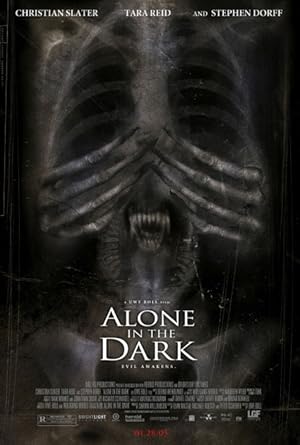
Alone in the Dark
Edward Carnby, detective of the paranormal, unexplained and supernatural, investigates a mystery (the recent death of a friend) with clues leading to "Shadow Island" that brings him face to face with bizarre horrors that prove both psychologically disturbing and lethal, as he discovers that evil demons worshiped by an ancient culture called the Abskani are planning on coming back to life in the 21st century to once again take over the world... and only he and a young genius anthropologist with an incredible memory (and his ex-girlfriend), Aline Cedrac, stand in their way, at a gateway to hell. Standing in Carnby's way, however, is the impact that a brief encounter with an evil spirit called the Queen had upon his mind, as he slowly finds himself overpowered by the forces of darkness as they eat away at his very sanity...
The film disappointed at the box office against its mid-range budget of $20.0M, earning $12.7M globally (-37% loss). While initial box office returns were modest, the film has gained appreciation for its unconventional structure within the action genre.
4 wins & 4 nominations


Plot Structure
Story beats plotted across runtime


Narrative Arc
Emotional journey through the story's key moments
Story Circle
Blueprint 15-beat structure
Arcplot Score Breakdown
Weighted: Precision (70%) + Arc (15%) + Theme (15%)
Alone in the Dark (2005) showcases precise dramatic framework, characteristic of Uwe Boll's storytelling approach. This structural analysis examines how the film's 15-point plot structure maps to proven narrative frameworks across 1 hour and 38 minutes. With an Arcplot score of 7.7, the film showcases strong structural fundamentals.
Characters
Cast & narrative archetypes

Edward Carnby
Aline Cedrac
Richard Burke
Main Cast & Characters
Edward Carnby
Played by Christian Slater
A paranormal investigator haunted by childhood amnesia who uncovers an ancient evil threatening humanity.
Aline Cedrac
Played by Tara Reid
An archaeologist and museum curator who joins Carnby to stop the supernatural threat.
Richard Burke
Played by Stephen Dorff
Head of Bureau 713, a secret government organization investigating paranormal phenomena.
Structural Analysis
The Status Quo at 1 minutes (1% through the runtime) establishes Opening text crawl establishes Edward Carnby as a paranormal investigator and former agent of Bureau 713, now working alone to uncover supernatural mysteries. Shows his isolated, obsessive lifestyle hunting creatures from beyond.. Notably, this early placement immediately immerses viewers in the story world.
The inciting incident occurs at 11 minutes when Edward is attacked by a possessed human infected with a creature from the darkness. The creature has crossed into our world, making the threat immediate and personal. His normal investigative work becomes a fight for survival.. At 11% through the film, this Disruption aligns precisely with traditional story structure. This beat shifts the emotional landscape, launching the protagonist into the central conflict.
The First Threshold at 24 minutes marks the transition into Act II, occurring at 24% of the runtime. This indicates the protagonist's commitment to Edward chooses to fully commit to stopping the supernatural invasion, agreeing to work with Bureau 713 and Commander Burke despite their history. He accepts that only by confronting his past as an orphan experiment can he stop the darkness., moving from reaction to action.
At 48 minutes, the Midpoint arrives at 49% of the runtime—precisely centered, creating perfect narrative symmetry. Significantly, this crucial beat False defeat: Edward discovers the mastermind Professor Hudgens has been using the orphans as vessels and plans to open a permanent gateway for the darkness. The conspiracy goes deeper than expected, and Bureau 713 has been infiltrated. Stakes are raised massively., fundamentally raising what's at risk. The emotional intensity shifts, dividing the narrative into clear before-and-after phases.
The Collapse moment at 72 minutes (74% through) represents the emotional nadir. Here, Bureau 713's headquarters is overrun and Commander Burke is killed. The organization that fought the darkness for decades is destroyed. Edward loses his mentor figure and institutional support. The whiff of death as hope seems extinguished., indicates the protagonist at their lowest point. This beat's placement in the final quarter sets up the climactic reversal.
The Second Threshold at 78 minutes initiates the final act resolution at 79% of the runtime. Edward realizes his orphan connection is not a weakness but a weapon—he can sense the creatures and close the gate from within. He synthesizes his supernatural nature with his human choice to protect others. New resolve to end this alone if necessary., demonstrating the transformation achieved throughout the journey.
Emotional Journey
Alone in the Dark's emotional architecture traces a deliberate progression across 15 carefully calibrated beats.
Narrative Framework
This structural analysis employs a 15-point narrative structure framework that maps key story moments. By mapping Alone in the Dark against these established plot points, we can identify how Uwe Boll utilizes or subverts traditional narrative conventions. The plot point approach reveals not only adherence to structural principles but also creative choices that distinguish Alone in the Dark within the action genre.
Uwe Boll's Structural Approach
Among the 4 Uwe Boll films analyzed on Arcplot, the average structural score is 7.4, reflecting strong command of classical structure. Alone in the Dark represents one of the director's most structurally precise works. For comparative analysis, explore the complete Uwe Boll filmography.
Comparative Analysis
Additional action films include The Bad Guys, Puss in Boots and Venom: The Last Dance. For more Uwe Boll analyses, see First Shift, House of the Dead and In the Name of the King: A Dungeon Siege Tale.
Plot Points by Act
Act I
SetupStatus Quo
Opening text crawl establishes Edward Carnby as a paranormal investigator and former agent of Bureau 713, now working alone to uncover supernatural mysteries. Shows his isolated, obsessive lifestyle hunting creatures from beyond.
Theme
A character warns Edward: "Some doors are better left unopened." Theme of forbidden knowledge and whether humanity should investigate supernatural forces it doesn't understand.
Worldbuilding
Establishes Edward's past as an orphan from the Abkani experiment, his relationship with ex-girlfriend Aline Cedrac (museum curator), Bureau 713's mission to fight supernatural threats, and the mysterious artifacts from an ancient civilization. Sets up the shadow creatures and missing orphans.
Disruption
Edward is attacked by a possessed human infected with a creature from the darkness. The creature has crossed into our world, making the threat immediate and personal. His normal investigative work becomes a fight for survival.
Resistance
Edward debates working with Bureau 713 again, reconnects reluctantly with Aline to research Abkani artifacts, and learns about the 19th-century gold mine where the darkness was first discovered. Resistance to rejoining his former organization while gathering information about the growing threat.
Act II
ConfrontationFirst Threshold
Edward chooses to fully commit to stopping the supernatural invasion, agreeing to work with Bureau 713 and Commander Burke despite their history. He accepts that only by confronting his past as an orphan experiment can he stop the darkness.
Mirror World
Edward and Aline rekindle their relationship as they work together. Aline represents connection and light versus Edward's isolation and darkness. Their romance subplot carries the theme of letting others in versus staying alone.
Premise
The supernatural action the audience came for: Edward and Bureau 713 battle shadow creatures, investigate the possessed orphans, explore ancient Abkani secrets, and piece together that someone is deliberately opening gates to let the darkness through. Action set pieces and monster encounters.
Midpoint
False defeat: Edward discovers the mastermind Professor Hudgens has been using the orphans as vessels and plans to open a permanent gateway for the darkness. The conspiracy goes deeper than expected, and Bureau 713 has been infiltrated. Stakes are raised massively.
Opposition
Bureau 713 is overwhelmed as creatures pour through multiple gates. Team members are killed. Hudgens stays one step ahead. Edward's orphan connection makes him vulnerable to possession. The darkness spreads and the enemy closes in from all sides.
Collapse
Bureau 713's headquarters is overrun and Commander Burke is killed. The organization that fought the darkness for decades is destroyed. Edward loses his mentor figure and institutional support. The whiff of death as hope seems extinguished.
Crisis
Edward processes the loss and confronts his deepest fear: that as an orphan experiment, he might be part of the darkness himself. Dark night wrestling with identity and purpose. Aline reminds him he has always chosen to fight the darkness.
Act III
ResolutionSecond Threshold
Edward realizes his orphan connection is not a weakness but a weapon—he can sense the creatures and close the gate from within. He synthesizes his supernatural nature with his human choice to protect others. New resolve to end this alone if necessary.
Synthesis
Final assault on Hudgens and the main gateway. Edward and Aline fight through creatures to reach the mine. Confrontation with Hudgens who tries to possess Edward. Edward uses his connection to turn the gateway against the darkness and destroys it, sealing the rift permanently.
Transformation
Edward and Aline stand together in daylight. Mirror of opening isolation—Edward is no longer alone in the dark but has accepted connection. He has transformed from a solitary investigator running from his past to someone who embraces both his nature and human bonds.