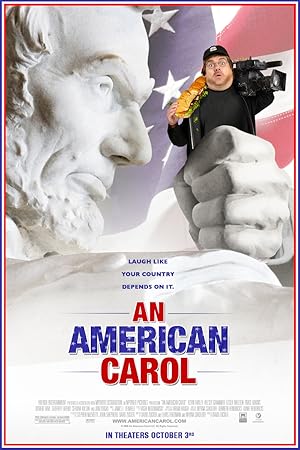
An American Carol
At a July 4 barbecue, gramps tells the kids the story of Michael Malone, a documentary filmmaker and Michael Moore look-alike who hates America and wants to abolish July 4th. He refuses to celebrate with his nephew Josh, who's shipping out soon to the Middle East. That night, Michel has a vision of his hero, JFK, who predicts that three ghosts will visit Michael. Sure enough, General Patton, George Washington, and country music star Trace Adkins visit Michael show him the fruits of patriotism, just wars, and pacifism. Meanwhile, Arab terrorists want Malone to help them with a propaganda film. Is he the next Leni Riefenstahl or will he see the light?
The film commercial failure against its moderate budget of $20.0M, earning $7.0M globally (-65% loss). While initial box office returns were modest, the film has gained appreciation for its unconventional structure within the comedy genre.


Plot Structure
Story beats plotted across runtime


Narrative Arc
Emotional journey through the story's key moments
Story Circle
Blueprint 15-beat structure
Arcplot Score Breakdown
Weighted: Precision (70%) + Arc (15%) + Theme (15%)
An American Carol (2008) showcases precise dramatic framework, characteristic of David Zucker's storytelling approach. This structural analysis examines how the film's 15-point plot structure maps to proven narrative frameworks across 1 hour and 22 minutes. With an Arcplot score of 7.4, the film balances conventional beats with creative variation.
Characters
Cast & narrative archetypes

Michael Malone
George Washington
General George S. Patton
Aziz
Angel of Death
JFK
Main Cast & Characters
Michael Malone
Played by Kevin Farley
An anti-American documentary filmmaker who undergoes a supernatural journey to rediscover American values through visits from historical figures.
George Washington
Played by Jon Voight
The Ghost of Christmas Past figure who guides Malone through American history, representing foundational patriotic values.
General George S. Patton
Played by Kelsey Grammer
A tough-talking military spirit who shows Malone the importance of military strength and sacrifice.
Aziz
Played by Robert Davi
A terrorist leader who represents the threat Malone refuses to acknowledge, serving as the primary antagonist.
Angel of Death
Played by Trace Adkins
A spectral figure showing Malone a dystopian future without American values and military protection.
JFK
Played by Chriss Anglin
The spirit of John F. Kennedy who represents patriotic liberalism and challenges Malone's selective historical memory.
Structural Analysis
The Status Quo at 1 minutes (1% through the runtime) establishes Michael Malone is introduced as a Michael Moore-like documentary filmmaker who despises America and plans an anti-July 4th rally to abolish the holiday.. Notably, this early placement immediately immerses viewers in the story world.
The inciting incident occurs at 10 minutes when Malone is approached by terrorists who want to recruit him to make anti-American propaganda films, though he doesn't yet realize their true nature.. At 12% through the film, this Disruption aligns precisely with traditional story structure. This beat shifts the emotional landscape, launching the protagonist into the central conflict.
The First Threshold at 20 minutes marks the transition into Act II, occurring at 24% of the runtime. This shows the protagonist's commitment to The first ghost (General George S. Patton) appears to Malone and forcibly takes him on a journey to confront America's past, beginning his supernatural education., moving from reaction to action.
At 41 minutes, the Midpoint arrives at 51% of the runtime—precisely centered, creating perfect narrative symmetry. The analysis reveals that this crucial beat Malone is shown a horrifying alternate reality where America lost its wars and he lives under oppressive rule. The stakes become real and personal - this is what his rhetoric actually enables., fundamentally raising what's at risk. The emotional intensity shifts, dividing the narrative into clear before-and-after phases.
The Collapse moment at 61 minutes (75% through) represents the emotional nadir. Here, Malone is shown his own death/grave and sees that he died unmourned and despised, having enabled terrorist attacks through his propaganda. He witnesses the destruction his ideology caused., reveals the protagonist at their lowest point. This beat's placement in the final quarter sets up the climactic reversal.
The Second Threshold at 66 minutes initiates the final act resolution at 81% of the runtime. Malone awakens transformed, understanding what America truly means. He realizes he must stop the terrorist plot and use his platform for good instead of destruction., demonstrating the transformation achieved throughout the journey.
Emotional Journey
An American Carol's emotional architecture traces a deliberate progression across 15 carefully calibrated beats.
Narrative Framework
This structural analysis employs a 15-point narrative structure framework that maps key story moments. By mapping An American Carol against these established plot points, we can identify how David Zucker utilizes or subverts traditional narrative conventions. The plot point approach reveals not only adherence to structural principles but also creative choices that distinguish An American Carol within the comedy genre.
David Zucker's Structural Approach
Among the 5 David Zucker films analyzed on Arcplot, the average structural score is 7.1, reflecting strong command of classical structure. An American Carol represents one of the director's most structurally precise works. For comparative analysis, explore the complete David Zucker filmography.
Comparative Analysis
Additional comedy films include The Bad Guys, Ella Enchanted and The Evening Star. For more David Zucker analyses, see The Naked Gun: From the Files of Police Squad!, Scary Movie 3 and Scary Movie 4.
Plot Points by Act
Act I
SetupStatus Quo
Michael Malone is introduced as a Michael Moore-like documentary filmmaker who despises America and plans an anti-July 4th rally to abolish the holiday.
Theme
A character mentions that some people need to be reminded what America really stands for and why freedom matters.
Worldbuilding
We see Malone's world: his hateful documentaries, his self-righteous activism, his relationship with his assistant, and his complete disdain for American values and military service.
Disruption
Malone is approached by terrorists who want to recruit him to make anti-American propaganda films, though he doesn't yet realize their true nature.
Resistance
Malone debates whether to take the terrorists' offer while continuing his anti-American activities. His nephew (a soldier) tries to reason with him but Malone dismisses him.
Act II
ConfrontationFirst Threshold
The first ghost (General George S. Patton) appears to Malone and forcibly takes him on a journey to confront America's past, beginning his supernatural education.
Mirror World
Malone encounters spirits and historical scenarios that challenge his worldview, introducing the thematic journey of understanding sacrifice and freedom.
Premise
The fun and games: Malone is taken through American history by multiple ghosts, experiencing comedic and pointed lessons about the Civil War, WWII, and the price of freedom. Each vignette satirizes his ignorance.
Midpoint
Malone is shown a horrifying alternate reality where America lost its wars and he lives under oppressive rule. The stakes become real and personal - this is what his rhetoric actually enables.
Opposition
Despite the lessons, Malone resists change. The terrorists' plot advances. The ghosts intensify their efforts, showing him the future consequences of his actions and the reality of terrorism.
Collapse
Malone is shown his own death/grave and sees that he died unmourned and despised, having enabled terrorist attacks through his propaganda. He witnesses the destruction his ideology caused.
Crisis
Malone processes the dark truth about himself. He realizes he's been a useful idiot for America's enemies and his self-righteousness has blinded him to reality.
Act III
ResolutionSecond Threshold
Malone awakens transformed, understanding what America truly means. He realizes he must stop the terrorist plot and use his platform for good instead of destruction.
Synthesis
Malone races to stop the terrorist attack at his own anti-July 4th rally. He confronts the terrorists, warns the crowd, and uses his documentary skills to expose the plot. Heroic action ensues.
Transformation
Malone celebrates July 4th with genuine patriotism, reconciles with his soldier nephew, and begins making documentaries that honor America. The former cynic has become a believer.