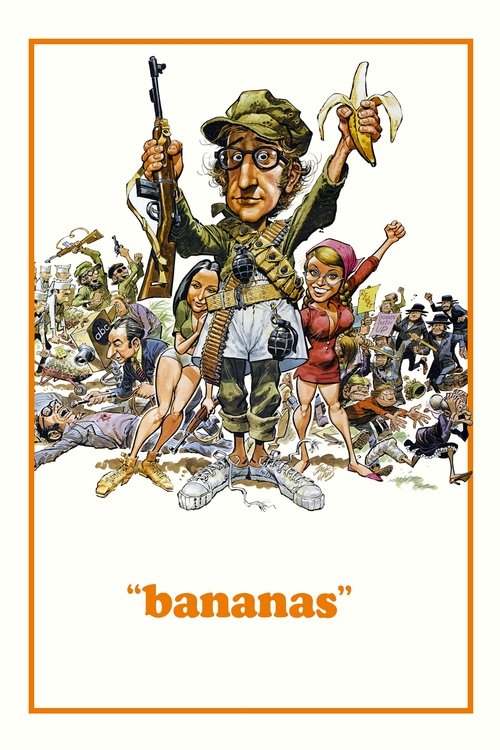
Bananas
When a bumbling New Yorker is dumped by his activist girlfriend, he travels to a tiny Latin American nation and becomes involved in its latest rebellion.
Despite its small-scale budget of $2.0M, Bananas became a solid performer, earning $11.8M worldwide—a 492% return. The film's innovative storytelling found its audience, demonstrating that strong storytelling can transcend budget limitations.


Plot Structure
Story beats plotted across runtime


Narrative Arc
Emotional journey through the story's key moments
Story Circle
Blueprint 15-beat structure
Arcplot Score Breakdown
Weighted: Precision (70%) + Arc (15%) + Theme (15%)
Bananas (1971) exhibits deliberately positioned story structure, characteristic of Woody Allen's storytelling approach. This structural analysis examines how the film's 15-point plot structure maps to proven narrative frameworks across 1 hour and 22 minutes. With an Arcplot score of 6.7, the film balances conventional beats with creative variation.
Characters
Cast & narrative archetypes

Fielding Mellish

Nancy

General Emilio Molina Vargas

Esposito
Main Cast & Characters
Fielding Mellish
Played by Woody Allen
A neurotic product tester who becomes accidentally involved in a Latin American revolution and ends up as the country's president
Nancy
Played by Louise Lasser
A social activist and Fielding's on-again-off-again love interest who inspires his revolutionary journey
General Emilio Molina Vargas
Played by Carlos Montalban
The dictatorial president of San Marcos who is eventually overthrown by the revolutionaries
Esposito
Played by Jacobo Morales
The rebel leader who recruits Fielding into the revolutionary cause and later becomes his advisor
Structural Analysis
The Status Quo at 1 minutes (1% through the runtime) establishes Howard Cosell narrates the assassination of San Marcos' president as a Wide World of Sports event, establishing the film's absurdist satirical tone and the political instability that will draw Fielding into adventure.. Notably, this early placement immediately immerses viewers in the story world.
The inciting incident occurs at 11 minutes when Nancy breaks up with Fielding, telling him she needs a "leader" and that he lacks the strength and dynamism she requires. His world is shattered by this rejection, forcing him to question his identity and worth.. At 13% through the film, this Disruption is delayed, allowing extended setup of the story world. This beat shifts the emotional landscape, launching the protagonist into the central conflict.
The First Threshold at 21 minutes marks the transition into Act II, occurring at 26% of the runtime. This reveals the protagonist's commitment to Fielding arrives in San Marcos, actively choosing to leave his safe New York existence behind. He commits to immersing himself in the revolutionary struggle, crossing from his ordinary world into a chaotic political landscape., moving from reaction to action.
At 41 minutes, the Midpoint arrives at 50% of the runtime—precisely centered, creating perfect narrative symmetry. Notably, this crucial beat The revolution succeeds and Esposito takes power, but immediately becomes a corrupt dictator himself. When he goes insane, the rebels make Fielding their new president—a false victory as he's now trapped in a role he never wanted., fundamentally raising what's at risk. The emotional intensity shifts, dividing the narrative into clear before-and-after phases.
The Collapse moment at 61 minutes (74% through) represents the emotional nadir. Here, Fielding's trial becomes a humiliating spectacle. His own parents testify against him wearing paper bags over their heads in shame. His identity as both an American and a revolutionary seems to have destroyed his life completely., shows the protagonist at their lowest point. This beat's placement in the final quarter sets up the climactic reversal.
The Second Threshold at 66 minutes initiates the final act resolution at 81% of the runtime. Fielding brilliantly cross-examines himself on the witness stand, revealing the absurdity of the charges. The judge, won over by his arguments and the trial's farcical nature, gives him a suspended sentence, freeing him to synthesize his two identities., demonstrating the transformation achieved throughout the journey.
Emotional Journey
Bananas's emotional architecture traces a deliberate progression across 15 carefully calibrated beats.
Narrative Framework
This structural analysis employs structural analysis methodology used to understand storytelling architecture. By mapping Bananas against these established plot points, we can identify how Woody Allen utilizes or subverts traditional narrative conventions. The plot point approach reveals not only adherence to structural principles but also creative choices that distinguish Bananas within the comedy genre.
Woody Allen's Structural Approach
Among the 42 Woody Allen films analyzed on Arcplot, the average structural score is 7.0, demonstrating varied approaches to story architecture. Bananas takes a more unconventional approach compared to the director's typical style. For comparative analysis, explore the complete Woody Allen filmography.
Comparative Analysis
Additional comedy films include The Bad Guys, Ella Enchanted and The Evening Star. For more Woody Allen analyses, see Everyone Says I Love You, Celebrity and Interiors.
Plot Points by Act
Act I
SetupStatus Quo
Howard Cosell narrates the assassination of San Marcos' president as a Wide World of Sports event, establishing the film's absurdist satirical tone and the political instability that will draw Fielding into adventure.
Theme
Fielding's coworker observes that he's "not the leader type" during a product testing mishap, establishing the thematic question of whether an ordinary nebbish can transform into someone capable of leading and being worthy of love.
Worldbuilding
Fielding Mellish's ordinary life as a products tester in New York is established through slapstick sequences. He meets political activist Nancy when she canvasses his apartment, and they begin an awkward romance marked by his neurotic insecurities.
Disruption
Nancy breaks up with Fielding, telling him she needs a "leader" and that he lacks the strength and dynamism she requires. His world is shattered by this rejection, forcing him to question his identity and worth.
Resistance
Fielding debates how to win Nancy back and prove himself. He decides to travel to San Marcos to become involved in the revolutionary cause she cares about, hoping political engagement will transform him into the leader she desires.
Act II
ConfrontationFirst Threshold
Fielding arrives in San Marcos, actively choosing to leave his safe New York existence behind. He commits to immersing himself in the revolutionary struggle, crossing from his ordinary world into a chaotic political landscape.
Mirror World
Fielding meets the rebel leader Esposito and his ragtag band of revolutionaries in the mountains. These relationships will teach him that leadership comes in unexpected forms and that courage can emerge from unlikely sources.
Premise
The comedic premise delivers as Fielding bumbles through revolutionary training, survives assassination attempts by General Vargas, and accidentally proves himself useful to the rebels through sheer luck and persistence despite his obvious incompetence.
Midpoint
The revolution succeeds and Esposito takes power, but immediately becomes a corrupt dictator himself. When he goes insane, the rebels make Fielding their new president—a false victory as he's now trapped in a role he never wanted.
Opposition
Fielding struggles with leadership while the U.S. government and CIA close in. He returns to America disguised with a fake beard to raise funds for San Marcos, but is recognized and arrested for subversion, facing trial as a traitor.
Collapse
Fielding's trial becomes a humiliating spectacle. His own parents testify against him wearing paper bags over their heads in shame. His identity as both an American and a revolutionary seems to have destroyed his life completely.
Crisis
The absurdist trial continues with Fielding forced to represent himself. Miss America testifies, and the proceedings devolve into farce as Fielding's fate hangs in the balance between patriotism and his accidental revolutionary career.
Act III
ResolutionSecond Threshold
Fielding brilliantly cross-examines himself on the witness stand, revealing the absurdity of the charges. The judge, won over by his arguments and the trial's farcical nature, gives him a suspended sentence, freeing him to synthesize his two identities.
Synthesis
Fielding reunites with Nancy, who now sees him as the transformed leader she always wanted. They marry, reconciling his neurotic New York self with his revolutionary experience to become someone worthy of love on his own absurdist terms.
Transformation
Howard Cosell provides play-by-play commentary of Fielding and Nancy's wedding night, mirroring the opening assassination broadcast. The nebbish has become a "leader" in the bedroom, his transformation complete in the most absurdly intimate way possible.