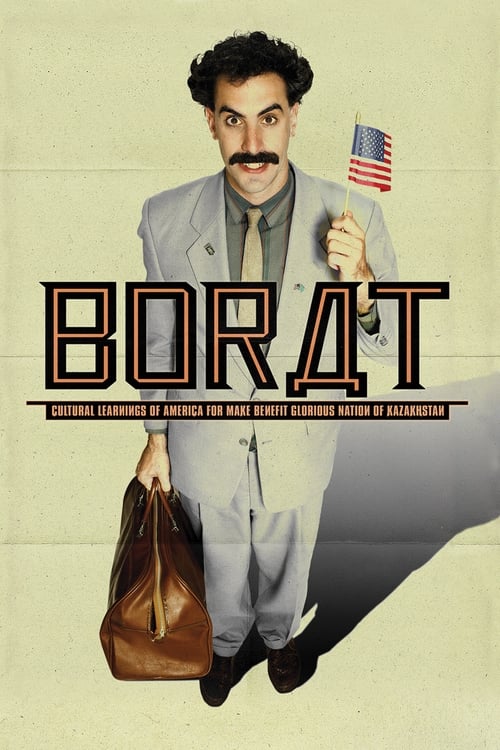
Borat: Cultural Learnings of America for Make Benefit Glorious Nation of Kazakhstan
Kazakh journalist Borat Sagdiyev travels to America to make a documentary. As he zigzags across the nation, Borat meets real people in real situations with hysterical consequences. His backwards behavior generates strong reactions around him exposing prejudices and hypocrisies in American culture.
Despite a mid-range budget of $18.0M, Borat: Cultural Learnings of America for Make Benefit Glorious Nation of Kazakhstan became a massive hit, earning $262.6M worldwide—a remarkable 1359% return.
Nominated for 1 Oscar. 20 wins & 34 nominations


Plot Structure
Story beats plotted across runtime


Narrative Arc
Emotional journey through the story's key moments
Story Circle
Blueprint 15-beat structure
Arcplot Score Breakdown
Weighted: Precision (70%) + Arc (15%) + Theme (15%)
Borat: Cultural Learnings of America for Make Benefit Glorious Nation of Kazakhstan (2006) demonstrates strategically placed story structure, characteristic of Larry Charles's storytelling approach. This structural analysis examines how the film's 15-point plot structure maps to proven narrative frameworks across 1 hour and 24 minutes. With an Arcplot score of 7.0, the film balances conventional beats with creative variation.
Characters
Cast & narrative archetypes

Borat Sagdiyev
Azamat Bagatov
Pamela Anderson
Luenell
Main Cast & Characters
Borat Sagdiyev
Played by Sacha Baron Cohen
A Kazakhstani journalist traveling across America to learn about its culture while harboring naive, offensive views. His journey becomes a chaotic exploration of his own prejudices and cultural misunderstandings.
Azamat Bagatov
Played by Ken Davitian
Borat's obese producer who accompanies him on the journey. Loyal but easily frustrated by Borat's obsessions and poor decisions.
Pamela Anderson
Played by Pamela Anderson
Herself - becomes Borat's fixation and romantic obsession after he sees her on Baywatch. Represents his idealized vision of American beauty.
Luenell
Played by Luenell
An African-American sex worker who befriends Borat and eventually becomes his companion. She shows him genuine kindness and humanity.
Structural Analysis
The Status Quo at 1 minutes (1% through the runtime) establishes Borat walks through his village in Kazakhstan, proudly introducing his hometown, neighbors, and sister (the "number four prostitute in all of Kazakhstan"). His cheerful ignorance and contentment with his backward world are on full display.. Significantly, this early placement immediately immerses viewers in the story world.
The inciting incident occurs at 10 minutes when Borat and Azamat arrive in New York City. The overwhelming contrast between Kazakhstan and America disorients Borat, launching him into a new world where none of his assumptions hold true.. At 12% through the film, this Disruption aligns precisely with traditional story structure. This beat shifts the emotional landscape, launching the protagonist into the central conflict.
The First Threshold at 22 minutes marks the transition into Act II, occurring at 26% of the runtime. This indicates the protagonist's commitment to Borat sees Pamela Anderson on Baywatch and becomes obsessed. He abandons the original documentary plan and decides to travel across America to California to make her his wife. This is his active choice to pursue a personal quest., moving from reaction to action.
At 42 minutes, the Midpoint arrives at 50% of the runtime—precisely centered, creating perfect narrative symmetry. Significantly, this crucial beat Borat and Azamat have a naked fight in the hotel after Borat discovers Azamat pleasured himself to a photo of Pamela Anderson. The partnership dissolves violently. This false defeat raises stakes—Borat loses his producer, money, and passport., fundamentally raising what's at risk. The emotional intensity shifts, dividing the narrative into clear before-and-after phases.
The Collapse moment at 63 minutes (75% through) represents the emotional nadir. Here, Borat breaks down emotionally, running through suburban streets in despair. At his lowest point, he stumbles into a Pentecostal revival meeting. His dream of Pamela seems impossible, and he faces the death of his old identity and beliefs., illustrates the protagonist at their lowest point. This beat's placement in the final quarter sets up the climactic reversal.
The Second Threshold at 67 minutes initiates the final act resolution at 80% of the runtime. Borat reconciles with Azamat and gains new clarity. He realizes he must complete his quest for Pamela, but he's now changed—more aware of connection and humanity. He synthesizes his Kazakh persistence with newfound American openness., demonstrating the transformation achieved throughout the journey.
Emotional Journey
Borat: Cultural Learnings of America for Make Benefit Glorious Nation of Kazakhstan's emotional architecture traces a deliberate progression across 15 carefully calibrated beats.
Narrative Framework
This structural analysis employs systematic plot point analysis that identifies crucial turning points. By mapping Borat: Cultural Learnings of America for Make Benefit Glorious Nation of Kazakhstan against these established plot points, we can identify how Larry Charles utilizes or subverts traditional narrative conventions. The plot point approach reveals not only adherence to structural principles but also creative choices that distinguish Borat: Cultural Learnings of America for Make Benefit Glorious Nation of Kazakhstan within the comedy genre.
Larry Charles's Structural Approach
Among the 3 Larry Charles films analyzed on Arcplot, the average structural score is 7.2, reflecting strong command of classical structure. Borat: Cultural Learnings of America for Make Benefit Glorious Nation of Kazakhstan takes a more unconventional approach compared to the director's typical style. For comparative analysis, explore the complete Larry Charles filmography.
Comparative Analysis
Additional comedy films include The Bad Guys, Ella Enchanted and The Evening Star. For more Larry Charles analyses, see The Dictator, Brüno.
Plot Points by Act
Act I
SetupStatus Quo
Borat walks through his village in Kazakhstan, proudly introducing his hometown, neighbors, and sister (the "number four prostitute in all of Kazakhstan"). His cheerful ignorance and contentment with his backward world are on full display.
Theme
Borat's producer Azamat discusses their mission to learn from America. The theme of cultural collision and what one can learn by stepping outside one's worldview is established through their documentary premise.
Worldbuilding
Introduction to Borat's life in Kazakhstan, his job as a television reporter, his family, his anti-Semitic village traditions, and the oppressive but familiar rhythms of his backward society. The segment establishes his complete lack of awareness about modern Western values.
Disruption
Borat and Azamat arrive in New York City. The overwhelming contrast between Kazakhstan and America disorients Borat, launching him into a new world where none of his assumptions hold true.
Resistance
Borat stumbles through New York, receiving etiquette lessons, attempting to understand American customs, struggling with feminism and modern social norms. Various Americans serve as inadvertent guides, though Borat resists or misunderstands most lessons.
Act II
ConfrontationFirst Threshold
Borat sees Pamela Anderson on Baywatch and becomes obsessed. He abandons the original documentary plan and decides to travel across America to California to make her his wife. This is his active choice to pursue a personal quest.
Mirror World
Borat buys an ice cream truck for the cross-country journey. The road trip begins, and his interactions with everyday Americans become the thematic mirror—revealing both American absurdities and Borat's potential for growth through human connection.
Premise
The "fun and games" road trip: Borat visits a humor coach, stays at a bed and breakfast, attends a rodeo, goes to a pentecostal church, takes driving lessons, and meets feminists. Each encounter delivers the mockumentary premise—culture clash comedy exploring American diversity and prejudice.
Midpoint
Borat and Azamat have a naked fight in the hotel after Borat discovers Azamat pleasured himself to a photo of Pamela Anderson. The partnership dissolves violently. This false defeat raises stakes—Borat loses his producer, money, and passport.
Opposition
Borat continues alone, increasingly desperate. He crashes a high-society dinner party with disastrous results, reveals his deep loneliness and prejudices, and struggles with the emotional weight of isolation. His flaws intensify as pressure mounts.
Collapse
Borat breaks down emotionally, running through suburban streets in despair. At his lowest point, he stumbles into a Pentecostal revival meeting. His dream of Pamela seems impossible, and he faces the death of his old identity and beliefs.
Crisis
At the church, Borat experiences a spiritual moment. The congregation embraces him despite his foreignness. He begins processing his journey—confronting his bigotry and loneliness. This dark night transforms into tentative hope.
Act III
ResolutionSecond Threshold
Borat reconciles with Azamat and gains new clarity. He realizes he must complete his quest for Pamela, but he's now changed—more aware of connection and humanity. He synthesizes his Kazakh persistence with newfound American openness.
Synthesis
Borat executes his plan to reach Pamela Anderson at a book signing in California. He attempts to kidnap her in a traditional Kazakh marriage sack. The absurd finale brings together all his cultural misunderstandings, but also shows his transformation—he's learned something about respect and boundaries when security stops him.
Transformation
Back in Kazakhstan, Borat has brought back American innovations—including feminism, technology, and tolerance. His village is transformed. He has a new wife (not Pamela, but someone he chose through connection). The closing image mirrors the opening, but Borat is fundamentally changed.