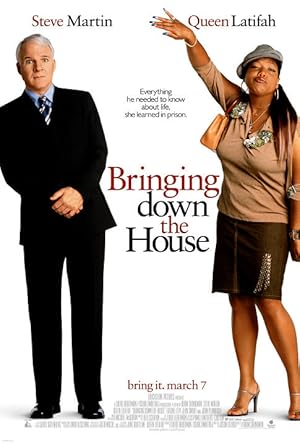
Bringing Down the House
Peter Sanderson (Steve Martin) is a divorced, straight-laced, uptight attorney who still loves his ex-wife and can't figure out what he did wrong to make her leave him. However, Peter's trying to move on, and he's smitten with a brainy, bombshell lawyer with whom he's been chatting on-line. However, when she comes to his house for their first face-to-face, she isn't refined, isn't Ivy League, and isn't even a lawyer. Instead, it's Charlene Morton (Queen Latifah), a prison escapee who's proclaiming her innocence and wants Peter to help her clear her name. But Peter wants nothing to do with her, prompting the loud and shocking Charlene to turn Peter's perfectly ordered life upside down, jeopardizing his effort to get back with his wife, and win a billion-dollar client.
Despite a moderate budget of $20.0M, Bringing Down the House became a commercial juggernaut, earning $132.7M worldwide—a remarkable 564% return.
4 wins & 13 nominations


Plot Structure
Story beats plotted across runtime


Narrative Arc
Emotional journey through the story's key moments
Story Circle
Blueprint 15-beat structure
Arcplot Score Breakdown
Weighted: Precision (70%) + Arc (15%) + Theme (15%)
Bringing Down the House (2003) demonstrates deliberately positioned narrative design, characteristic of Adam Shankman's storytelling approach. This structural analysis examines how the film's 15-point plot structure maps to proven narrative frameworks across 1 hour and 45 minutes. With an Arcplot score of 7.0, the film balances conventional beats with creative variation.
Characters
Cast & narrative archetypes

Peter Sanderson
Charlene Morton
Kate Sanderson
Howie Rottman
Mrs. Virginia Arness
Sarah Sanderson
Georgie Sanderson
Main Cast & Characters
Peter Sanderson
Played by Steve Martin
An uptight tax attorney who is blindsided when an escaped convict he met online shows up at his door seeking legal help.
Charlene Morton
Played by Queen Latifah
A street-smart escaped convict who forces Peter to help prove her innocence while teaching him to loosen up.
Kate Sanderson
Played by Jean Smart
Peter's estranged wife who is considering divorce and skeptical of his attempts at reconciliation.
Howie Rottman
Played by Eugene Levy
Peter's law partner and best friend who becomes immediately attracted to Charlene.
Mrs. Virginia Arness
Played by Joan Plowright
A wealthy, uptight widow and potential client whom Peter desperately tries to impress while hiding Charlene.
Sarah Sanderson
Played by Kimberly J. Brown
Peter's teenage daughter who is embarrassed by her father and drawn to hip-hop culture.
Georgie Sanderson
Played by Angus T. Jones
Peter's young son who quickly bonds with Charlene and her authentic, fun-loving spirit.
Structural Analysis
The Status Quo at 1 minutes (1% through the runtime) establishes Peter Sanderson, uptight tax attorney, works late in his sterile office, separated from his wife, desperately seeking order and control in his lonely, buttoned-up life.. The analysis reveals that this early placement immediately immerses viewers in the story world.
The inciting incident occurs at 13 minutes when Charlene arrives at Peter's door - not the refined lawyer he expected online, but a loud, street-smart Black woman escaped from prison, turning his orderly world upside down.. At 12% through the film, this Disruption aligns precisely with traditional story structure. This beat shifts the emotional landscape, launching the protagonist into the central conflict.
The First Threshold at 26 minutes marks the transition into Act II, occurring at 25% of the runtime. This illustrates the protagonist's commitment to Peter actively chooses to help Charlene prove her innocence and allows her to stay in his house, crossing into a new world where his control will be constantly challenged., moving from reaction to action.
At 53 minutes, the Midpoint arrives at 50% of the runtime—precisely centered, creating perfect narrative symmetry. Significantly, this crucial beat False victory: Peter successfully passes Charlene off as his friend at a crucial country club dinner with Mrs. Arness, and he's getting closer to winning back Kate - everything seems to be working., fundamentally raising what's at risk. The emotional intensity shifts, dividing the narrative into clear before-and-after phases.
The Collapse moment at 79 minutes (75% through) represents the emotional nadir. Here, Everything falls apart: Peter's lies are exposed at the club, Mrs. Arness rejects him, Kate refuses to reconcile, and worst of all, Peter betrays Charlene by revealing his shame of her, destroying their friendship - the death of his chance at transformation., illustrates the protagonist at their lowest point. This beat's placement in the final quarter sets up the climactic reversal.
The Second Threshold at 84 minutes initiates the final act resolution at 80% of the runtime. Peter realizes what truly matters and discovers evidence to prove Charlene's innocence. He synthesizes his legal skills with the authenticity and courage Charlene taught him, ready to fight for what's right instead of what's proper., demonstrating the transformation achieved throughout the journey.
Emotional Journey
Bringing Down the House's emotional architecture traces a deliberate progression across 15 carefully calibrated beats.
Narrative Framework
This structural analysis employs systematic plot point analysis that identifies crucial turning points. By mapping Bringing Down the House against these established plot points, we can identify how Adam Shankman utilizes or subverts traditional narrative conventions. The plot point approach reveals not only adherence to structural principles but also creative choices that distinguish Bringing Down the House within the comedy genre.
Adam Shankman's Structural Approach
Among the 9 Adam Shankman films analyzed on Arcplot, the average structural score is 7.1, reflecting strong command of classical structure. Bringing Down the House takes a more unconventional approach compared to the director's typical style. For comparative analysis, explore the complete Adam Shankman filmography.
Comparative Analysis
Additional comedy films include The Bad Guys, Ella Enchanted and The Evening Star. For more Adam Shankman analyses, see Cheaper by the Dozen 2, The Wedding Planner and What Men Want.
Plot Points by Act
Act I
SetupStatus Quo
Peter Sanderson, uptight tax attorney, works late in his sterile office, separated from his wife, desperately seeking order and control in his lonely, buttoned-up life.
Theme
Peter's colleague mentions "you need to loosen up and take some chances" - establishing the theme that rigid control and prejudice prevent genuine connection and happiness.
Worldbuilding
Peter's carefully controlled world: his law practice, awkward relationship with his kids, failed marriage to Kate, desperate online romance with "lawyer-girl," and his country club aspirations with the stuffy Virginian Mrs. Arness.
Disruption
Charlene arrives at Peter's door - not the refined lawyer he expected online, but a loud, street-smart Black woman escaped from prison, turning his orderly world upside down.
Resistance
Peter tries desperately to get rid of Charlene while she insists on his help proving her innocence. He resists, debates, and attempts to maintain his controlled facade as she disrupts everything.
Act II
ConfrontationFirst Threshold
Peter actively chooses to help Charlene prove her innocence and allows her to stay in his house, crossing into a new world where his control will be constantly challenged.
Mirror World
Charlene begins teaching Peter's kids and connecting with them authentically, showing Peter what genuine, unprejudiced human connection looks like - the thematic mirror to his uptight world.
Premise
The promise of the premise: fish-out-of-water comedy as Charlene crashes Peter's world - the club, his clients, his ex-wife - while teaching him to loosen up, dance, and see beyond his prejudices.
Midpoint
False victory: Peter successfully passes Charlene off as his friend at a crucial country club dinner with Mrs. Arness, and he's getting closer to winning back Kate - everything seems to be working.
Opposition
The lies compound: neighbor Howie becomes obsessed with Charlene, Mrs. Arness grows suspicious, Kate discovers the deception, and the real criminal (who framed Charlene) emerges as a threat. Peter's old prejudices surface under pressure.
Collapse
Everything falls apart: Peter's lies are exposed at the club, Mrs. Arness rejects him, Kate refuses to reconcile, and worst of all, Peter betrays Charlene by revealing his shame of her, destroying their friendship - the death of his chance at transformation.
Crisis
Peter sits alone in his empty, orderly house, realizing he's lost everything that mattered - not the country club or the image, but the genuine connections with Charlene and his family. His prejudice and control have cost him real love.
Act III
ResolutionSecond Threshold
Peter realizes what truly matters and discovers evidence to prove Charlene's innocence. He synthesizes his legal skills with the authenticity and courage Charlene taught him, ready to fight for what's right instead of what's proper.
Synthesis
Peter confronts the real criminal, helps Charlene clear her name, publicly defends her at the club without shame, and demonstrates his complete transformation by choosing authenticity and justice over social acceptance.
Transformation
Peter dances freely with Charlene and his family, completely unselfconscious - the mirror opposite of the uptight, controlled lawyer from the opening. He's learned to embrace people for who they are, including himself.