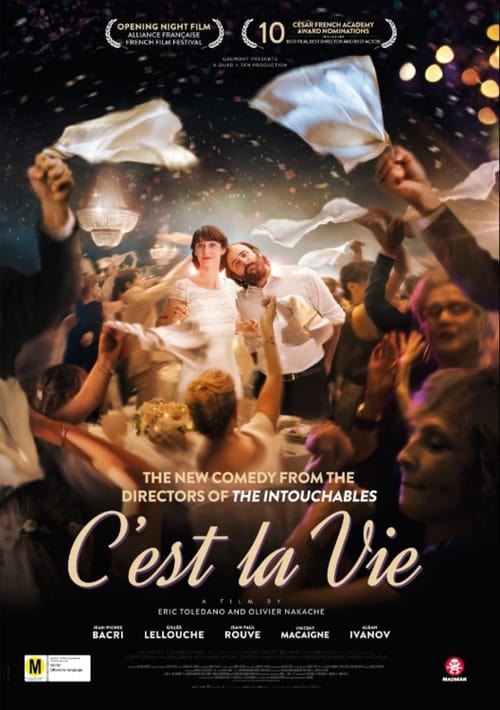
C'est la vie!
Max is a battle-weary veteran of the wedding-planning racket. His latest — and last — gig is a hell of a fête, involving stuffy period costumes for the caterers, a vain, hyper- sensitive singer who thinks he's a Gallic James Brown, and a morose, micromanaging groom determined to make Max's night as miserable as possible. But what makes the affair too bitter to endure is that Max's colleague and ostensible girlfriend, Joisette, seems to have written him off, coolly going about her professional duties while openly flirting with a much younger server. It's going to be a very long night… especially once the groom's aerial serenade gets underway.
Working with a respectable budget of $17.2M, the film achieved a modest success with $23.8M in global revenue (+38% profit margin).

Plot Structure
Story beats plotted across runtime


Narrative Arc
Emotional journey through the story's key moments
Story Circle
Blueprint 15-beat structure
Arcplot Score Breakdown
Weighted: Precision (70%) + Arc (15%) + Theme (15%)
C'est la vie! (2017) showcases precise dramatic framework, characteristic of Olivier Nakache's storytelling approach. This structural analysis examines how the film's 15-point plot structure maps to proven narrative frameworks across 1 hour and 55 minutes. With an Arcplot score of 7.6, the film showcases strong structural fundamentals.
Characters
Cast & narrative archetypes

Max Angely

Adèle
James

Guy
Julien
Helena
Pierre
Samy
Main Cast & Characters
Max Angely
Played by Jean-Pierre Bacri
A veteran wedding planner who struggles to maintain control during an increasingly chaotic reception while confronting his own exhaustion and the meaning of his work.
Adèle
Played by Eye Haïdara
Max's ambitious young assistant who still believes in the romance and meaning of weddings, challenging his cynicism with hope and idealism.
James
Played by Gilles Lellouche
A charming English bartender on the team who brings a different cultural perspective and adaptable energy to the French wedding chaos.
Guy
Played by Jean-Paul Rouve
An aging waiter desperately clinging to his career despite making catastrophic mistakes, exploring themes of dignity and professional obsolescence.
Julien
Played by Benjamin Lavernhe
A pretentious photographer who sees himself as an artist rather than a service provider, struggling between artistic ambition and commercial reality.
Helena
Played by Judith Chemla
The bride whose perfect wedding day becomes a nightmare of technical failures and family drama, growing increasingly panicked as things spiral.
Pierre
Played by Jérémie Laheurte
The groom trying to keep peace between his difficult family and his bride while the wedding spirals into chaos.
Samy
Played by Alban Ivanov
A member of the kitchen staff dealing with the pressure of service and his own personal issues during the chaotic event.
Structural Analysis
The Status Quo at 1 minutes (1% through the runtime) establishes Max arrives at the château, establishing himself as a veteran wedding planner who's seen it all. His world is one of controlled chaos, managing events with precision while barely concealing his exhaustion with the profession.. The analysis reveals that this early placement immediately immerses viewers in the story world.
The inciting incident occurs at 14 minutes when The bride and groom arrive, and Max discovers the wedding will be far more complicated than expected. The groom's difficult family, excessive demands, and the château's technical limitations create immediate problems. What should be routine becomes a minefield.. At 12% through the film, this Disruption aligns precisely with traditional story structure. This beat shifts the emotional landscape, launching the protagonist into the central conflict.
The First Threshold at 28 minutes marks the transition into Act II, occurring at 24% of the runtime. This reveals the protagonist's commitment to The ceremony concludes and the reception officially begins. Max commits fully to seeing this wedding through despite mounting evidence that everything will go wrong. He chooses to fight for perfection rather than abandon ship, entering the crucible of the reception proper., moving from reaction to action.
At 58 minutes, the Midpoint arrives at 50% of the runtime—precisely centered, creating perfect narrative symmetry. Structural examination shows that this crucial beat A major crisis hits: the power fails completely during the dinner service, plunging the reception into darkness and chaos. What seemed manageable becomes catastrophic. Max's control shatters as guests complain, the bride panics, and his team begins to fracture under pressure. False defeat., fundamentally raising what's at risk. The emotional intensity shifts, dividing the narrative into clear before-and-after phases.
The Collapse moment at 86 minutes (74% through) represents the emotional nadir. Here, Max has a breakdown, his exhaustion and disillusionment reaching a breaking point. He confronts the possibility that he can't do this anymore, that his career and methods are obsolete. The illusion of his competence and control dies. He considers walking away from the profession entirely., reveals the protagonist at their lowest point. This beat's placement in the final quarter sets up the climactic reversal.
The Second Threshold at 92 minutes initiates the final act resolution at 80% of the runtime. Adèle and the team rally without Max, showing him that the meaning isn't in perfection but in collective human effort. Max realizes he doesn't need total control—he needs to trust his team and embrace imperfection. He synthesizes his experience with renewed purpose: it's about people, not performance., demonstrating the transformation achieved throughout the journey.
Emotional Journey
C'est la vie!'s emotional architecture traces a deliberate progression across 15 carefully calibrated beats.
Narrative Framework
This structural analysis employs systematic plot point analysis that identifies crucial turning points. By mapping C'est la vie! against these established plot points, we can identify how Olivier Nakache utilizes or subverts traditional narrative conventions. The plot point approach reveals not only adherence to structural principles but also creative choices that distinguish C'est la vie! within the comedy genre.
Comparative Analysis
Additional comedy films include The Ministry of Ungentlemanly Warfare, The Bad Guys and Lake Placid.
Plot Points by Act
Act I
SetupStatus Quo
Max arrives at the château, establishing himself as a veteran wedding planner who's seen it all. His world is one of controlled chaos, managing events with precision while barely concealing his exhaustion with the profession.
Theme
A staff member comments on the absurdity of creating perfect moments for others while one's own life falls apart. The theme: the tension between professional performance and personal authenticity, between creating illusions and living reality.
Worldbuilding
Introduction to Max's diverse team: Adèle the ambitious assistant, Julien the photographer with dreams of art, Guy the aging waiter clinging to his career, James the English bartender, and the kitchen staff. We see the backstage machinery of wedding perfection and the personal struggles each team member carries.
Disruption
The bride and groom arrive, and Max discovers the wedding will be far more complicated than expected. The groom's difficult family, excessive demands, and the château's technical limitations create immediate problems. What should be routine becomes a minefield.
Resistance
Max attempts to maintain control through preparation and planning. He navigates initial conflicts: the sound system issues, the demanding mother-of-the-bride, personality clashes among staff. He relies on his experience and rules, resisting the chaos that threatens to overwhelm the event.
Act II
ConfrontationFirst Threshold
The ceremony concludes and the reception officially begins. Max commits fully to seeing this wedding through despite mounting evidence that everything will go wrong. He chooses to fight for perfection rather than abandon ship, entering the crucible of the reception proper.
Mirror World
Max's interactions with Adèle intensify as she challenges his cynical worldview. She still believes in the romance and meaning of weddings, representing what Max has lost. Their relationship becomes the thematic counterpoint: can you serve others' dreams without believing in your own?
Premise
The "fun and games" of wedding chaos: the dysfunctional band, electrical failures, kitchen disasters, drunk guests, family feuds erupting, the photographer's artistic pretensions, Guy's desperate attempts to stay relevant. Escalating comedic complications as Max juggles multiple crises simultaneously.
Midpoint
A major crisis hits: the power fails completely during the dinner service, plunging the reception into darkness and chaos. What seemed manageable becomes catastrophic. Max's control shatters as guests complain, the bride panics, and his team begins to fracture under pressure. False defeat.
Opposition
Everything deteriorates: personal conflicts among staff explode, Max's health issues surface, Guy makes catastrophic mistakes, the groom's family becomes openly hostile, technical problems multiply. Max's authoritarian control tactics backfire, alienating his team when he needs them most. His old methods fail against new problems.
Collapse
Max has a breakdown, his exhaustion and disillusionment reaching a breaking point. He confronts the possibility that he can't do this anymore, that his career and methods are obsolete. The illusion of his competence and control dies. He considers walking away from the profession entirely.
Crisis
Max sits in darkness, processing his failure and mortality. His team scatters, dealing with their own crises. The wedding appears doomed. Max questions whether the pretense and performance are worth it, whether creating false perfection for others has cost him his authentic self.
Act III
ResolutionSecond Threshold
Adèle and the team rally without Max, showing him that the meaning isn't in perfection but in collective human effort. Max realizes he doesn't need total control—he needs to trust his team and embrace imperfection. He synthesizes his experience with renewed purpose: it's about people, not performance.
Synthesis
Max rejoins the team with a new approach: collaborative, improvisational, human. Together they salvage the wedding through creativity and cooperation rather than control. The reception succeeds not despite its imperfections but because of the authentic human connections made in crisis. The finale is messy, real, and joyful.
Transformation
Max watches the married couple depart, genuinely moved for the first time in years. He shares a moment of connection with his team, his cynicism replaced by appreciation for the imperfect beauty of what they create together. He's rediscovered meaning in his work—not through perfection, but through authentic human collaboration.