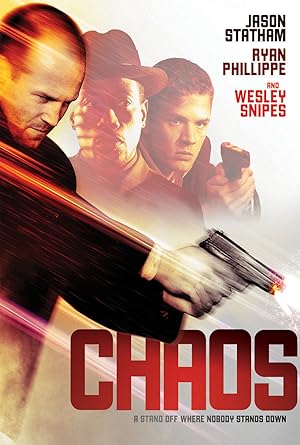
Chaos
In Seattle, detective Quentin Conners is unfairly suspended and his partner Jason York leaves the police force after a tragic shooting on Pearl Street Bridge, when the hostage and the criminal die. During a bank heist with a hostage situation, Conners is assigned in charge of the operation with the rookie Shane Dekker as his partner. The thieves, lead by Lorenz, apparently do not steal a penny from the bank. While chasing the gangsters, the police team disclose that they planted a virus in the system, stealing one billion dollars from the different accounts, using the principle of the Chaos Theory. Further, they find that Lorenz is killing his accomplices.
The film financial setback against its mid-range budget of $30.0M, earning $7.0M globally (-77% loss). While initial box office returns were modest, the film has gained appreciation for its distinctive approach within the action genre.


Plot Structure
Story beats plotted across runtime


Narrative Arc
Emotional journey through the story's key moments
Story Circle
Blueprint 15-beat structure
Arcplot Score Breakdown
Weighted: Precision (70%) + Arc (15%) + Theme (15%)
Chaos (2005) reveals meticulously timed plot construction, characteristic of Tony Giglio's storytelling approach. This structural analysis examines how the film's 15-point plot structure maps to proven narrative frameworks across 1 hour and 46 minutes. With an Arcplot score of 7.9, the film showcases strong structural fundamentals.
Characters
Cast & narrative archetypes

Quentin Conners
Shane Dekker
Lorenz
Captain Martin Jenkins
Main Cast & Characters
Quentin Conners
Played by Jason Statham
A veteran detective and hostage negotiator, suspended after a failed negotiation, who is brought back to track down a brilliant bank robber.
Shane Dekker
Played by Ryan Phillippe
A young, by-the-book detective partnered with Conners to solve a complex bank heist orchestrated by a criminal mastermind.
Lorenz
Played by Wesley Snipes
A mysterious and brilliant criminal mastermind who orchestrates an elaborate bank robbery with deeper motives than simple theft.
Captain Martin Jenkins
Played by Henry Czerny
The police captain overseeing the investigation who has a contentious relationship with Conners.
Structural Analysis
The Status Quo at 1 minutes (1% through the runtime) establishes Detective Conners is an established, methodical detective working a routine case, representing the ordered world of law enforcement before everything changes.. Structural examination shows that this early placement immediately immerses viewers in the story world.
The inciting incident occurs at 13 minutes when A violent bank robbery erupted by a criminal named Lorenz who specifically requests Detective Conners by name, transforming a routine day into a deadly hostage crisis.. At 12% through the film, this Disruption aligns precisely with traditional story structure. This beat shifts the emotional landscape, launching the protagonist into the central conflict.
The First Threshold at 27 minutes marks the transition into Act II, occurring at 25% of the runtime. This reveals the protagonist's commitment to Conners and Dekker actively choose to enter the bank to negotiate with Lorenz, crossing from observation into direct confrontation and beginning the deadly game., moving from reaction to action.
At 53 minutes, the Midpoint arrives at 50% of the runtime—precisely centered, creating perfect narrative symmetry. Significantly, this crucial beat The detectives discover that the bank robbery was a diversion - the real crime was digital theft of massive funds. What seemed like a solved case reveals itself as something far larger and more dangerous., fundamentally raising what's at risk. The emotional intensity shifts, dividing the narrative into clear before-and-after phases.
The Collapse moment at 80 minutes (75% through) represents the emotional nadir. Here, The devastating revelation that Conners himself orchestrated the entire scheme as Lorenz - his partner has been investigating him all along. The mentor dies metaphorically; everything Dekker believed collapses., indicates the protagonist at their lowest point. This beat's placement in the final quarter sets up the climactic reversal.
The Second Threshold at 85 minutes initiates the final act resolution at 80% of the runtime. Dekker synthesizes what he's learned - using Conners' methods of deception against him while maintaining his moral code. He sees the full picture and chooses to act decisively to stop his former mentor., demonstrating the transformation achieved throughout the journey.
Emotional Journey
Chaos's emotional architecture traces a deliberate progression across 15 carefully calibrated beats.
Narrative Framework
This structural analysis employs structural analysis methodology used to understand storytelling architecture. By mapping Chaos against these established plot points, we can identify how Tony Giglio utilizes or subverts traditional narrative conventions. The plot point approach reveals not only adherence to structural principles but also creative choices that distinguish Chaos within the action genre.
Comparative Analysis
Additional action films include The Bad Guys, Puss in Boots and Venom: The Last Dance.
Plot Points by Act
Act I
SetupStatus Quo
Detective Conners is an established, methodical detective working a routine case, representing the ordered world of law enforcement before everything changes.
Theme
Quentin Conners mentions "Nothing is what it seems" when discussing the nature of their work - establishing the film's central theme of deception and hidden truth.
Worldbuilding
Establishes the police department hierarchy, introduces rookie Shane Dekker fresh from the academy, shows Conners' reputation and methods, and sets up the normal procedural world.
Disruption
A violent bank robbery erupted by a criminal named Lorenz who specifically requests Detective Conners by name, transforming a routine day into a deadly hostage crisis.
Resistance
Conners and Dekker debate how to handle Lorenz, navigate department politics, and prepare for the negotiation. Dekker is uncertain about Conners' suspended status and unorthodox methods.
Act II
ConfrontationFirst Threshold
Conners and Dekker actively choose to enter the bank to negotiate with Lorenz, crossing from observation into direct confrontation and beginning the deadly game.
Mirror World
Dekker begins to see that Conners operates in shades of gray rather than black and white, introducing the moral complexity that will define their partnership and carry the theme.
Premise
The investigation unfolds as Conners and Dekker chase leads, uncover the complexity of the heist, and discover that the bank robbery was far more sophisticated than it appeared. The promise of a clever cat-and-mouse thriller delivers.
Midpoint
The detectives discover that the bank robbery was a diversion - the real crime was digital theft of massive funds. What seemed like a solved case reveals itself as something far larger and more dangerous.
Opposition
As Conners and Dekker dig deeper, they face resistance from within their own department, the criminals stay ahead of them, and evidence suggests corruption at high levels. Trust erodes and danger escalates.
Collapse
The devastating revelation that Conners himself orchestrated the entire scheme as Lorenz - his partner has been investigating him all along. The mentor dies metaphorically; everything Dekker believed collapses.
Crisis
Dekker processes the betrayal, grapples with his complicity, and faces the darkness of realizing he's been manipulated. He must decide whether to become like Conners or hold onto his principles.
Act III
ResolutionSecond Threshold
Dekker synthesizes what he's learned - using Conners' methods of deception against him while maintaining his moral code. He sees the full picture and chooses to act decisively to stop his former mentor.
Synthesis
The final confrontation where Dekker outmaneuvers Conners, recovers the stolen funds, and brings him to justice. He proves he learned from Conners without becoming him, executing his own plan.
Transformation
Dekker stands as a detective who has kept his integrity despite being tested by deception and betrayal. He is no longer the naive rookie but a wise investigator who understands that nothing is what it seems.