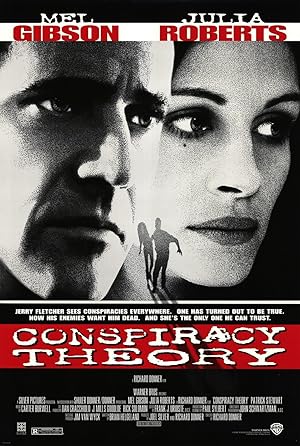
Conspiracy Theory
Jerry Fletcher is a man in love with a woman he observes from afar. She works for the government. Fletcher is an outspoken critic of that government. He has conspiracy theories for everything, from aliens to political assassinations. But soon, one of his theories finds itself to be accurate. But which one? Some dangerous people want him dead, and the only person he trusts is the woman he loves, but does not know.
Working with a considerable budget of $75.0M, the film achieved a respectable showing with $137.0M in global revenue (+83% profit margin).
4 wins & 1 nomination


Plot Structure
Story beats plotted across runtime


Narrative Arc
Emotional journey through the story's key moments
Story Circle
Blueprint 15-beat structure
Arcplot Score Breakdown
Weighted: Precision (70%) + Arc (15%) + Theme (15%)
Conspiracy Theory (1997) reveals strategically placed narrative architecture, characteristic of Richard Donner's storytelling approach. This structural analysis examines how the film's 15-point plot structure maps to proven narrative frameworks across 2 hours and 15 minutes. With an Arcplot score of 6.3, the film takes an unconventional approach to traditional narrative frameworks.
Characters
Cast & narrative archetypes

Jerry Fletcher
Alice Sutton
Dr. Jonas
Agent Lowry
Main Cast & Characters
Jerry Fletcher
Played by Mel Gibson
Paranoid NYC cab driver who publishes conspiracy theories newsletter, later revealed to be a victim of CIA mind control experiments
Alice Sutton
Played by Julia Roberts
Department of Justice attorney who becomes entangled in Jerry's world while investigating her father's murder
Dr. Jonas
Played by Patrick Stewart
CIA psychiatrist and antagonist who ran the MK-ULTRA mind control program that created Jerry
Agent Lowry
Played by Cylk Cozart
FBI agent assigned to investigate Jerry, initially skeptical but becomes ally
Structural Analysis
The Status Quo at 1 minutes (1% through the runtime) establishes Jerry Fletcher drives his taxi through New York City, spouting conspiracy theories to passengers. His manic energy and endless paranoid observations establish him as an unreliable narrator living on society's fringe.. The analysis reveals that this early placement immediately immerses viewers in the story world.
The inciting incident occurs at 16 minutes when Jerry is abducted by mysterious men in black suits after one of his newsletter theories accidentally hits too close to the truth. His paranoid fantasies become terrifyingly real as he's taken to be tortured.. At 12% through the film, this Disruption aligns precisely with traditional story structure. This beat shifts the emotional landscape, launching the protagonist into the central conflict.
The First Threshold at 34 minutes marks the transition into Act II, occurring at 25% of the runtime. This reveals the protagonist's commitment to Alice discovers Jerry's apartment has been professionally sanitized - someone has erased all evidence of his life. She realizes that whatever Jerry is, he's not simply crazy. She chooses to help him investigate, crossing into his world of paranoia., moving from reaction to action.
At 68 minutes, the Midpoint arrives at 50% of the runtime—precisely centered, creating perfect narrative symmetry. Notably, this crucial beat Dr. Jonas is revealed as Jerry's torturer and the mastermind. Jerry's fragmented memories begin returning - he was a CIA assassin subjected to MKUltra-style mind control. His conspiracy theories weren't delusions but buried memories fighting to surface. False defeat: the truth is worse than paranoia., fundamentally raising what's at risk. The emotional intensity shifts, dividing the narrative into clear before-and-after phases.
The Collapse moment at 101 minutes (75% through) represents the emotional nadir. Here, Jerry is captured and subjected to torture again by Dr. Jonas. Strapped to a wheelchair, injected with drugs, he faces the complete destruction of his identity. The man he thought he was may never have existed - he was manufactured to be a killer., shows the protagonist at their lowest point. This beat's placement in the final quarter sets up the climactic reversal.
The Second Threshold at 108 minutes initiates the final act resolution at 80% of the runtime. Jerry breaks through his conditioning by focusing on his love for Alice - the one thing the CIA couldn't program. His connection to her, built on genuine choice rather than conditioning, gives him the strength to fight back and escape with her., demonstrating the transformation achieved throughout the journey.
Emotional Journey
Conspiracy Theory's emotional architecture traces a deliberate progression across 15 carefully calibrated beats.
Narrative Framework
This structural analysis employs a 15-point narrative structure framework that maps key story moments. By mapping Conspiracy Theory against these established plot points, we can identify how Richard Donner utilizes or subverts traditional narrative conventions. The plot point approach reveals not only adherence to structural principles but also creative choices that distinguish Conspiracy Theory within the action genre.
Richard Donner's Structural Approach
Among the 16 Richard Donner films analyzed on Arcplot, the average structural score is 6.9, demonstrating varied approaches to story architecture. Conspiracy Theory takes a more unconventional approach compared to the director's typical style. For comparative analysis, explore the complete Richard Donner filmography.
Comparative Analysis
Additional action films include The Bad Guys, Puss in Boots and Venom: The Last Dance. For more Richard Donner analyses, see Assassins, Superman and Lethal Weapon 2.
Plot Points by Act
Act I
SetupStatus Quo
Jerry Fletcher drives his taxi through New York City, spouting conspiracy theories to passengers. His manic energy and endless paranoid observations establish him as an unreliable narrator living on society's fringe.
Theme
A passenger dismisses Jerry's theories by saying "A good conspiracy is unprovable" - establishing the central question of whether paranoia can ever be justified, and when does crazy become prophetic.
Worldbuilding
Jerry's obsessive routines are revealed: his newsletter "Conspiracy Theory," his locks and security measures, his purchases of Catcher in the Rye, and most importantly, his fixation on Justice Department attorney Alice Sutton, whom he visits repeatedly with invented legal problems.
Disruption
Jerry is abducted by mysterious men in black suits after one of his newsletter theories accidentally hits too close to the truth. His paranoid fantasies become terrifyingly real as he's taken to be tortured.
Resistance
Jerry escapes his captors and flees to Alice for help. She doesn't believe him but agrees to investigate. Jerry debates whether to trust anyone while Alice struggles with whether Jerry is truly insane or genuinely in danger.
Act II
ConfrontationFirst Threshold
Alice discovers Jerry's apartment has been professionally sanitized - someone has erased all evidence of his life. She realizes that whatever Jerry is, he's not simply crazy. She chooses to help him investigate, crossing into his world of paranoia.
Mirror World
Alice and Jerry begin working together as genuine partners. Their connection deepens as she represents what Jerry lost - the ability to trust another person. She becomes his anchor to reality while he opens her eyes to hidden truths.
Premise
Jerry and Alice investigate the conspiracy together. They uncover connections between Jerry's abduction, Alice's father's murder, and a shadowy CIA program. Jerry's paranoid skills prove genuinely useful as he spots surveillance and predicts enemy movements.
Midpoint
Dr. Jonas is revealed as Jerry's torturer and the mastermind. Jerry's fragmented memories begin returning - he was a CIA assassin subjected to MKUltra-style mind control. His conspiracy theories weren't delusions but buried memories fighting to surface. False defeat: the truth is worse than paranoia.
Opposition
Dr. Jonas and the CIA close in relentlessly. Jerry is recaptured and Alice is taken. The agency works to discredit Jerry completely while reactivating his programming. Every safe house is compromised, every ally is suspect.
Collapse
Jerry is captured and subjected to torture again by Dr. Jonas. Strapped to a wheelchair, injected with drugs, he faces the complete destruction of his identity. The man he thought he was may never have existed - he was manufactured to be a killer.
Crisis
In the depths of chemical interrogation, Jerry's mind fractures between his programmed assassin identity and the person he chose to become. Alice, also captured, watches helplessly as the man who protected her is systematically destroyed.
Act III
ResolutionSecond Threshold
Jerry breaks through his conditioning by focusing on his love for Alice - the one thing the CIA couldn't program. His connection to her, built on genuine choice rather than conditioning, gives him the strength to fight back and escape with her.
Synthesis
Jerry confronts Dr. Jonas in a final showdown. Using both his assassin training and his newfound humanity, he defeats Jonas and exposes the conspiracy. The CIA program is shut down. Jerry saves Alice and himself, proving that the truth can set you free even when you're the conspiracy.
Transformation
Jerry, now validated and free, watches Alice from a distance - a protector by choice, not compulsion. He rides a horse on a hillside, at peace. The paranoid taxi driver has become a man who knows the truth and found something real worth believing in: love and connection.