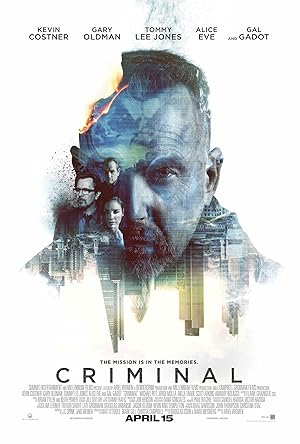
Criminal
Bill Pope (Ryan Reynolds) is a CIA agent on a mission in London tracking down a shadowy hacker nicknamed "The Dutchman" (Michael Pitt). When he gets mysteriously ambushed and killed, an experimental procedure is used to transfer his memories into dangerous convict Jerico Stewart (Kevin Costner). When he wakes up with the CIA agent's memories, his mission is to find The Dutchman and make the deal with him before the hacker launches ICBM's and starts World War III. But complications soon arise and the mission turns personal.
The film commercial failure against its moderate budget of $31.5M, earning $14.7M globally (-53% loss). While initial box office returns were modest, the film has gained appreciation for its bold vision within the action genre.


Plot Structure
Story beats plotted across runtime


Narrative Arc
Emotional journey through the story's key moments
Story Circle
Blueprint 15-beat structure
Arcplot Score Breakdown
Weighted: Precision (70%) + Arc (15%) + Theme (15%)
Criminal (2016) showcases strategically placed dramatic framework, characteristic of Ariel Vromen's storytelling approach. This structural analysis examines how the film's 15-point plot structure maps to proven narrative frameworks across 1 hour and 53 minutes. With an Arcplot score of 6.6, the film balances conventional beats with creative variation.
Characters
Cast & narrative archetypes

Jericho Stewart
Bill Pope
Quaker Wells
Jill Pope
Jan Strook
Dr. Franks
Xavier Heimdahl
Main Cast & Characters
Jericho Stewart
Played by Kevin Costner
A violent, psychopathic convict who receives experimental memory implants from a deceased CIA agent, gaining his skills and emotions.
Bill Pope
Played by Ryan Reynolds
A skilled CIA operative who is killed while protecting critical information; his memories are implanted into Jericho.
Quaker Wells
Played by Gary Oldman
A ruthless CIA London Station Chief who orchestrates the experimental memory transfer to stop a global threat.
Jill Pope
Played by Gal Gadot
Bill Pope's widow who becomes unexpectedly connected to Jericho as he experiences her husband's memories and feelings.
Jan Strook
Played by Michael Pitt
A brilliant but unstable hacker known as "The Dutchman" who possesses wormhole technology that could trigger global warfare.
Dr. Franks
Played by Tommy Lee Jones
The neurosurgeon who performs the experimental memory implant procedure on Jericho, creating an unprecedented merging of two minds.
Xavier Heimdahl
Played by Jordi Mollà
A dangerous anarchist and terrorist who seeks to acquire the hacker's wormhole technology for his own destructive purposes.
Structural Analysis
The Status Quo at 1 minutes (1% through the runtime) establishes Jerico Stewart is shown in his cell at RAF Cheltenham prison, a violent sociopath with brain damage from childhood abuse, completely lacking empathy or conscience.. Structural examination shows that this early placement immediately immerses viewers in the story world.
The inciting incident occurs at 14 minutes when Bill Pope is captured, tortured, and killed by Heimdahl's men before he can reveal The Dutchman's location, leaving the CIA with no leads and a ticking clock on the missile threat.. At 12% through the film, this Disruption aligns precisely with traditional story structure. This beat shifts the emotional landscape, launching the protagonist into the central conflict.
The First Threshold at 28 minutes marks the transition into Act II, occurring at 25% of the runtime. This indicates the protagonist's commitment to Jerico unwillingly undergoes the experimental surgery, having Pope's memories implanted into his brain. He awakens as a hybrid being - a violent criminal with a dead CIA agent's memories flooding his mind., moving from reaction to action.
At 57 minutes, the Midpoint arrives at 51% of the runtime—precisely centered, creating perfect narrative symmetry. The analysis reveals that this crucial beat Jerico successfully locates and meets The Dutchman (Jan Strook), gaining the crucial information needed to stop the missile attack. The mission seems achievable, but Heimdahl is closing in., fundamentally raising what's at risk. The emotional intensity shifts, dividing the narrative into clear before-and-after phases.
The Collapse moment at 84 minutes (74% through) represents the emotional nadir. Here, Heimdahl's men kill The Dutchman and capture Emma. Jerico has failed to protect the innocent, and the child of the man whose life he's experiencing is now in mortal danger. The mission and his newfound humanity both seem lost., indicates the protagonist at their lowest point. This beat's placement in the final quarter sets up the climactic reversal.
The Second Threshold at 91 minutes initiates the final act resolution at 81% of the runtime. Jerico makes the conscious choice to save Emma, not because of Pope's memories, but because he has genuinely changed. He synthesizes his brutal skills with Pope's moral purpose, becoming neither fully Pope nor fully his old self - but someone new., demonstrating the transformation achieved throughout the journey.
Emotional Journey
Criminal's emotional architecture traces a deliberate progression across 15 carefully calibrated beats.
Narrative Framework
This structural analysis employs systematic plot point analysis that identifies crucial turning points. By mapping Criminal against these established plot points, we can identify how Ariel Vromen utilizes or subverts traditional narrative conventions. The plot point approach reveals not only adherence to structural principles but also creative choices that distinguish Criminal within the action genre.
Comparative Analysis
Additional action films include The Bad Guys, Puss in Boots and Venom: The Last Dance.
Plot Points by Act
Act I
SetupStatus Quo
Jerico Stewart is shown in his cell at RAF Cheltenham prison, a violent sociopath with brain damage from childhood abuse, completely lacking empathy or conscience.
Theme
Dr. Franks explains that memories and personality can be transferred, stating "We are nothing more than the sum of our memories" - the film's exploration of identity and what makes us human.
Worldbuilding
CIA agent Bill Pope is introduced running an operation in London to find The Dutchman, a hacker who can stop an impending missile attack. Pope has a wife and daughter. Anarchist Xavier Heimdahl is hunting the same target.
Disruption
Bill Pope is captured, tortured, and killed by Heimdahl's men before he can reveal The Dutchman's location, leaving the CIA with no leads and a ticking clock on the missile threat.
Resistance
Dr. Franks proposes his experimental memory transfer procedure to save the mission. CIA Director Quaker Wells debates the ethics and risks. They select Jerico as the recipient due to his unique brain damage.
Act II
ConfrontationFirst Threshold
Jerico unwillingly undergoes the experimental surgery, having Pope's memories implanted into his brain. He awakens as a hybrid being - a violent criminal with a dead CIA agent's memories flooding his mind.
Mirror World
Jerico encounters Bill Pope's widow Jill and daughter Emma. These strangers trigger powerful emotional memories in him, creating an unfamiliar pull toward connection and family that contradicts his sociopathic nature.
Premise
Jerico navigates life with Pope's memories while the CIA uses him to find The Dutchman. He experiences fragments of Pope's life - love for his family, professional skills, moral code - while retaining his brutal instincts and methods.
Midpoint
Jerico successfully locates and meets The Dutchman (Jan Strook), gaining the crucial information needed to stop the missile attack. The mission seems achievable, but Heimdahl is closing in.
Opposition
Heimdahl's forces intensify their hunt for The Dutchman. Jerico struggles with increasing emotional connections to Jill and Emma while the CIA pressures him. His two conflicting natures create internal chaos as Pope's humanity battles Jerico's brutality.
Collapse
Heimdahl's men kill The Dutchman and capture Emma. Jerico has failed to protect the innocent, and the child of the man whose life he's experiencing is now in mortal danger. The mission and his newfound humanity both seem lost.
Crisis
Jerico faces his darkest moment, torn between self-preservation and sacrifice. He processes Pope's love for Emma and confronts whether these implanted emotions are real or just neurological echoes. He must choose who he will be.
Act III
ResolutionSecond Threshold
Jerico makes the conscious choice to save Emma, not because of Pope's memories, but because he has genuinely changed. He synthesizes his brutal skills with Pope's moral purpose, becoming neither fully Pope nor fully his old self - but someone new.
Synthesis
Jerico launches an assault on Heimdahl's operation, using his violent capabilities for a righteous purpose. He rescues Emma, stops the missile attack, and eliminates Heimdahl, protecting the family he has come to genuinely care for.
Transformation
Jerico sits peacefully with Jill and Emma, showing genuine affection and care. The violent sociopath from the opening has been transformed through Pope's memories into someone capable of love, sacrifice, and human connection - proving we are more than our original programming.