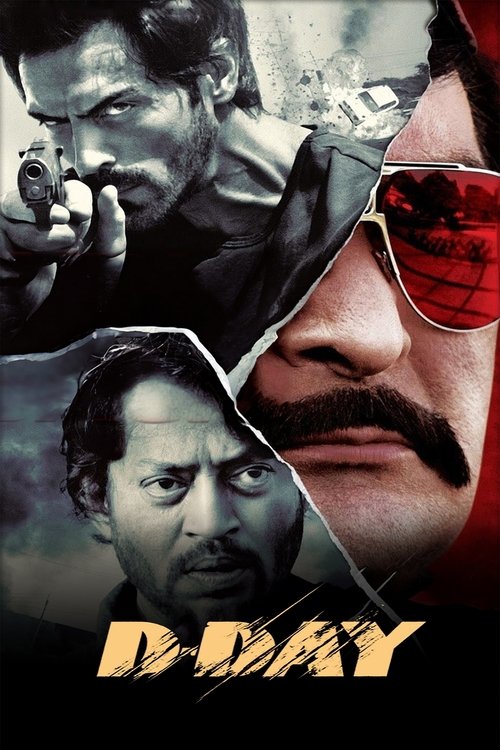
D-Day
Four Indian agents spend nine years under cover to track down India's most wanted criminal.
Working with a small-scale budget of $3.9M, the film achieved a steady performer with $5.6M in global revenue (+44% profit margin).

Plot Structure
Story beats plotted across runtime


Narrative Arc
Emotional journey through the story's key moments
Story Circle
Blueprint 15-beat structure
Arcplot Score Breakdown
Weighted: Precision (70%) + Arc (15%) + Theme (15%)
D-Day (2013) exhibits strategically placed narrative design, characteristic of Nikkhil Advani's storytelling approach. This structural analysis examines how the film's 15-point plot structure maps to proven narrative frameworks across 2 hours and 33 minutes. With an Arcplot score of 7.1, the film balances conventional beats with creative variation.
Structural Analysis
The Status Quo at 2 minutes (1% through the runtime) establishes RAW agents Wali Khan, Rudra, Zoya, and Aslam operate deep undercover in Karachi, living dual lives while gathering intelligence on Goldman, India's most wanted terrorist responsible for multiple attacks.. The analysis reveals that this early placement immediately immerses viewers in the story world.
The inciting incident occurs at 18 minutes when The Indian government greenlit Operation Goldman: a covert mission to capture Goldman alive from Pakistani soil and bring him to India for trial. The mission activates all sleeper agents who have waited years for this moment.. At 12% through the film, this Disruption aligns precisely with traditional story structure. This beat shifts the emotional landscape, launching the protagonist into the central conflict.
The First Threshold at 39 minutes marks the transition into Act II, occurring at 25% of the runtime. This indicates the protagonist's commitment to Wali successfully infiltrates Goldman's compound by saving his son from an attack, earning Goldman's trust and becoming part of his security detail. The team commits fully to the extraction plan with no turning back., moving from reaction to action.
At 77 minutes, the Midpoint arrives at 50% of the runtime—precisely centered, creating perfect narrative symmetry. Notably, this crucial beat The team successfully captures Goldman during a carefully orchestrated ambush. False victory: they have him in custody, but they're still deep in Pakistani territory with the entire nation's security apparatus about to hunt them down., fundamentally raising what's at risk. The emotional intensity shifts, dividing the narrative into clear before-and-after phases.
The Collapse moment at 115 minutes (75% through) represents the emotional nadir. Here, Team members are killed in the firefight with Pakistani forces. Aslam sacrifices himself to buy time. The mission appears doomed, Goldman may escape, and the survivors face certain death or capture. Everything they've built and sacrificed for seven years collapses., indicates the protagonist at their lowest point. This beat's placement in the final quarter sets up the climactic reversal.
The Second Threshold at 123 minutes initiates the final act resolution at 81% of the runtime. Wali chooses to complete the mission at any cost, honoring their fallen comrades. They devise a desperate final plan combining everything they've learned about Pakistani security patterns, using their burned covers as an advantage to reach the border., demonstrating the transformation achieved throughout the journey.
Emotional Journey
D-Day's emotional architecture traces a deliberate progression across 15 carefully calibrated beats.
Narrative Framework
This structural analysis employs a 15-point narrative structure framework that maps key story moments. By mapping D-Day against these established plot points, we can identify how Nikkhil Advani utilizes or subverts traditional narrative conventions. The plot point approach reveals not only adherence to structural principles but also creative choices that distinguish D-Day within the action genre.
Nikkhil Advani's Structural Approach
Among the 2 Nikkhil Advani films analyzed on Arcplot, the average structural score is 7.3, reflecting strong command of classical structure. D-Day takes a more unconventional approach compared to the director's typical style. For comparative analysis, explore the complete Nikkhil Advani filmography.
Comparative Analysis
Additional action films include The Bad Guys, Puss in Boots and Venom: The Last Dance. For more Nikkhil Advani analyses, see Hero.
Plot Points by Act
Act I
SetupStatus Quo
RAW agents Wali Khan, Rudra, Zoya, and Aslam operate deep undercover in Karachi, living dual lives while gathering intelligence on Goldman, India's most wanted terrorist responsible for multiple attacks.
Theme
A senior RAW official states that sacrifice for the nation requires giving up everything, including identity and recognition—establishing the film's exploration of patriotism, sacrifice, and the personal cost of duty.
Worldbuilding
Introduction to each agent's cover life in Pakistan: Wali as a low-level informant, Rudra as a paan shop owner, Zoya as a prostitute with access to powerful men, and Aslam as a student. Their isolation, dedication, and the dangerous tightrope they walk daily is established.
Disruption
The Indian government greenlit Operation Goldman: a covert mission to capture Goldman alive from Pakistani soil and bring him to India for trial. The mission activates all sleeper agents who have waited years for this moment.
Resistance
The team debates strategy and preparation. Wali must infiltrate Goldman's inner circle, Zoya uses her connections to gather intelligence, and they coordinate the complex logistics. Each agent grapples with fear and the reality that this mission could expose them after years of careful cover.
Act II
ConfrontationFirst Threshold
Wali successfully infiltrates Goldman's compound by saving his son from an attack, earning Goldman's trust and becoming part of his security detail. The team commits fully to the extraction plan with no turning back.
Mirror World
Wali witnesses Goldman's human side—his love for his family, his children—creating internal conflict. The terrorist is not just a monster but a person, complicating Wali's mission and forcing him to confront what he's sacrificing and why.
Premise
The team executes the intricate plan: gathering intelligence, coordinating timing, securing extraction routes, and maintaining their covers. Tension builds as they navigate Pakistani security forces, ISI surveillance, and Goldman's paranoid security measures. The promise of a daring covert operation unfolds.
Midpoint
The team successfully captures Goldman during a carefully orchestrated ambush. False victory: they have him in custody, but they're still deep in Pakistani territory with the entire nation's security apparatus about to hunt them down.
Opposition
The extraction becomes a nightmare. Pakistani forces discover the operation and launch a massive manhunt. The team faces checkpoints, betrayals, dwindling resources, and impossible odds. Each agent's cover is burned, and they're hunted as terrorists on Pakistani soil.
Collapse
Team members are killed in the firefight with Pakistani forces. Aslam sacrifices himself to buy time. The mission appears doomed, Goldman may escape, and the survivors face certain death or capture. Everything they've built and sacrificed for seven years collapses.
Crisis
Wali and the surviving agents process the devastating losses while trapped in Pakistan with Goldman. They question whether any of this was worth the sacrifice, whether they'll be remembered or denied by their own government, and whether to continue or surrender.
Act III
ResolutionSecond Threshold
Wali chooses to complete the mission at any cost, honoring their fallen comrades. They devise a desperate final plan combining everything they've learned about Pakistani security patterns, using their burned covers as an advantage to reach the border.
Synthesis
The final desperate push to the border. The surviving agents execute a high-stakes gambit, fighting through Pakistani military with Goldman in custody. A climactic confrontation determines whether years of sacrifice will result in justice or tragedy.
Transformation
Goldman faces trial in India. The surviving agents remain unnamed heroes, their identities still classified, watching from the shadows. They've transformed from isolated operatives to patriots who sacrificed everything, finding meaning not in recognition but in service itself.