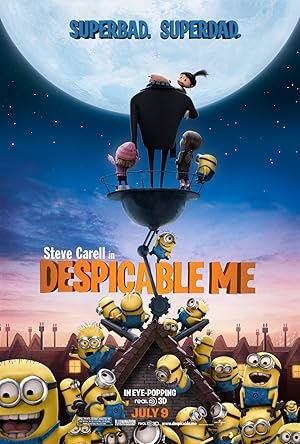
Despicable Me
In a happy suburban neighborhood surrounded by white picket fences with flowering rose bushes, sits a black house with a dead lawn. Unbeknownst to the neighbors, hidden beneath this house is a vast secret hideout. Surrounded by a small army of minions, we discover Gru (Steve Carell), planning the biggest heist in the history of the world. He is going to steal the moon. Gru delights in all things wicked. Armed with his arsenal of shrink rays, freeze rays, and battle-ready vehicles for land and air, he vanquishes all who stand in his way. Until the day he encounters the immense will of three little orphaned girls who look at him and see something that no one else has ever seen: a potential Dad. The world's greatest villain has just met his greatest challenge: three little girls named Margo (Miranda Cosgrove), Edith (Dana Gaier), and Agnes (Elsie Fisher).
Despite a respectable budget of $69.0M, Despicable Me became a massive hit, earning $543.3M worldwide—a remarkable 687% return.
Nominated for 1 BAFTA Award3 wins & 41 nominations


Plot Structure
Story beats plotted across runtime


Narrative Arc
Emotional journey through the story's key moments
Story Circle
Blueprint 15-beat structure
Arcplot Score Breakdown
Weighted: Precision (70%) + Arc (15%) + Theme (15%)
Despicable Me (2010) demonstrates strategically placed story structure, characteristic of Chris Renaud's storytelling approach. This structural analysis examines how the film's 15-point plot structure maps to proven narrative frameworks across 1 hour and 35 minutes. With an Arcplot score of 6.8, the film balances conventional beats with creative variation.
Characters
Cast & narrative archetypes

Gru
Vector
Dr. Nefario
Margo
Edith
Agnes
Miss Hattie
Main Cast & Characters
Gru
Played by Steve Carell
A supervillain who adopts three orphan girls as part of a heist, only to discover the joys of fatherhood.
Vector
Played by Jason Segel
A younger, tech-savvy rival villain who steals the shrink ray and becomes Gru's main competition.
Dr. Nefario
Played by Russell Brand
Gru's elderly gadget-inventing assistant who provides technical support and occasionally questionable advice.
Margo
Played by Miranda Cosgrove
The eldest and most responsible of the three orphan sisters, protective of her younger siblings.
Edith
Played by Dana Gaier
The tomboyish middle sister with a penchant for mischief and adventure.
Agnes
Played by Elsie Fisher
The youngest and most innocent sister who dreams of owning a unicorn and melts Gru's heart.
Miss Hattie
Played by Kristen Wiig
The unpleasant orphanage owner who exploits the girls to sell cookies.
Structural Analysis
The Status Quo at 1 minutes (1% through the runtime) establishes Gru lives as the world's greatest villain in his dark suburban fortress, surrounded by minions and technology, respected and feared in the villain community but emotionally isolated and obsessed with outdoing Vector who just stole the Pyramid.. Notably, this early placement immediately immerses viewers in the story world.
The inciting incident occurs at 12 minutes when Gru fails to steal the shrink ray from Vector's fortress - his carefully laid plans are thwarted by Vector's superior defenses, forcing him to realize he cannot simply overpower his rival and needs a new approach.. At 13% through the film, this Disruption is delayed, allowing extended setup of the story world. This beat shifts the emotional landscape, launching the protagonist into the central conflict.
The First Threshold at 23 minutes marks the transition into Act II, occurring at 25% of the runtime. This demonstrates the protagonist's commitment to Gru officially adopts Margo, Edith, and Agnes, making an active choice to bring them into his home. This irreversible decision launches him into the unfamiliar world of fatherhood, completely disrupting his villain-only lifestyle., moving from reaction to action.
At 48 minutes, the Midpoint arrives at 50% of the runtime—precisely centered, creating perfect narrative symmetry. Structural examination shows that this crucial beat Gru successfully steals the moon - achieving his lifelong dream and greatest heist. False victory: he thinks he's won everything, but the shrink ray's effects are temporary, and he's about to lose what actually matters - the girls., fundamentally raising what's at risk. The emotional intensity shifts, dividing the narrative into clear before-and-after phases.
The Collapse moment at 72 minutes (75% through) represents the emotional nadir. Here, Gru arrives at the recital and finds the girls gone - Dr. Nefario returned them to the orphanage. The death of his dream of having both: his villain life and his family. He realizes too late what he truly values., demonstrates the protagonist at their lowest point. This beat's placement in the final quarter sets up the climactic reversal.
The Second Threshold at 76 minutes initiates the final act resolution at 80% of the runtime. Dr. Nefario reveals Vector kidnapped the girls and offers to help rescue them. Gru realizes he must combine his villain skills with his newfound love - he chooses the girls over the moon, fully embracing fatherhood over glory., demonstrating the transformation achieved throughout the journey.
Emotional Journey
Despicable Me's emotional architecture traces a deliberate progression across 15 carefully calibrated beats.
Narrative Framework
This structural analysis employs structural analysis methodology used to understand storytelling architecture. By mapping Despicable Me against these established plot points, we can identify how Chris Renaud utilizes or subverts traditional narrative conventions. The plot point approach reveals not only adherence to structural principles but also creative choices that distinguish Despicable Me within the animation genre.
Chris Renaud's Structural Approach
Among the 5 Chris Renaud films analyzed on Arcplot, the average structural score is 7.2, reflecting strong command of classical structure. Despicable Me takes a more unconventional approach compared to the director's typical style. For comparative analysis, explore the complete Chris Renaud filmography.
Comparative Analysis
Additional animation films include The Bad Guys, Puss in Boots and Violet Evergarden: Eternity and the Auto Memory Doll. For more Chris Renaud analyses, see The Secret Life of Pets, Despicable Me 4 and The Secret Life of Pets 2.
Plot Points by Act
Act I
SetupStatus Quo
Gru lives as the world's greatest villain in his dark suburban fortress, surrounded by minions and technology, respected and feared in the villain community but emotionally isolated and obsessed with outdoing Vector who just stole the Pyramid.
Theme
Miss Hattie at the orphanage tells the girls "Any girl who doesn't sell cookies will be left behind" - introducing the theme of belonging, family, and what happens to those who don't fit into their current world.
Worldbuilding
Establishment of Gru's villain world: his競争 with Vector, his relationship with Dr. Nefario and the minions, his strained dynamic with his disapproving mother, and his desperate need to prove himself by stealing the moon with the shrink ray.
Disruption
Gru fails to steal the shrink ray from Vector's fortress - his carefully laid plans are thwarted by Vector's superior defenses, forcing him to realize he cannot simply overpower his rival and needs a new approach.
Resistance
Gru debates and devises the cookie robot scheme to infiltrate Vector's fortress. He reluctantly visits the orphanage, interviews the three girls (Margo, Edith, Agnes), and wrestles with adopting children as part of a villainous plot rather than genuine care.
Act II
ConfrontationFirst Threshold
Gru officially adopts Margo, Edith, and Agnes, making an active choice to bring them into his home. This irreversible decision launches him into the unfamiliar world of fatherhood, completely disrupting his villain-only lifestyle.
Mirror World
Agnes shows Gru her unicorn toy and asks about bedtime stories, representing the innocent, loving relationship that will teach Gru what he truly needs - genuine connection and family rather than villainous glory.
Premise
The "villain with kids" premise plays out: Gru awkwardly navigates fatherhood (bedtime stories, ballet recitals, Vector's cookie scheme success), while the girls begin to soften his cold heart and he experiences the fun and chaos of family life.
Midpoint
Gru successfully steals the moon - achieving his lifelong dream and greatest heist. False victory: he thinks he's won everything, but the shrink ray's effects are temporary, and he's about to lose what actually matters - the girls.
Opposition
Pressure mounts as Gru must choose between villainy and family: the moon begins growing, Vector kidnaps the girls, Dr. Nefario sends the girls back to the orphanage without permission, and Gru's two worlds collide catastrophically.
Collapse
Gru arrives at the recital and finds the girls gone - Dr. Nefario returned them to the orphanage. The death of his dream of having both: his villain life and his family. He realizes too late what he truly values.
Crisis
Gru races to the orphanage only to discover the girls have been adopted by another family. He returns home in despair, sitting alone among the girls' abandoned toys, processing that his villainy cost him the family he didn't know he needed.
Act III
ResolutionSecond Threshold
Dr. Nefario reveals Vector kidnapped the girls and offers to help rescue them. Gru realizes he must combine his villain skills with his newfound love - he chooses the girls over the moon, fully embracing fatherhood over glory.
Synthesis
Gru storms Vector's fortress using all his villain resources but motivated by love. He trades the moon for the girls, battles Vector, and with the minions' help rescues Margo, Edith, and Agnes as the shrink ray reverses and chaos ensues.
Transformation
Gru reads the girls a bedtime story he wrote himself, tucking them into bed in their permanent home with him. The once-isolated villain is now a loving father, transformed from seeking external validation to finding genuine happiness in family.