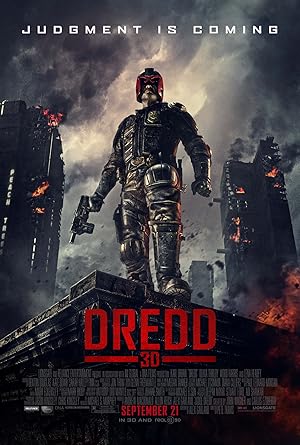
Dredd
The future America is an irradiated waste land. On its East Coast, running from Boston to Washington DC, lies Mega City One - a vast, violent metropolis where criminals rule the chaotic streets. The only force of order lies with the urban cops called "Judges" who possess the combined powers of judge, jury and instant executioner. Known and feared throughout the city, Dredd is the ultimate Judge, challenged with ridding the city of its latest scourge - a dangerous drug epidemic that has users of "Slo-Mo" experiencing reality at a fraction of its normal speed. During a routine day on the job, Dredd is assigned to train and evaluate Cassandra Anderson, a rookie with powerful psychic abilities thanks to a genetic mutation. A heinous crime calls them to a neighborhood where fellow Judges rarely dare to venture - a 200 storey vertical slum controlled by prostitute turned drug lord Ma-Ma and her ruthless clan. When they capture one of the clan's inner circle, Ma-Ma overtakes the compound's control center and wages a dirty, vicious war against the Judges that proves she will stop at nothing to protect her empire. With the body count climbing and no way out, Dredd and Anderson must confront the odds and engage in the relentless battle for their survival.
The film underperformed commercially against its moderate budget of $50.0M, earning $41.0M globally (-18% loss).
2 wins & 14 nominations


Plot Structure
Story beats plotted across runtime


Narrative Arc
Emotional journey through the story's key moments
Story Circle
Blueprint 15-beat structure
Arcplot Score Breakdown
Weighted: Precision (70%) + Arc (15%) + Theme (15%)
Dredd (2012) demonstrates carefully calibrated plot construction, characteristic of Pete Travis's storytelling approach. This structural analysis examines how the film's 15-point plot structure maps to proven narrative frameworks across 1 hour and 36 minutes. With an Arcplot score of 7.2, the film balances conventional beats with creative variation.
Characters
Cast & narrative archetypes

Judge Dredd
Cassandra Anderson
Ma-Ma
Kay
Main Cast & Characters
Judge Dredd
Played by Karl Urban
A hardened lawman who serves as judge, jury, and executioner in a dystopian mega-city. Utterly devoted to the law and his duty.
Cassandra Anderson
Played by Olivia Thirlby
A rookie Judge with powerful psychic abilities on her evaluation day. Empathetic and idealistic despite her dangerous gift.
Ma-Ma
Played by Lena Headey
A ruthless drug lord who controls Peach Trees tower with an iron fist. Scarred, calculating, and willing to kill hundreds to survive.
Kay
Played by Wood Harris
Ma-Ma's right-hand man and tech expert, captured by the Judges. Cold and loyal to his clan.
Structural Analysis
The Status Quo at 1 minutes (1% through the runtime) establishes Dredd pursues criminals through the chaotic streets of Mega-City One, executing justice with absolute authority and zero emotion. His world is one of endless crime and mechanical law enforcement.. Significantly, this early placement immediately immerses viewers in the story world.
The inciting incident occurs at 12 minutes when Dredd and Anderson respond to a triple homicide at Peach Trees tower block. What seems like a routine call becomes their assignment for the day, pulling them toward the fortress controlled by Ma-Ma.. At 12% through the film, this Disruption aligns precisely with traditional story structure. This beat shifts the emotional landscape, launching the protagonist into the central conflict.
The First Threshold at 25 minutes marks the transition into Act II, occurring at 26% of the runtime. This shows the protagonist's commitment to Ma-Ma seals the entire building on lockdown, trapping Dredd and Anderson inside with orders to kill them. The routine evaluation becomes a fight for survival. They choose to push forward rather than retreat., moving from reaction to action.
At 48 minutes, the Midpoint arrives at 50% of the runtime—precisely centered, creating perfect narrative symmetry. Of particular interest, this crucial beat Ma-Ma deploys heavily armed enforcers with miniguns to execute the Judges. The stakes escalate dramatically from street thugs to military-grade opposition. False defeat: the mission seems impossible as overwhelming firepower rains down on them., fundamentally raising what's at risk. The emotional intensity shifts, dividing the narrative into clear before-and-after phases.
The Collapse moment at 71 minutes (74% through) represents the emotional nadir. Here, Anderson is captured and tortured by Kay. She appears broken and helpless, stripped of her weapon and dignity. Her psychic abilities seem useless against physical brutality. This is her darkest moment, alone and seemingly defeated., illustrates the protagonist at their lowest point. This beat's placement in the final quarter sets up the climactic reversal.
The Second Threshold at 77 minutes initiates the final act resolution at 80% of the runtime. Anderson uses her psychic abilities in a new way, turning her captor's mind against him and escaping. She realizes her power comes from within, not from her weapon or badge. This synthesis of vulnerability and strength enables the final push., demonstrating the transformation achieved throughout the journey.
Emotional Journey
Dredd's emotional architecture traces a deliberate progression across 15 carefully calibrated beats.
Narrative Framework
This structural analysis employs a 15-point narrative structure framework that maps key story moments. By mapping Dredd against these established plot points, we can identify how Pete Travis utilizes or subverts traditional narrative conventions. The plot point approach reveals not only adherence to structural principles but also creative choices that distinguish Dredd within the action genre.
Pete Travis's Structural Approach
Among the 2 Pete Travis films analyzed on Arcplot, the average structural score is 7.2, reflecting strong command of classical structure. Dredd exemplifies the director's characteristic narrative technique. For comparative analysis, explore the complete Pete Travis filmography.
Comparative Analysis
Additional action films include The Bad Guys, Puss in Boots and Venom: The Last Dance. For more Pete Travis analyses, see Vantage Point.
Plot Points by Act
Act I
SetupStatus Quo
Dredd pursues criminals through the chaotic streets of Mega-City One, executing justice with absolute authority and zero emotion. His world is one of endless crime and mechanical law enforcement.
Theme
Chief Judge asks Dredd to evaluate Anderson despite her failing scores: "What do you see?" The question establishes the film's central theme: looking beyond the surface to find true strength and humanity within rigid systems.
Worldbuilding
Introduction to Mega-City One's dystopian reality, the Judge system, the Slo-Mo drug epidemic, and Anderson's psychic abilities. Dredd is assigned to evaluate the rookie Anderson on a routine day.
Disruption
Dredd and Anderson respond to a triple homicide at Peach Trees tower block. What seems like a routine call becomes their assignment for the day, pulling them toward the fortress controlled by Ma-Ma.
Resistance
Dredd and Anderson enter Peach Trees, investigate the crime scene, and use Anderson's psychic abilities to identify Kay as a suspect. They debate procedure and methods while preparing to extract him from the building.
Act II
ConfrontationFirst Threshold
Ma-Ma seals the entire building on lockdown, trapping Dredd and Anderson inside with orders to kill them. The routine evaluation becomes a fight for survival. They choose to push forward rather than retreat.
Mirror World
Anderson uses her psychic abilities to extract information from Kay, revealing the Peach Trees operation. Her humanity and empathy contrast with Dredd's pure law enforcement, establishing the relationship that will carry the thematic exploration.
Premise
The promise of the premise: two Judges fighting their way up through a locked-down tower block against an army of criminals. Intense action sequences, Anderson proving her worth, and the exploration of justice within impossible odds.
Midpoint
Ma-Ma deploys heavily armed enforcers with miniguns to execute the Judges. The stakes escalate dramatically from street thugs to military-grade opposition. False defeat: the mission seems impossible as overwhelming firepower rains down on them.
Opposition
Dredd and Anderson are separated. Anderson is captured by Kay and must survive on her own. Corrupt Judges arrive as reinforcements but are actually there to kill them. The building's residents become increasingly hostile. Every apparent ally becomes an enemy.
Collapse
Anderson is captured and tortured by Kay. She appears broken and helpless, stripped of her weapon and dignity. Her psychic abilities seem useless against physical brutality. This is her darkest moment, alone and seemingly defeated.
Crisis
Anderson processes her fear and finds her inner strength. Dredd fights the corrupt Judges alone. Both face their individual dark nights, questioning whether they can survive and complete the mission.
Act III
ResolutionSecond Threshold
Anderson uses her psychic abilities in a new way, turning her captor's mind against him and escaping. She realizes her power comes from within, not from her weapon or badge. This synthesis of vulnerability and strength enables the final push.
Synthesis
Dredd and Anderson reunite and push to the top floor. Anderson has proven herself through inner strength rather than passing conventional tests. They confront Ma-Ma, execute justice, and fight their way to freedom. The finale resolves both the external mission and Anderson's internal journey.
Transformation
Dredd tells the Chief Judge that Anderson has passed her evaluation. Anderson walks away from the Judge program by choice, having proven she has the strength but choosing humanity over the system. The final image shows her transformed: confident, self-aware, and free.