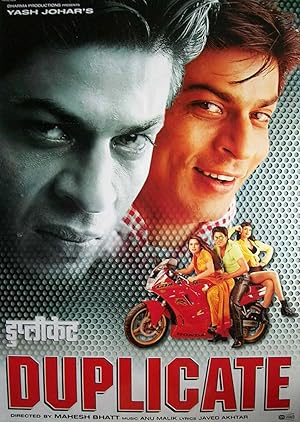
Duplicate
Bablu (Shah Rukh Khan), an aspiring chef, works in a hotel where Sonia Kapoor,(Juhi) works with him as banquet manager at the restaurant. His look-alike Manu (Shah Rukh Khan), a gangster, robs a bank along with his friend (Gulshan Grover) but gets caught. He comes out of prison and discovers that his cohort has double-crossed him. He murders his partner and escapes from the scene of the crime...without the money. Bablu stumbles on the money and keeps it. Manu's lover Lily (Sonali Bendre) mistakes Bablu to be Manu and spirits him away. Manu takes shelter in Bablu's house and realizes that he can use their resemblance to his advantage.Then starts the fun-ride with Babloo constantly being mistaken for Manu. With both Sonia and Lily after him, Manu furious and the Law taking him to be Manu, Babloo faces a tough time. And then, Manu kidnaps Bibi (Farida Jalal) Babloo's mother and holds her hostage.
Despite its small-scale budget of $4.5M, Duplicate became a box office success, earning $10.0M worldwide—a 122% return.





Plot Structure
Story beats plotted across runtime


Narrative Arc
Emotional journey through the story's key moments
Story Circle
Blueprint 15-beat structure
Arcplot Score Breakdown
Weighted: Precision (70%) + Arc (15%) + Theme (15%)
Duplicate (1998) exemplifies deliberately positioned dramatic framework, characteristic of Mahesh Bhatt's storytelling approach. This structural analysis examines how the film's 15-point plot structure maps to proven narrative frameworks across 2 hours and 45 minutes. With an Arcplot score of 7.6, the film showcases strong structural fundamentals.
Structural Analysis
The Status Quo at 2 minutes (1% through the runtime) establishes Bablu, a simple cook, lives a humble life working in a restaurant, dreaming of a better future. His innocent, hardworking nature is established through his daily routine and interactions with colleagues.. The analysis reveals that this early placement immediately immerses viewers in the story world.
The inciting incident occurs at 20 minutes when Bablu is mistaken for Manu by criminals who kidnap him, thrusting the innocent cook into the dangerous world of crime and forcing him to confront his evil doppelganger's existence.. At 12% through the film, this Disruption aligns precisely with traditional story structure. This beat shifts the emotional landscape, launching the protagonist into the central conflict.
The First Threshold at 41 minutes marks the transition into Act II, occurring at 25% of the runtime. This shows the protagonist's commitment to Bablu makes the active decision to stop running and instead confront Manu directly, choosing to fight for his identity and protect those he loves from being caught in the crossfire of mistaken identity., moving from reaction to action.
At 83 minutes, the Midpoint arrives at 50% of the runtime—precisely centered, creating perfect narrative symmetry. Significantly, this crucial beat Bablu and Manu finally come face to face in a direct confrontation. The false victory of thinking he can reason with his double turns to defeat as Manu's ruthlessness becomes clear, and the stakes escalate dramatically., fundamentally raising what's at risk. The emotional intensity shifts, dividing the narrative into clear before-and-after phases.
The Collapse moment at 124 minutes (75% through) represents the emotional nadir. Here, Bablu loses everything: his reputation, his freedom, and nearly loses Sonia as she begins to doubt him. A close ally is killed by Manu, representing the "whiff of death" and the cost of his double's evil., shows the protagonist at their lowest point. This beat's placement in the final quarter sets up the climactic reversal.
The Second Threshold at 132 minutes initiates the final act resolution at 80% of the runtime. Bablu realizes that the only way to defeat Manu is to embrace what makes them different: his goodness and the genuine relationships he's built. He synthesizes his humble skills with newfound courage to turn the tables., demonstrating the transformation achieved throughout the journey.
Emotional Journey
Duplicate's emotional architecture traces a deliberate progression across 15 carefully calibrated beats.
Narrative Framework
This structural analysis employs proven narrative structure principles that track dramatic progression. By mapping Duplicate against these established plot points, we can identify how Mahesh Bhatt utilizes or subverts traditional narrative conventions. The plot point approach reveals not only adherence to structural principles but also creative choices that distinguish Duplicate within the action genre.
Comparative Analysis
Additional action films include The Ministry of Ungentlemanly Warfare, The Bad Guys and Lake Placid.
Plot Points by Act
Act I
SetupStatus Quo
Bablu, a simple cook, lives a humble life working in a restaurant, dreaming of a better future. His innocent, hardworking nature is established through his daily routine and interactions with colleagues.
Theme
A character remarks that "appearances can be deceiving" and that two people can look the same but be entirely different in nature, foreshadowing the doppelganger conflict and the theme of identity versus character.
Worldbuilding
Introduction to Bablu's modest world as a cook, his friendship with Lily, and his simple aspirations. Parallel establishment of Manu, a ruthless criminal who happens to be Bablu's exact physical double, operating in the underworld.
Disruption
Bablu is mistaken for Manu by criminals who kidnap him, thrusting the innocent cook into the dangerous world of crime and forcing him to confront his evil doppelganger's existence.
Resistance
Bablu struggles to prove his identity and innocence while learning about Manu's criminal activities. He debates whether to flee or confront the situation, receiving guidance from Lily who believes in him despite the confusion.
Act II
ConfrontationFirst Threshold
Bablu makes the active decision to stop running and instead confront Manu directly, choosing to fight for his identity and protect those he loves from being caught in the crossfire of mistaken identity.
Mirror World
Bablu's relationship with Sonia deepens as she represents the life of honesty and love he aspires to, contrasting with Manu's violent world. She becomes the thematic mirror showing that true character cannot be duplicated.
Premise
The "fun and games" of the premise: mistaken identity chaos as Bablu navigates between his world and Manu's, creating comedic and tense situations. He attempts to use the confusion to his advantage while staying true to himself.
Midpoint
Bablu and Manu finally come face to face in a direct confrontation. The false victory of thinking he can reason with his double turns to defeat as Manu's ruthlessness becomes clear, and the stakes escalate dramatically.
Opposition
Manu actively works to destroy Bablu's life, framing him for crimes and turning his loved ones against him. The criminal world closes in, and Bablu's attempts to prove the truth become increasingly desperate as evidence mounts against him.
Collapse
Bablu loses everything: his reputation, his freedom, and nearly loses Sonia as she begins to doubt him. A close ally is killed by Manu, representing the "whiff of death" and the cost of his double's evil.
Crisis
In his darkest moment, Bablu questions whether his goodness matters in a world where evil wears his face. He processes the loss and devastation, struggling with the injustice of being punished for another's crimes.
Act III
ResolutionSecond Threshold
Bablu realizes that the only way to defeat Manu is to embrace what makes them different: his goodness and the genuine relationships he's built. He synthesizes his humble skills with newfound courage to turn the tables.
Synthesis
The finale unfolds as Bablu executes a plan to expose Manu's true nature, using the confusion of their identical appearances against the criminal. Final confrontation where character, not appearance, determines the victor.
Transformation
Bablu, now vindicated and reunited with Sonia, returns to his simple life but transformed by the ordeal. The closing image shows him at peace, his identity secure, proving that true character cannot be duplicated or destroyed.