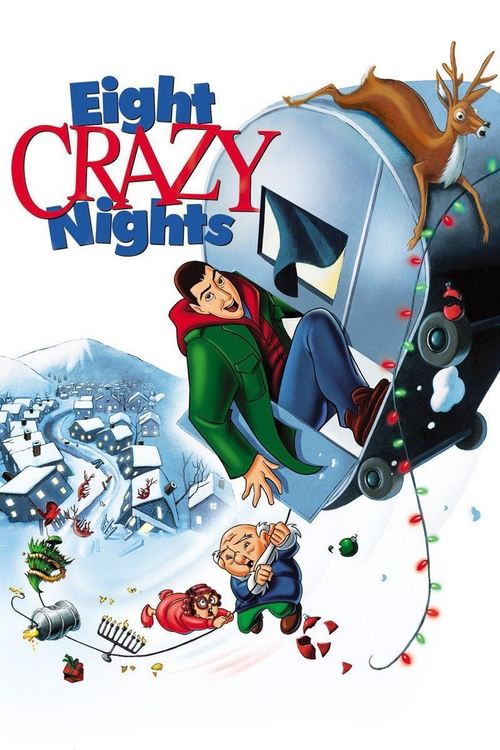
Eight Crazy Nights
Davey Stone, a 33-year old party animal, finds himself in trouble with the law after his wild ways go too far.
Despite its small-scale budget of $3.4M, Eight Crazy Nights became a massive hit, earning $23.8M worldwide—a remarkable 601% return. The film's unconventional structure found its audience, proving that strong storytelling can transcend budget limitations.
1 win & 5 nominations


Plot Structure
Story beats plotted across runtime


Narrative Arc
Emotional journey through the story's key moments
Story Circle
Blueprint 15-beat structure
Arcplot Score Breakdown
Weighted: Precision (70%) + Arc (15%) + Theme (15%)
Eight Crazy Nights (2002) demonstrates carefully calibrated narrative design, characteristic of Seth Kearsley's storytelling approach. This structural analysis examines how the film's 15-point plot structure maps to proven narrative frameworks across 1 hour and 16 minutes. With an Arcplot score of 7.4, the film balances conventional beats with creative variation.
Characters
Cast & narrative archetypes

Davey Stone
Whitey Duvall
Eleanore Duvall
Jennifer Friedman
Main Cast & Characters
Davey Stone
Played by Adam Sandler
A 33-year-old alcoholic troublemaker who must perform community service as a basketball referee during Hanukkah or face jail time.
Whitey Duvall
Played by Adam Sandler
An elderly, optimistic volunteer referee with a high-pitched voice who becomes Davey's mentor and tries to help him change his ways.
Eleanore Duvall
Played by Adam Sandler
Whitey's fraternal twin sister who is crude, aggressive, and initially hostile toward Davey but shares her brother's good heart.
Jennifer Friedman
Played by Jackie Titone
Davey's former girlfriend who still cares for him and represents the life and love he lost after his parents' death.
Structural Analysis
The Status Quo at 1 minutes (1% through the runtime) establishes Davey Stone, a bitter 33-year-old alcoholic, causes chaos at a mall during Hanukkah, showing his complete disconnect from community and joy. He's an outcast living a destructive life.. Structural examination shows that this early placement immediately immerses viewers in the story world.
The inciting incident occurs at 9 minutes when The judge sentences Davey to jail, but Whitey intervenes and volunteers to supervise Davey through community service refereeing youth basketball. Davey faces either prison or spending time with the person he's mocked for years.. At 11% through the film, this Disruption aligns precisely with traditional story structure. This beat shifts the emotional landscape, launching the protagonist into the central conflict.
The First Threshold at 18 minutes marks the transition into Act II, occurring at 24% of the runtime. This demonstrates the protagonist's commitment to After another humiliation of Whitey at a town event, Davey has a moment where he sees Whitey's genuine hurt. Rather than flee town or continue pure sabotage, he reluctantly continues with the community service, beginning to engage (however minimally) with the process., moving from reaction to action.
At 37 minutes, the Midpoint arrives at 49% of the runtime—precisely centered, creating perfect narrative symmetry. Structural examination shows that this crucial beat Davey performs a surprisingly kind act: he helps Whitey prepare for the Referees of the Year banquet and shows genuine effort. For the first time, Davey experiences what it feels like to do something for someone else. False victory: it seems like Davey is changing., fundamentally raising what's at risk. The emotional intensity shifts, dividing the narrative into clear before-and-after phases.
The Collapse moment at 56 minutes (73% through) represents the emotional nadir. Here, Whitey has a breakdown and runs into the freezing cold, devastated by the public humiliation. Davey realizes the damage he's caused. Whitey collapses in the snow and nearly dies from exposure. Davey finds him barely alive—a literal "whiff of death."., demonstrates the protagonist at their lowest point. This beat's placement in the final quarter sets up the climactic reversal.
The Second Threshold at 61 minutes initiates the final act resolution at 80% of the runtime. Davey discovers evidence that Whitey has suffered decades of rejection but never stopped trying to help others. He sees Whitey's trailer filled with mementos of all the kids he's helped. Davey finally understands unconditional kindness and makes the choice to become that person., demonstrating the transformation achieved throughout the journey.
Emotional Journey
Eight Crazy Nights's emotional architecture traces a deliberate progression across 15 carefully calibrated beats.
Narrative Framework
This structural analysis employs systematic plot point analysis that identifies crucial turning points. By mapping Eight Crazy Nights against these established plot points, we can identify how Seth Kearsley utilizes or subverts traditional narrative conventions. The plot point approach reveals not only adherence to structural principles but also creative choices that distinguish Eight Crazy Nights within the animation genre.
Comparative Analysis
Additional animation films include The Bad Guys, Puss in Boots and Violet Evergarden: Eternity and the Auto Memory Doll.
Plot Points by Act
Act I
SetupStatus Quo
Davey Stone, a bitter 33-year-old alcoholic, causes chaos at a mall during Hanukkah, showing his complete disconnect from community and joy. He's an outcast living a destructive life.
Theme
Whitey Duvall speaks about giving people chances and believing everyone deserves redemption, even when others have given up on them. This establishes the film's theme of redemption through community and second chances.
Worldbuilding
Establishment of Dukesberry, the small town that celebrates Hanukkah together. Introduction of Whitey, the elderly referee who everyone ridicules. Davey's arrest and court appearance reveal his criminal history and the town's frustration with him.
Disruption
The judge sentences Davey to jail, but Whitey intervenes and volunteers to supervise Davey through community service refereeing youth basketball. Davey faces either prison or spending time with the person he's mocked for years.
Resistance
Davey resists Whitey's mentorship, mocking him cruelly and sabotaging the youth basketball games. Whitey remains patient and kind despite abuse. Flashbacks reveal Davey's tragic past: his parents died in a car accident on Hanukkah when he was a child.
Act II
ConfrontationFirst Threshold
After another humiliation of Whitey at a town event, Davey has a moment where he sees Whitey's genuine hurt. Rather than flee town or continue pure sabotage, he reluctantly continues with the community service, beginning to engage (however minimally) with the process.
Mirror World
Reconnection with Jennifer, Davey's childhood sweetheart, who still sees the good person he once was. She represents hope and the life Davey could have if he chooses redemption. Her son Benjamin needs a positive male role model.
Premise
Davey reluctantly participates in community events with Whitey. Despite continued mockery and resistance, small moments of connection emerge. Whitey shares his own painful past of rejection. The town's annual contest for "Referees of the Year" becomes important to Whitey.
Midpoint
Davey performs a surprisingly kind act: he helps Whitey prepare for the Referees of the Year banquet and shows genuine effort. For the first time, Davey experiences what it feels like to do something for someone else. False victory: it seems like Davey is changing.
Opposition
At the banquet, Davey's past cruel actions are exposed through a video montage of him tormenting Whitey. The entire town sees Davey's cruelty. Whitey is humiliated and denied the award he's worked toward for decades. Davey's self-destructive patterns reassert themselves.
Collapse
Whitey has a breakdown and runs into the freezing cold, devastated by the public humiliation. Davey realizes the damage he's caused. Whitey collapses in the snow and nearly dies from exposure. Davey finds him barely alive—a literal "whiff of death."
Crisis
At the hospital, Davey confronts his own responsibility for nearly killing the one person who believed in him. He faces the reality that his bitterness has poisoned everything he touches. The town condemns him completely.
Act III
ResolutionSecond Threshold
Davey discovers evidence that Whitey has suffered decades of rejection but never stopped trying to help others. He sees Whitey's trailer filled with mementos of all the kids he's helped. Davey finally understands unconditional kindness and makes the choice to become that person.
Synthesis
Davey rallies the town to honor Whitey properly. He organizes a ceremony where Whitey finally receives recognition. Davey publicly apologizes and takes responsibility for his actions. He uses his basketball skills to help the youth team win, showing he can contribute positively.
Transformation
One year later: Davey is now a responsible member of the community, coaching kids alongside Whitey. He's in a relationship with Jennifer. The town embraces him. The closing image mirrors the opening but shows Davey as joyful and connected rather than bitter and isolated.