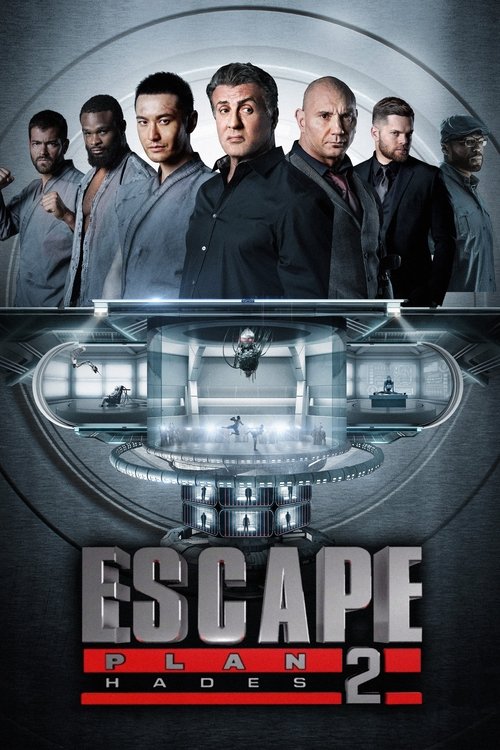
Escape Plan 2: Hades
Ray Breslin manages an elite team of security specialists trained in the art of breaking people out of the world's most impenetrable prisons. When his most trusted operative, Shu Ren, is kidnapped and disappears inside the most elaborate prison ever built, Ray must track him down with the help of some of his former friends.
The film struggled financially against its mid-range budget of $20.0M, earning $17.6M globally (-12% loss).


Plot Structure
Story beats plotted across runtime


Narrative Arc
Emotional journey through the story's key moments
Story Circle
Blueprint 15-beat structure
Arcplot Score Breakdown
Weighted: Precision (70%) + Arc (15%) + Theme (15%)
Escape Plan 2: Hades (2018) exemplifies strategically placed dramatic framework, characteristic of Steven C. Miller's storytelling approach. This structural analysis examines how the film's 15-point plot structure maps to proven narrative frameworks across 1 hour and 33 minutes. With an Arcplot score of 7.4, the film balances conventional beats with creative variation.
Characters
Cast & narrative archetypes

Ray Breslin
Shu Ren
Kimbral
Trent DeRosa
Jaspar Kimbral
Yusheng
Luke
Main Cast & Characters
Ray Breslin
Played by Sylvester Stallone
Security expert who designed the world's most secure prisons, now running a rescue operation to save his team member from a high-tech black site.
Shu Ren
Played by Huang Xiaoming
Ray's business partner who gets captured and imprisoned in Hades, a computerized prison where inmates fight to the death.
Kimbral
Played by Wes Chatham
The sadistic warden of Hades who runs the prison like a gladiatorial arena and profits from death matches.
Trent DeRosa
Played by Dave Bautista
Former UFC fighter and member of Ray's security team who helps from the outside to locate and infiltrate Hades.
Jaspar Kimbral
Played by Jaime King
Tech genius cousin of the warden who designed the AI-controlled prison system and helps manage Hades.
Yusheng
Played by Chen Tang
Shu's cousin and wealthy businessman whose illegal activities lead to Shu's capture and imprisonment in Hades.
Luke
Played by Curtis Jackson
Member of Ray's team who provides tech support and intelligence gathering for the rescue mission.
Structural Analysis
The Status Quo at 1 minutes (1% through the runtime) establishes Ray Breslin's security team successfully completes a training exercise, demonstrating their expertise in testing high-security facilities. The team is confident and functioning smoothly.. Structural examination shows that this early placement immediately immerses viewers in the story world.
The inciting incident occurs at 10 minutes when Shu Ren is kidnapped during what appears to be a routine mission in Chechnya. The team loses contact with him, and he awakens in the mysterious underground prison called Hades.. At 11% through the film, this Disruption aligns precisely with traditional story structure. This beat shifts the emotional landscape, launching the protagonist into the central conflict.
The First Threshold at 23 minutes marks the transition into Act II, occurring at 24% of the runtime. This indicates the protagonist's commitment to Breslin commits to the rescue mission. Jaspar Kimbral and other team members enter Hades undercover to locate and extract Shu, crossing into the dangerous unknown., moving from reaction to action.
At 47 minutes, the Midpoint arrives at 50% of the runtime—precisely centered, creating perfect narrative symmetry. The analysis reveals that this crucial beat The team discovers that one of their own has betrayed them - the kidnapping was an inside job. The prison's designer knows all of Breslin's escape techniques, making their situation far more dire than anticipated., fundamentally raising what's at risk. The emotional intensity shifts, dividing the narrative into clear before-and-after phases.
The Collapse moment at 68 minutes (73% through) represents the emotional nadir. Here, A team member is killed during a failed escape attempt. Shu is severely beaten and scheduled for execution. All seems lost as the team is separated and their plans have fallen apart., shows the protagonist at their lowest point. This beat's placement in the final quarter sets up the climactic reversal.
The Second Threshold at 73 minutes initiates the final act resolution at 79% of the runtime. Breslin realizes the prison's one weakness - the designer's arrogance. He formulates a new plan combining old-school tactics with the team's tech knowledge, something the designer wouldn't anticipate., demonstrating the transformation achieved throughout the journey.
Emotional Journey
Escape Plan 2: Hades's emotional architecture traces a deliberate progression across 15 carefully calibrated beats.
Narrative Framework
This structural analysis employs proven narrative structure principles that track dramatic progression. By mapping Escape Plan 2: Hades against these established plot points, we can identify how Steven C. Miller utilizes or subverts traditional narrative conventions. The plot point approach reveals not only adherence to structural principles but also creative choices that distinguish Escape Plan 2: Hades within the action genre.
Steven C. Miller's Structural Approach
Among the 2 Steven C. Miller films analyzed on Arcplot, the average structural score is 7.4, reflecting strong command of classical structure. Escape Plan 2: Hades exemplifies the director's characteristic narrative technique. For comparative analysis, explore the complete Steven C. Miller filmography.
Comparative Analysis
Additional action films include The Bad Guys, Puss in Boots and Venom: The Last Dance. For more Steven C. Miller analyses, see Werewolves.
Plot Points by Act
Act I
SetupStatus Quo
Ray Breslin's security team successfully completes a training exercise, demonstrating their expertise in testing high-security facilities. The team is confident and functioning smoothly.
Theme
Discussion about trust and loyalty within the team. A team member mentions that in their line of work, "you're only as strong as your weakest link" - foreshadowing the betrayal to come.
Worldbuilding
Establishment of Breslin's security consulting business, introduction of team members including Shu Ren, and presentation of their high-tech operations center. The team takes on various prison security testing assignments.
Disruption
Shu Ren is kidnapped during what appears to be a routine mission in Chechnya. The team loses contact with him, and he awakens in the mysterious underground prison called Hades.
Resistance
Breslin debates whether to mount a rescue mission. The team investigates Shu's disappearance, discovering the existence of Hades. Internal conflict about the risks involved and preparation for infiltration.
Act II
ConfrontationFirst Threshold
Breslin commits to the rescue mission. Jaspar Kimbral and other team members enter Hades undercover to locate and extract Shu, crossing into the dangerous unknown.
Mirror World
Inside Hades, the team encounters the brutal reality of the prison - a technological nightmare designed by someone who knows Breslin's methods. The inmates form alliances to survive.
Premise
The team navigates Hades' complex security systems and violent prison culture. They attempt various escape strategies, analyze the prison's layout, and deal with the corrupt warden and guards while searching for Shu.
Midpoint
The team discovers that one of their own has betrayed them - the kidnapping was an inside job. The prison's designer knows all of Breslin's escape techniques, making their situation far more dire than anticipated.
Opposition
The warden tightens security and turns inmates against each other. The team's escape attempts are systematically thwarted. Violence escalates within the prison, and the external support team faces obstacles in providing assistance.
Collapse
A team member is killed during a failed escape attempt. Shu is severely beaten and scheduled for execution. All seems lost as the team is separated and their plans have fallen apart.
Crisis
The surviving team members regroup in despair. They process the loss and their apparent failure. Outside, Breslin must decide whether to risk more lives or accept defeat.
Act III
ResolutionSecond Threshold
Breslin realizes the prison's one weakness - the designer's arrogance. He formulates a new plan combining old-school tactics with the team's tech knowledge, something the designer wouldn't anticipate.
Synthesis
The team executes the final escape plan, fighting through guards and overcoming the prison's security systems. Confrontation with the warden and traitor. Explosive action sequence as they battle their way out of Hades.
Transformation
The surviving team members escape Hades and ensure justice for their fallen comrade. Breslin's team is battle-scarred but stronger, having learned that trust must be earned and verified, not freely given.