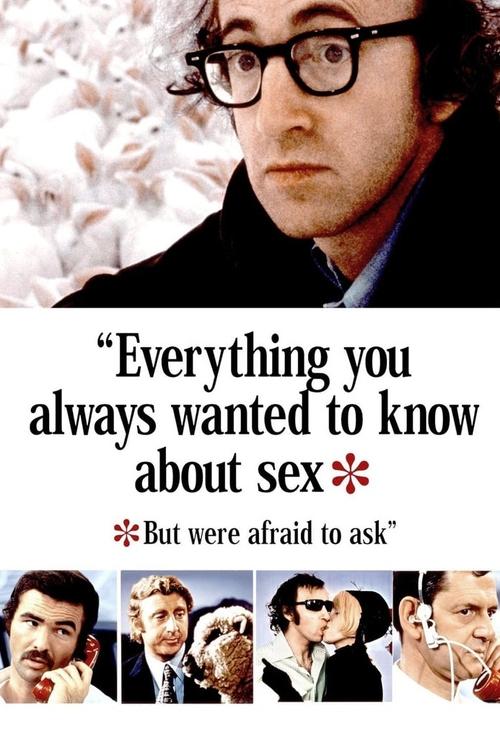
Everything You Always Wanted to Know About Sex *But Were Afraid to Ask
A collection of seven vignettes, which each address a question concerning human sexuality. From aphrodisiacs to sexual perversion to the mystery of the male orgasm, characters like a court jester, a doctor, a queen and a journalist adventure through lab experiments and game shows, all seeking answers to common questions that many would never ask.
Despite its tight budget of $2.0M, Everything You Always Wanted to Know About Sex *But Were Afraid to Ask became a commercial juggernaut, earning $18.0M worldwide—a remarkable 801% return. The film's fresh perspective connected with viewers, proving that strong storytelling can transcend budget limitations.
1 win & 1 nomination


Plot Structure
Story beats plotted across runtime


Narrative Arc
Emotional journey through the story's key moments
Story Circle
Blueprint 15-beat structure
Arcplot Score Breakdown
Weighted: Precision (70%) + Arc (15%) + Theme (15%)
Everything You Always Wanted to Know About Sex *But Were Afraid to Ask (1972) showcases meticulously timed plot construction, characteristic of Woody Allen's storytelling approach. This structural analysis examines how the film's 15-point plot structure maps to proven narrative frameworks across 1 hour and 28 minutes. With an Arcplot score of 5.8, the film takes an unconventional approach to traditional narrative frameworks.
Characters
Cast & narrative archetypes

The Fool
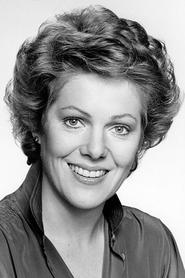
The Queen
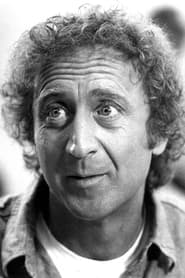
Dr. Doug Ross
Fabrizio
Victor Shakapopulis
Main Cast & Characters
The Fool
Played by Woody Allen
A court jester in medieval times who becomes infatuated with the Queen and seeks help from a sorcerer
The Queen
Played by Lynn Redgrave
The object of the Fool's desire in the medieval segment, trapped in a chastity belt
Dr. Doug Ross
Played by Gene Wilder
A respectable doctor who develops an uncontrollable attraction to sheep, risking his career and marriage
Fabrizio
Played by Woody Allen
An Italian husband whose wife can only achieve orgasm in public places, leading to increasingly risky situations
Victor Shakapopulis
Played by Woody Allen
A sperm cell preparing for ejaculation, nervous about the mission ahead
Structural Analysis
The Status Quo at 1 minutes (1% through the runtime) establishes Opening title card poses the first question about sexuality, establishing the film's comedic interrogation format and tone of clinical absurdity applied to human desire.. Notably, this early placement immediately immerses viewers in the story world.
The inciting incident occurs at 11 minutes when Transition to second segment "What is Sodomy?" shifts from historical setting to contemporary psychiatry, disrupting expectations and expanding the film's scope to modern taboos.. At 13% through the film, this Disruption is delayed, allowing extended setup of the story world. This beat shifts the emotional landscape, launching the protagonist into the central conflict.
The First Threshold at 22 minutes marks the transition into Act II, occurring at 25% of the runtime. This indicates the protagonist's commitment to Fourth segment "Why Do Some Women Have Trouble Reaching Orgasm?" crosses into domestic sexuality, moving from exotic taboos to everyday marital dysfunction that audiences recognize., moving from reaction to action.
At 44 minutes, the Midpoint arrives at 50% of the runtime—precisely centered, creating perfect narrative symmetry. Structural examination shows that this crucial beat Fifth segment "Are Transvestites Homosexuals?" begins with the game show parody, representing a false victory where sexuality becomes public spectacle and entertainment rather than private shame., fundamentally raising what's at risk. The emotional intensity shifts, dividing the narrative into clear before-and-after phases.
The Collapse moment at 66 minutes (75% through) represents the emotional nadir. Here, Sixth segment "What Are Sex Perverts?" reaches the darkest point with a rabbi attracted to his wife through voyeurism, showing how desire can corrupt even the most devout., reveals the protagonist at their lowest point. This beat's placement in the final quarter sets up the climactic reversal.
The Second Threshold at 70 minutes initiates the final act resolution at 80% of the runtime. Final segment "What Happens During Ejaculation?" synthesizes the film's approach by literalizing the internal mechanics of sex, transforming body into science fiction spectacle., demonstrating the transformation achieved throughout the journey.
Emotional Journey
Everything You Always Wanted to Know About Sex *But Were Afraid to Ask's emotional architecture traces a deliberate progression across 15 carefully calibrated beats.
Narrative Framework
This structural analysis employs proven narrative structure principles that track dramatic progression. By mapping Everything You Always Wanted to Know About Sex *But Were Afraid to Ask against these established plot points, we can identify how Woody Allen utilizes or subverts traditional narrative conventions. The plot point approach reveals not only adherence to structural principles but also creative choices that distinguish Everything You Always Wanted to Know About Sex *But Were Afraid to Ask within the comedy genre.
Woody Allen's Structural Approach
Among the 42 Woody Allen films analyzed on Arcplot, the average structural score is 7.0, demonstrating varied approaches to story architecture. Everything You Always Wanted to Know About Sex *But Were Afraid to Ask takes a more unconventional approach compared to the director's typical style. For comparative analysis, explore the complete Woody Allen filmography.
Comparative Analysis
Additional comedy films include The Bad Guys, Ella Enchanted and The Evening Star. For more Woody Allen analyses, see Everyone Says I Love You, Celebrity and Interiors.
Plot Points by Act
Act I
SetupStatus Quo
Opening title card poses the first question about sexuality, establishing the film's comedic interrogation format and tone of clinical absurdity applied to human desire.
Theme
The court jester in the first segment comments that forbidden desire drives people to absurd lengths, stating the film's core theme: human sexuality makes fools of everyone.
Worldbuilding
First segment "Do Aphrodisiacs Work?" establishes the anthology's structure and comedic universe where sexual questions receive elaborate, absurdist narrative answers through historical parody.
Disruption
Transition to second segment "What is Sodomy?" shifts from historical setting to contemporary psychiatry, disrupting expectations and expanding the film's scope to modern taboos.
Resistance
Segments two and three explore increasingly transgressive topics through absurdist comedy, guiding the audience to accept that no sexual question is too bizarre for examination.
Act II
ConfrontationFirst Threshold
Fourth segment "Why Do Some Women Have Trouble Reaching Orgasm?" crosses into domestic sexuality, moving from exotic taboos to everyday marital dysfunction that audiences recognize.
Mirror World
The Italian wife and her fantasy lover represent the mirror world where repressed desire finds expression, embodying the gap between social propriety and private longing.
Premise
The film delivers its comedic premise: elaborate parodies of film genres applied to sexual questions, from Italian neo-realism to game shows, exploring human sexuality's absurd dimensions.
Midpoint
Fifth segment "Are Transvestites Homosexuals?" begins with the game show parody, representing a false victory where sexuality becomes public spectacle and entertainment rather than private shame.
Opposition
Segments five and six escalate the absurdity and darkness, with sexual topics becoming more clinical and grotesque, challenging audience comfort as comedy grows more surreal.
Collapse
Sixth segment "What Are Sex Perverts?" reaches the darkest point with a rabbi attracted to his wife through voyeurism, showing how desire can corrupt even the most devout.
Crisis
The rabbi segment concludes with him caught and humiliated, representing the crisis of exposure where private desire meets public judgment and moral consequence.
Act III
ResolutionSecond Threshold
Final segment "What Happens During Ejaculation?" synthesizes the film's approach by literalizing the internal mechanics of sex, transforming body into science fiction spectacle.
Synthesis
The elaborate sperm-launch sequence combines all previous elements—parody, spectacle, clinical detail, absurdism—into a grand finale that demystifies sexuality through total ridiculous exaggeration.
Transformation
The successful ejaculation and sperm's journey concludes with mechanical triumph, transforming anxiety about sex into celebration of the body's absurd, wonderful functionality.