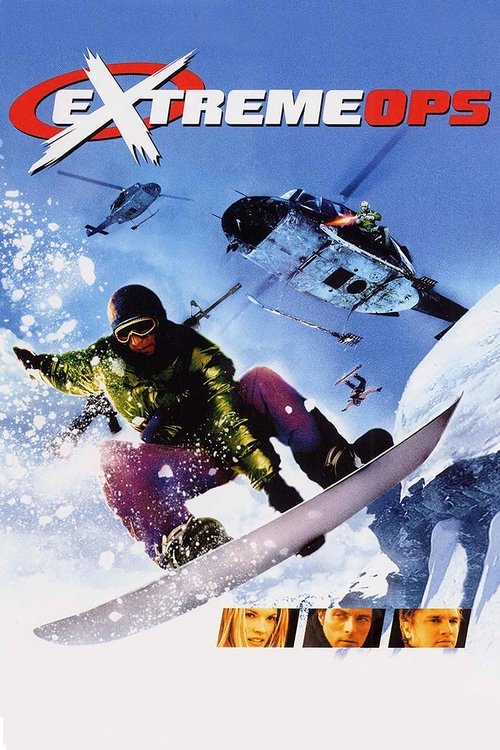
Extreme Ops
While filming an advertisement, some extreme sports enthusiasts unwittingly stop a group of terrorists.
The film commercial failure against its moderate budget of $40.0M, earning $11.0M globally (-73% loss). While initial box office returns were modest, the film has gained appreciation for its bold vision within the action genre.

Plot Structure
Story beats plotted across runtime


Narrative Arc
Emotional journey through the story's key moments
Story Circle
Blueprint 15-beat structure
Arcplot Score Breakdown
Weighted: Precision (70%) + Arc (15%) + Theme (15%)
Extreme Ops (2002) demonstrates precise story structure, characteristic of Christian Duguay's storytelling approach. This structural analysis examines how the film's 15-point plot structure maps to proven narrative frameworks across 1 hour and 33 minutes. With an Arcplot score of 7.6, the film showcases strong structural fundamentals.
Characters
Cast & narrative archetypes

Ian
Chloe
Kittie
Jeffrey
Will
Silo
Pavlov
Main Cast & Characters
Ian
Played by Devon Sawa
Extreme sports cameraman and leader of the film crew who must protect his team from terrorists.
Chloe
Played by Bridgette Wilson-Sampras
Professional extreme skier and the crew's main talent, bringing both skill and determination.
Kittie
Played by Jana Pallaske
Snowboarder and team member who provides technical expertise and courage under pressure.
Jeffrey
Played by Rufus Sewell
The commercial director trying to capture the perfect extreme sports footage in the Austrian Alps.
Will
Played by Cliff Curtis
Extreme sports athlete and crew member who excels at death-defying stunts.
Silo
Played by Joe Absolom
Production assistant and tech expert providing logistical support to the film crew.
Pavlov
Played by Klaus Löwitsch
Serbian war criminal hiding in the mountains who becomes the main antagonist.
Structural Analysis
The Status Quo at 1 minutes (1% through the runtime) establishes Extreme sports crew films dangerous stunts in spectacular mountain locations. They live for adrenaline and pushing boundaries, showcasing their fearless world of professional extreme sports filmmaking.. The analysis reveals that this early placement immediately immerses viewers in the story world.
The inciting incident occurs at 11 minutes when The crew arrives at a remote, closed-for-season ski resort in the Austrian Alps. The isolated location and harsh conditions create immediate challenges, disrupting their plans for a straightforward shoot.. At 12% through the film, this Disruption aligns precisely with traditional story structure. This beat shifts the emotional landscape, launching the protagonist into the central conflict.
The First Threshold at 24 minutes marks the transition into Act II, occurring at 26% of the runtime. This indicates the protagonist's commitment to The crew commits to filming the most dangerous sequence yet - an extreme ski jump combined with aerial stunts. They actively choose to push beyond safe limits to get the perfect shot, fully entering the world of extreme risk., moving from reaction to action.
At 46 minutes, the Midpoint arrives at 49% of the runtime—precisely centered, creating perfect narrative symmetry. Notably, this crucial beat While filming, the crew accidentally witnesses a secret meeting between terrorists plotting an assassination. They capture it on camera without realizing the danger. False victory of getting great footage becomes a false defeat - they're now targets. Stakes raise dramatically., fundamentally raising what's at risk. The emotional intensity shifts, dividing the narrative into clear before-and-after phases.
The Collapse moment at 69 minutes (74% through) represents the emotional nadir. Here, A crew member is killed by the terrorists. The group is separated, communication is cut, and they're trapped on the mountain with no escape. The "whiff of death" is literal - their adventure has turned deadly and they're outmatched., indicates the protagonist at their lowest point. This beat's placement in the final quarter sets up the climactic reversal.
The Second Threshold at 74 minutes initiates the final act resolution at 80% of the runtime. The crew realizes their extreme sports expertise IS their advantage. They synthesize their skills with the terrain knowledge to turn the mountain into their weapon. The same recklessness that got them into danger becomes their salvation., demonstrating the transformation achieved throughout the journey.
Emotional Journey
Extreme Ops's emotional architecture traces a deliberate progression across 15 carefully calibrated beats.
Narrative Framework
This structural analysis employs a 15-point narrative structure framework that maps key story moments. By mapping Extreme Ops against these established plot points, we can identify how Christian Duguay utilizes or subverts traditional narrative conventions. The plot point approach reveals not only adherence to structural principles but also creative choices that distinguish Extreme Ops within the action genre.
Christian Duguay's Structural Approach
Among the 5 Christian Duguay films analyzed on Arcplot, the average structural score is 7.4, reflecting strong command of classical structure. Extreme Ops represents one of the director's most structurally precise works. For comparative analysis, explore the complete Christian Duguay filmography.
Comparative Analysis
Additional action films include The Bad Guys, Puss in Boots and Venom: The Last Dance. For more Christian Duguay analyses, see Screamers, The Art of War and Belle and Sebastian: The Adventure Continues.
Plot Points by Act
Act I
SetupStatus Quo
Extreme sports crew films dangerous stunts in spectacular mountain locations. They live for adrenaline and pushing boundaries, showcasing their fearless world of professional extreme sports filmmaking.
Theme
Discussion about the difference between calculated risk and recklessness. "There's a line between being extreme and being stupid" - establishing the theme of responsibility versus thrill-seeking.
Worldbuilding
Introduction to the extreme sports film crew: director Ian, cameraman Will, athletes Jeffrey and Silo. Establishing their relationships, competitive dynamics, and the high-pressure world of extreme sports advertising. They need to create an epic commercial in the Austrian Alps.
Disruption
The crew arrives at a remote, closed-for-season ski resort in the Austrian Alps. The isolated location and harsh conditions create immediate challenges, disrupting their plans for a straightforward shoot.
Resistance
The team debates their approach to filming in the dangerous conditions. They scout locations, deal with equipment challenges, and navigate interpersonal tensions. Romance develops between crew members while they prepare for increasingly dangerous stunts.
Act II
ConfrontationFirst Threshold
The crew commits to filming the most dangerous sequence yet - an extreme ski jump combined with aerial stunts. They actively choose to push beyond safe limits to get the perfect shot, fully entering the world of extreme risk.
Mirror World
Romantic subplot deepens between crew members, contrasting the theme of calculated risk in relationships versus physical stunts. The developing connection represents trust and vulnerability in a world of adrenaline junkies.
Premise
The promise of the premise: spectacular extreme sports sequences in breathtaking Alpine locations. The crew films increasingly dangerous stunts - snowboarding, skiing, BASE jumping. This is the fun and games of extreme sports filmmaking at its finest.
Midpoint
While filming, the crew accidentally witnesses a secret meeting between terrorists plotting an assassination. They capture it on camera without realizing the danger. False victory of getting great footage becomes a false defeat - they're now targets. Stakes raise dramatically.
Opposition
Terrorists realize they've been filmed and hunt the crew through the mountains. The extreme sports athletes must use their skills to survive rather than perform. Bad guys close in, picking off crew members. The isolation that made filming perfect now traps them.
Collapse
A crew member is killed by the terrorists. The group is separated, communication is cut, and they're trapped on the mountain with no escape. The "whiff of death" is literal - their adventure has turned deadly and they're outmatched.
Crisis
Survivors process the loss and their dire situation. Facing the reality that their extreme sports skills may not be enough against armed terrorists. Dark night as they contemplate surrendering or making a desperate stand.
Act III
ResolutionSecond Threshold
The crew realizes their extreme sports expertise IS their advantage. They synthesize their skills with the terrain knowledge to turn the mountain into their weapon. The same recklessness that got them into danger becomes their salvation.
Synthesis
Finale: The crew uses extreme sports tactics against the terrorists - avalanches, skiing stunts, terrain traps. They transform from victims to hunters, using every trick in their arsenal. Action-packed confrontation combining survival instincts with athletic prowess.
Transformation
Survivors descend the mountain, forever changed. The closing image mirrors the opening but shows growth - they still seek extreme experiences but now understand the true difference between calculated risk and recklessness. They've learned when the stakes are real.