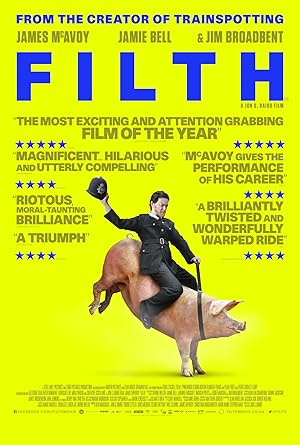
Filth
Scheming Bruce Robertson (James McAvoy), a bigoted and corrupt policeman, is in line for a promotion and will stop at nothing to get what he wants. Enlisted to solve a brutal murder and threatened by the aspirations of his colleagues, including Ray Lennox (Jamie Bell), Bruce sets about ensuring their ruin, right under the nose of unwitting Chief Inspector Toal. As he turns his colleagues against one another by stealing their wives and exposing their secrets, Bruce starts to lose himself in a web of deceit that he can no longer control. His past is slowly catching up with him, and a missing wife, a crippling drug habit and suspicious colleagues start to take their toll on his sanity. The question is: can he keep his grip on reality long enough to disentangle himself from the filth?
Working with a tight budget of $5.0M, the film achieved a steady performer with $9.1M in global revenue (+82% profit margin).
9 wins & 15 nominations


Plot Structure
Story beats plotted across runtime


Narrative Arc
Emotional journey through the story's key moments
Story Circle
Blueprint 15-beat structure
Arcplot Score Breakdown
Weighted: Precision (70%) + Arc (15%) + Theme (15%)
Filth (2013) demonstrates meticulously timed dramatic framework, characteristic of Jon S. Baird's storytelling approach. This structural analysis examines how the film's 15-point plot structure maps to proven narrative frameworks across 1 hour and 37 minutes. With an Arcplot score of 6.8, the film balances conventional beats with creative variation.
Characters
Cast & narrative archetypes

Bruce Robertson
Carole Robertson
Dr. Rossi
Ray Lennox
Mary
Amanda Drummond
Peter Inglis
Main Cast & Characters
Bruce Robertson
Played by James McAvoy
A corrupt, manipulative Detective Sergeant in Edinburgh who spirals into psychological breakdown while investigating a murder and scheming for promotion.
Carole Robertson
Played by Shauna Macdonald
Bruce's estranged wife who left him, appearing in his hallucinations and memories, representing his lost innocence and moral anchor.
Dr. Rossi
Played by Jim Broadbent
Bruce's psychiatrist who tries to help him through therapy sessions, though Bruce manipulates and lies throughout their interactions.
Ray Lennox
Played by Jamie Bell
A fellow detective and colleague who becomes one of Bruce's primary targets for manipulation and sabotage in the promotion race.
Mary
Played by Joanne Froggatt
A school teacher and love interest who represents a potential path to redemption for Bruce, showing him kindness and genuine connection.
Amanda Drummond
Played by Imogen Poots
The wife of Bruce's colleague whom he manipulates and uses for his own gratification and schemes.
Peter Inglis
Played by Emun Elliott
A naive young detective constable whom Bruce befriends and mentors while secretly plotting to use him in his schemes.
Structural Analysis
The Status Quo at 1 minutes (1% through the runtime) establishes Bruce Robertson at a crime scene, establishing him as a crude, manipulative detective who believes he's in control of his world and destined for promotion.. Of particular interest, this early placement immediately immerses viewers in the story world.
The inciting incident occurs at 12 minutes when Bruce is assigned to lead the murder investigation of a Japanese student, which he sees as his ticket to promotion, but the case triggers deeper psychological unraveling.. At 12% through the film, this Disruption aligns precisely with traditional story structure. This beat shifts the emotional landscape, launching the protagonist into the central conflict.
The First Threshold at 25 minutes marks the transition into Act II, occurring at 26% of the runtime. This demonstrates the protagonist's commitment to Bruce fully commits to his destructive path, actively sabotaging the investigation and his colleagues while pursuing the promotion at any cost, choosing manipulation over integrity., moving from reaction to action.
At 49 minutes, the Midpoint arrives at 51% of the runtime—precisely centered, creating perfect narrative symmetry. Of particular interest, this crucial beat Bruce believes he's secured the promotion through his schemes, a false victory that marks the peak of his delusion before everything begins to collapse around him., fundamentally raising what's at risk. The emotional intensity shifts, dividing the narrative into clear before-and-after phases.
The Collapse moment at 73 minutes (76% through) represents the emotional nadir. Here, Bruce learns he didn't get the promotion and his wife is never coming back. The full weight of his self-destruction and the revelation of his childhood abuse crashes down on him., illustrates the protagonist at their lowest point. This beat's placement in the final quarter sets up the climactic reversal.
The Second Threshold at 79 minutes initiates the final act resolution at 82% of the runtime. Bruce achieves devastating clarity about who he really is: the abused has become the abuser. He sees through his own lies and understands his life has been built on self-deception., demonstrating the transformation achieved throughout the journey.
Emotional Journey
Filth's emotional architecture traces a deliberate progression across 15 carefully calibrated beats.
Narrative Framework
This structural analysis employs a 15-point narrative structure framework that maps key story moments. By mapping Filth against these established plot points, we can identify how Jon S. Baird utilizes or subverts traditional narrative conventions. The plot point approach reveals not only adherence to structural principles but also creative choices that distinguish Filth within the action genre.
Jon S. Baird's Structural Approach
Among the 3 Jon S. Baird films analyzed on Arcplot, the average structural score is 7.2, reflecting strong command of classical structure. Filth takes a more unconventional approach compared to the director's typical style. For comparative analysis, explore the complete Jon S. Baird filmography.
Comparative Analysis
Additional action films include The Bad Guys, Puss in Boots and Venom: The Last Dance. For more Jon S. Baird analyses, see Stan & Ollie, Tetris.
Plot Points by Act
Act I
SetupStatus Quo
Bruce Robertson at a crime scene, establishing him as a crude, manipulative detective who believes he's in control of his world and destined for promotion.
Theme
Dr. Rossi asks Bruce about the difference between his public self and private self, introducing the film's central theme of fractured identity and self-deception.
Worldbuilding
Introduction to Bruce's toxic workplace dynamics, his schemes to undermine colleagues for promotion, substance abuse, sexual misconduct, and racist behavior. His hallucinations begin to surface.
Disruption
Bruce is assigned to lead the murder investigation of a Japanese student, which he sees as his ticket to promotion, but the case triggers deeper psychological unraveling.
Resistance
Bruce manipulates the investigation while escalating his schemes against colleagues. His therapy sessions with Dr. Rossi intensify, and his hallucinations of his estranged wife worsen.
Act II
ConfrontationFirst Threshold
Bruce fully commits to his destructive path, actively sabotaging the investigation and his colleagues while pursuing the promotion at any cost, choosing manipulation over integrity.
Mirror World
Bruce's interactions with Mary, his best friend's wife, represent a potential path to genuine human connection and redemption that he both craves and sabotages.
Premise
Bruce descends deeper into depravity: elaborate pranks, sexual exploitation, drug-fueled chaos, and increasingly severe hallucinations, all while the investigation stalls and his grip on reality weakens.
Midpoint
Bruce believes he's secured the promotion through his schemes, a false victory that marks the peak of his delusion before everything begins to collapse around him.
Opposition
Bruce's schemes backfire spectacularly: colleagues discover his manipulations, the investigation crumbles, his hallucinations become violent and uncontrollable, and his past trauma surfaces brutally.
Collapse
Bruce learns he didn't get the promotion and his wife is never coming back. The full weight of his self-destruction and the revelation of his childhood abuse crashes down on him.
Crisis
Bruce spirals into complete psychological breakdown. His hallucinations consume him, revealing the tapeworm as a manifestation of his self-hatred and the abuse that shaped him.
Act III
ResolutionSecond Threshold
Bruce achieves devastating clarity about who he really is: the abused has become the abuser. He sees through his own lies and understands his life has been built on self-deception.
Synthesis
Bruce makes his final choices: confesses his crimes, reaches out to those he's hurt, and prepares for his end, executing his plan with the same methodical nature he used for destruction.
Transformation
Bruce takes his own life, dressed in his wife's clothes, achieving a tragic transformation: from complete self-deception to absolute self-awareness, paying the ultimate price for his clarity.