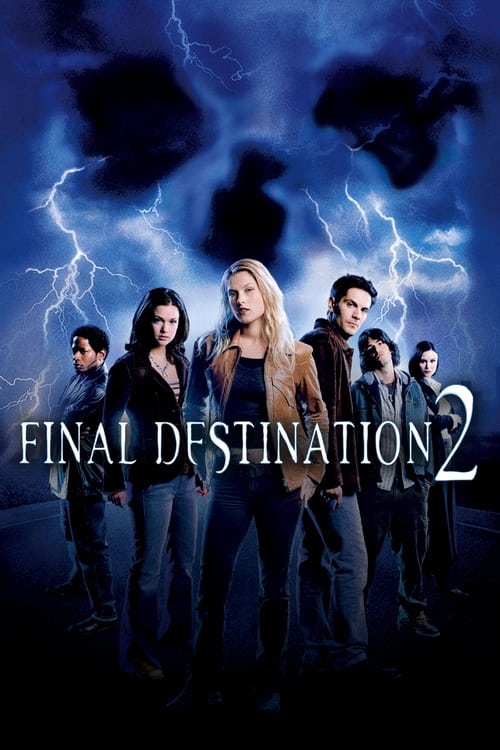
Final Destination 2
When Kimberly has a violent premonition of a highway pileup she blocks the freeway, keeping a few others meant to die, safe...Or are they? The survivors mysteriously start dying and it's up to Kimberly to stop it before she's next.
Despite a mid-range budget of $26.0M, Final Destination 2 became a box office success, earning $90.9M worldwide—a 250% return.













Plot Structure
Story beats plotted across runtime


Narrative Arc
Emotional journey through the story's key moments
Story Circle
Blueprint 15-beat structure
Arcplot Score Breakdown
Weighted: Precision (70%) + Arc (15%) + Theme (15%)
Final Destination 2 (2003) exemplifies carefully calibrated plot construction, characteristic of David R. Ellis's storytelling approach. This structural analysis examines how the film's 15-point plot structure maps to proven narrative frameworks across 1 hour and 30 minutes. With an Arcplot score of 7.1, the film balances conventional beats with creative variation.
Characters
Cast & narrative archetypes

Kimberly Corman
Thomas Burke
Clear Rivers
Eugene Dix
Rory Peters
Kat Jennings
Nora Carpenter
Tim Carpenter
Main Cast & Characters
Kimberly Corman
Played by A.J. Cook
Young woman who has a premonition of a highway pile-up and saves several people from death, then struggles to prevent Death's design.
Thomas Burke
Played by Michael Landes
State trooper who becomes Kimberly's ally in trying to prevent the survivors from dying.
Clear Rivers
Played by Ali Larter
Survivor from the first film, institutionalized by choice to avoid Death, who helps the new survivors understand the rules.
Eugene Dix
Played by T.C. Carson
High school teacher and survivor who is initially skeptical but becomes consumed by researching Death's design.
Rory Peters
Played by Jonathan Cherry
Lottery winner and survivor who is reckless and dismissive of the death warnings.
Kat Jennings
Played by Keegan Connor Tracy
Materialistic woman obsessed with cosmetic surgery who survives the highway accident.
Nora Carpenter
Played by Lynda Boyd
Single mother traveling with her son Tim who becomes a survivor of the pile-up.
Tim Carpenter
Played by James Kirk
Nora's teenage son who survives the highway accident and struggles with the aftermath.
Structural Analysis
The Status Quo at 1 minutes (1% through the runtime) establishes Kimberly Corman packs for a road trip with friends, an ordinary college student heading out for spring break, unaware her life is about to change forever.. The analysis reveals that this early placement immediately immerses viewers in the story world.
The inciting incident occurs at 10 minutes when Kimberly has a horrific premonition of a massive pile-up on Route 23 that kills everyone including herself, jolting awake before entering the highway and blocking traffic.. At 11% through the film, this Disruption aligns precisely with traditional story structure. This beat shifts the emotional landscape, launching the protagonist into the central conflict.
The First Threshold at 22 minutes marks the transition into Act II, occurring at 25% of the runtime. This reveals the protagonist's commitment to Evan Lewis dies in a spectacular apartment accident - proving that death is coming for the survivors. Kimberly realizes they must actively fight to stay alive and seeks out Clear Rivers for help., moving from reaction to action.
At 46 minutes, the Midpoint arrives at 51% of the runtime—precisely centered, creating perfect narrative symmetry. The analysis reveals that this crucial beat Kat dies in a brutal car accident despite their efforts to save her. The survivors realize saving each other isn't working - death is adapting. Bludworth reveals "new life" might defeat death, raising stakes and changing their strategy., fundamentally raising what's at risk. The emotional intensity shifts, dividing the narrative into clear before-and-after phases.
The Collapse moment at 68 minutes (75% through) represents the emotional nadir. Here, Clear Rivers sacrifices herself in a hospital explosion trying to save Eugene, dying in flames. Kimberly loses her guide and partner, facing the final confrontation alone. Death seems unstoppable., demonstrates the protagonist at their lowest point. This beat's placement in the final quarter sets up the climactic reversal.
The Second Threshold at 73 minutes initiates the final act resolution at 81% of the runtime. Kimberly realizes she was never supposed to survive - she died in the lake in her vision. The truth clicks: Isabella's baby already happened, but Kimberly herself is the "new life" needed because she must die and be revived., demonstrating the transformation achieved throughout the journey.
Emotional Journey
Final Destination 2's emotional architecture traces a deliberate progression across 15 carefully calibrated beats.
Narrative Framework
This structural analysis employs a 15-point narrative structure framework that maps key story moments. By mapping Final Destination 2 against these established plot points, we can identify how David R. Ellis utilizes or subverts traditional narrative conventions. The plot point approach reveals not only adherence to structural principles but also creative choices that distinguish Final Destination 2 within the horror genre.
David R. Ellis's Structural Approach
Among the 6 David R. Ellis films analyzed on Arcplot, the average structural score is 7.2, reflecting strong command of classical structure. Final Destination 2 takes a more unconventional approach compared to the director's typical style. For comparative analysis, explore the complete David R. Ellis filmography.
Comparative Analysis
Additional horror films include Thinner, A Nightmare on Elm Street and Mary Reilly. For more David R. Ellis analyses, see Homeward Bound II: Lost in San Francisco, Shark Night 3D and The Final Destination.
Plot Points by Act
Act I
SetupStatus Quo
Kimberly Corman packs for a road trip with friends, an ordinary college student heading out for spring break, unaware her life is about to change forever.
Theme
Kimberly's father warns her to drive safely and says "Death doesn't like to be cheated" - referencing Flight 180, establishing the film's central theme that death has a design.
Worldbuilding
Introduction to multiple characters converging on Route 23: Kimberly and friends, the Gibbons family, Evan the lottery winner, Tim and Nora in their SUV, Kat the businesswoman, and others - ordinary people on an ordinary day.
Disruption
Kimberly has a horrific premonition of a massive pile-up on Route 23 that kills everyone including herself, jolting awake before entering the highway and blocking traffic.
Resistance
The survivors are detained by police and questioned. Kimberly struggles to convince them her vision was real. Clear Rivers is contacted - the sole survivor of Flight 180 who understands death's design. The pile-up occurs exactly as Kimberly predicted.
Act II
ConfrontationFirst Threshold
Evan Lewis dies in a spectacular apartment accident - proving that death is coming for the survivors. Kimberly realizes they must actively fight to stay alive and seeks out Clear Rivers for help.
Mirror World
Clear Rivers, institutionalized after Flight 180, explains the rules of death's design to Kimberly. Their partnership represents the thematic heart: experience vs. innocence, both fighting the inevitable.
Premise
The "fun and games" of cheating death: the survivors try to figure out the order and prevent deaths. Tim dies at the dentist, Nora is killed by elevator. Kimberly and Clear race against time, visiting William Bludworth for clues about breaking the chain.
Midpoint
Kat dies in a brutal car accident despite their efforts to save her. The survivors realize saving each other isn't working - death is adapting. Bludworth reveals "new life" might defeat death, raising stakes and changing their strategy.
Opposition
The survivors splinter under pressure. Eugene nearly dies but is saved by Rory, who then dies himself. Kimberly realizes Isabella's baby might be the "new life" that can break the chain. Clear researches patterns while deaths mount.
Collapse
Clear Rivers sacrifices herself in a hospital explosion trying to save Eugene, dying in flames. Kimberly loses her guide and partner, facing the final confrontation alone. Death seems unstoppable.
Crisis
Kimberly races to save Isabella and her baby, who represent the only hope left. She grapples with grief over Clear's death and the weight of responsibility for the remaining survivors.
Act III
ResolutionSecond Threshold
Kimberly realizes she was never supposed to survive - she died in the lake in her vision. The truth clicks: Isabella's baby already happened, but Kimberly herself is the "new life" needed because she must die and be revived.
Synthesis
Kimberly deliberately drowns herself in a lake. Thomas Burke revives her through CPR. As "new life," she breaks death's chain. The survivors are finally safe, having beaten death's design through sacrifice and rebirth.
Transformation
Brian Gibbons dies in a barbecue explosion - revealing the chain isn't broken after all. Death has simply moved to those who were saved before the premonition. The design continues, infinite and inescapable.