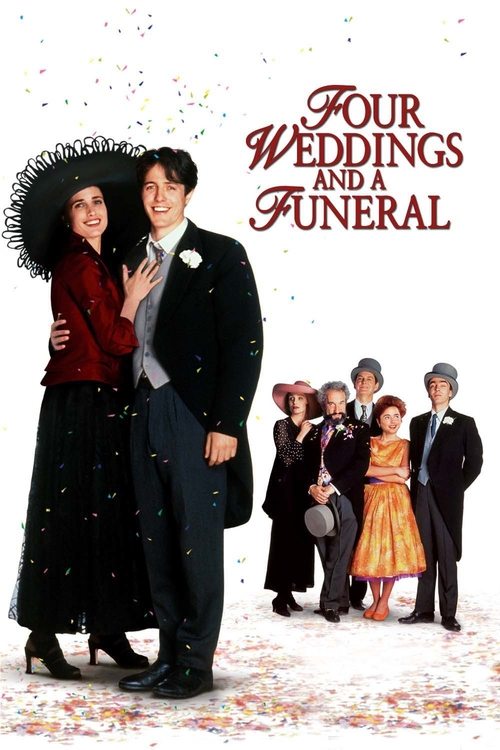
Four Weddings and a Funeral
Over the course of five social occasions, a committed bachelor must consider the notion that he may have discovered love.
Despite its limited budget of $4.4M, Four Weddings and a Funeral became a massive hit, earning $245.7M worldwide—a remarkable 5484% return. The film's unique voice connected with viewers, demonstrating that strong storytelling can transcend budget limitations.
Nominated for 2 Oscars. 24 wins & 27 nominations


Plot Structure
Story beats plotted across runtime


Narrative Arc
Emotional journey through the story's key moments
Story Circle
Blueprint 15-beat structure
Arcplot Score Breakdown
Weighted: Precision (70%) + Arc (15%) + Theme (15%)
Four Weddings and a Funeral (1994) reveals meticulously timed plot construction, characteristic of Mike Newell's storytelling approach. This structural analysis examines how the film's 15-point plot structure maps to proven narrative frameworks across 1 hour and 57 minutes. With an Arcplot score of 7.1, the film balances conventional beats with creative variation.
Characters
Cast & narrative archetypes

Charles
Carrie
Fiona
Tom
Gareth
Matthew
Scarlett
Main Cast & Characters
Charles
Played by Hugh Grant
A charming but commitment-phobic British bachelor who perpetually attends weddings but avoids marriage himself.
Carrie
Played by Andie MacDowell
A beautiful American woman who captivates Charles, appearing and disappearing through his life at various weddings.
Fiona
Played by Kristin Scott Thomas
Charles's close friend and confidante, secretly harboring unrequited feelings for him.
Tom
Played by James Fleet
Charles's deaf brother and best friend, offering wisdom and emotional support throughout.
Gareth
Played by Simon Callow
The life of the party, a flamboyant and jovial friend whose sudden death shakes the group.
Matthew
Played by John Hannah
Gareth's devoted partner who delivers a moving eulogy at his funeral.
Scarlett
Played by Charlotte Coleman
Charles's eccentric and outspoken friend, known for her unconventional behavior and loud opinions.
Structural Analysis
The Status Quo at 1 minutes (1% through the runtime) establishes Charles wakes up late, racing frantically to a wedding with his group of perpetually single friends. Establishes him as charming but commitment-phobic, surrounded by marriage yet unable to commit himself.. Notably, this early placement immediately immerses viewers in the story world.
The inciting incident occurs at 13 minutes when Charles meets Carrie at the wedding. Instant chemistry leads to a magical night together. She represents everything he didn't know he wanted—spontaneous, honest, and unafraid of intimacy.. At 11% through the film, this Disruption aligns precisely with traditional story structure. This beat shifts the emotional landscape, launching the protagonist into the central conflict.
The First Threshold at 29 minutes marks the transition into Act II, occurring at 25% of the runtime. This illustrates the protagonist's commitment to At the second wedding, Charles discovers Carrie has returned to England. He chooses to actively pursue a relationship with her rather than letting her slip away. This marks his entry into emotional vulnerability., moving from reaction to action.
At 57 minutes, the Midpoint arrives at 49% of the runtime—precisely centered, creating perfect narrative symmetry. Of particular interest, this crucial beat At the third wedding, Charles is about to confess his love to Carrie when she introduces him to her fiancé, Hamish. False defeat: the woman he loves is marrying someone else. The stakes are raised—he's waited too long., fundamentally raising what's at risk. The emotional intensity shifts, dividing the narrative into clear before-and-after phases.
The Collapse moment at 86 minutes (74% through) represents the emotional nadir. Here, At Carrie's wedding (the fourth wedding), Gareth suddenly dies during the reception. Literal death—the "whiff of death" moment. Charles's mentor figure, the one who championed love despite cynicism, is gone. Everything feels futile., shows the protagonist at their lowest point. This beat's placement in the final quarter sets up the climactic reversal.
The Second Threshold at 94 minutes initiates the final act resolution at 81% of the runtime. Carrie appears at Charles's door in the rain, confessing she's left Hamish and still loves Charles. New information: she wants him too. Charles now understands what he learned from Gareth—love requires courage, not just convention. He must choose truth over safety., demonstrating the transformation achieved throughout the journey.
Emotional Journey
Four Weddings and a Funeral's emotional architecture traces a deliberate progression across 15 carefully calibrated beats.
Narrative Framework
This structural analysis employs structural analysis methodology used to understand storytelling architecture. By mapping Four Weddings and a Funeral against these established plot points, we can identify how Mike Newell utilizes or subverts traditional narrative conventions. The plot point approach reveals not only adherence to structural principles but also creative choices that distinguish Four Weddings and a Funeral within the comedy genre.
Mike Newell's Structural Approach
Among the 11 Mike Newell films analyzed on Arcplot, the average structural score is 6.9, demonstrating varied approaches to story architecture. Four Weddings and a Funeral represents one of the director's most structurally precise works. For comparative analysis, explore the complete Mike Newell filmography.
Comparative Analysis
Additional comedy films include The Bad Guys, Ella Enchanted and The Evening Star. For more Mike Newell analyses, see Prince of Persia: The Sands of Time, Mona Lisa Smile and The Guernsey Literary & Potato Peel Pie Society.
Plot Points by Act
Act I
SetupStatus Quo
Charles wakes up late, racing frantically to a wedding with his group of perpetually single friends. Establishes him as charming but commitment-phobic, surrounded by marriage yet unable to commit himself.
Theme
At the first wedding reception, Gareth pronounces: "Marriage is just a way of getting out of an embarrassing pause in conversation." The film's central question: Is marriage meaningful commitment or social performance?
Worldbuilding
Introduction to Charles's world: his close-knit group of friends (Scarlett, Tom, Fiona, Gareth, Matthew), his brother David, and their cynical views on marriage. Establishes the pattern of attending weddings while remaining romantically adrift.
Disruption
Charles meets Carrie at the wedding. Instant chemistry leads to a magical night together. She represents everything he didn't know he wanted—spontaneous, honest, and unafraid of intimacy.
Resistance
Charles is smitten but hesitant. The morning after their encounter, Carrie leaves for America. Charles debates whether to pursue her or retreat to his safe, commitment-free existence. His friends encourage him, but he remains paralyzed by fear.
Act II
ConfrontationFirst Threshold
At the second wedding, Charles discovers Carrie has returned to England. He chooses to actively pursue a relationship with her rather than letting her slip away. This marks his entry into emotional vulnerability.
Mirror World
Carrie and Charles share intimate confessions about their romantic histories (she's had 33 partners, he's had fewer). She represents the thematic counterpoint—someone who's experienced love fully without cynicism, showing him what honest connection looks like.
Premise
The "promise of the premise"—romantic near-misses and comic misunderstandings across multiple weddings. Charles grows closer to Carrie while navigating his friends' relationships and his own emotional cowardice. The fun of watching commitment-phobes attend endless weddings.
Midpoint
At the third wedding, Charles is about to confess his love to Carrie when she introduces him to her fiancé, Hamish. False defeat: the woman he loves is marrying someone else. The stakes are raised—he's waited too long.
Opposition
Charles spirals as Carrie's wedding approaches. His flaws catch up with him—his inability to commit, his passivity. Meanwhile, his friends push him to act. Tension builds as he accepts a proposal from Henrietta (Duckface) out of resignation, not love.
Collapse
At Carrie's wedding (the fourth wedding), Gareth suddenly dies during the reception. Literal death—the "whiff of death" moment. Charles's mentor figure, the one who championed love despite cynicism, is gone. Everything feels futile.
Crisis
The funeral. Matthew's eulogy for Gareth reveals the depth of their love—a committed relationship that existed without marriage's validation. Charles processes loss and realizes what truly matters isn't the institution but the courage to love authentically.
Act III
ResolutionSecond Threshold
Carrie appears at Charles's door in the rain, confessing she's left Hamish and still loves Charles. New information: she wants him too. Charles now understands what he learned from Gareth—love requires courage, not just convention. He must choose truth over safety.
Synthesis
Charles's own wedding to Henrietta. At the altar, he finally finds his voice and admits he loves someone else. He stops the wedding, faces the consequences, and pursues Carrie. He combines his old charm with newfound honesty and courage.
Transformation
Months later, at the fifth wedding (his friends'), Charles and Carrie are together—committed but unmarried. The closing image mirrors the opening: another wedding, but Charles is transformed. He's chosen love without needing marriage to validate it, answering the film's thematic question.