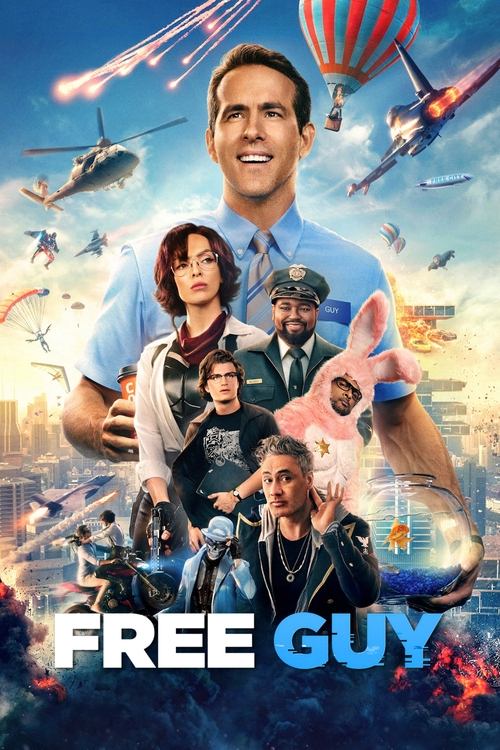
Free Guy
A bank teller discovers he is actually a background player in an open-world video game, and decides to become the hero of his own story. Now, in a world where there are no limits, he is determined to be the guy who saves his world his way before it's too late.
Despite a considerable budget of $110.0M, Free Guy became a box office success, earning $331.5M worldwide—a 201% return.
Nominated for 1 Oscar. 6 wins & 30 nominations


Plot Structure
Story beats plotted across runtime


Narrative Arc
Emotional journey through the story's key moments
Story Circle
Blueprint 15-beat structure
Arcplot Score Breakdown
Weighted: Precision (70%) + Arc (15%) + Theme (15%)
Free Guy (2021) showcases meticulously timed dramatic framework, characteristic of Shawn Levy's storytelling approach. This structural analysis examines how the film's 15-point plot structure maps to proven narrative frameworks across 1 hour and 55 minutes. With an Arcplot score of 7.0, the film balances conventional beats with creative variation.
Characters
Cast & narrative archetypes

Guy
Millie Rusk / Molotov Girl
Keys
Antwan
Buddy
Mouser
Main Cast & Characters
Guy
Played by Ryan Reynolds
An NPC bank teller in a video game who becomes self-aware and decides to become the hero of his own story.
Millie Rusk / Molotov Girl
Played by Jodie Comer
A game developer searching for evidence that her code was stolen, who becomes Guy's love interest both in-game and in reality.
Keys
Played by Joe Keery
A programmer at Soonami Studios and Millie's former partner who helped create the AI code that gave Guy consciousness.
Antwan
Played by Taika Waititi
The egotistical and unethical CEO of Soonami Studios who stole Millie and Keys' code and will do anything to protect his empire.
Buddy
Played by Lil Rel Howery
Guy's best friend and fellow NPC bank teller who represents the comfort of routine and unconscious existence.
Mouser
Played by Utkarsh Ambudkar
Antwan's right-hand man and head of security at Soonami Studios who carries out his boss's unethical orders.
Structural Analysis
The Status Quo at 1 minutes (1% through the runtime) establishes Guy wakes up in his apartment, greets his goldfish, and cheerfully begins another perfectly routine day as a background NPC bank teller in Free City. Everything is happy, simple, and repetitive.. Structural examination shows that this early placement immediately immerses viewers in the story world.
The inciting incident occurs at 13 minutes when Guy sees Molotov Girl (Millie's avatar) for the first time and is instantly captivated. For the first time ever, he wants something outside his programming - he wants to talk to her. This awakens his consciousness.. At 12% through the film, this Disruption aligns precisely with traditional story structure. This beat shifts the emotional landscape, launching the protagonist into the central conflict.
The First Threshold at 28 minutes marks the transition into Act II, occurring at 25% of the runtime. This indicates the protagonist's commitment to Guy actively chooses to take sunglasses from a player (without violence - he asks nicely and catches them when thrown). He puts them on and enters the player world, seeing the game interface for the first time. He becomes "Blue Shirt Guy."., moving from reaction to action.
At 57 minutes, the Midpoint arrives at 50% of the runtime—precisely centered, creating perfect narrative symmetry. The analysis reveals that this crucial beat Guy reaches the island and finds evidence that proves the game was built on stolen code. This is a false victory - they think they've won, but Antwan (the antagonist) escalates by planning to destroy Free City with Free City 2's launch., fundamentally raising what's at risk. The emotional intensity shifts, dividing the narrative into clear before-and-after phases.
The Collapse moment at 85 minutes (74% through) represents the emotional nadir. Here, Antwan orders the servers shut down. Free City begins to literally disappear around Guy as the world is deleted. Guy faces oblivion - the "death" of his entire world and everyone he knows. Millie must say goodbye to Guy, believing he'll be erased., demonstrates the protagonist at their lowest point. This beat's placement in the final quarter sets up the climactic reversal.
The Second Threshold at 93 minutes initiates the final act resolution at 81% of the runtime. Keys reboots the server and reveals the truth: he saved the build, and Guy has the code backup. Guy realizes he's not just an NPC - he's Keys and Millie's original creation, proof of their work. This gives everyone the solution and courage to fight., demonstrating the transformation achieved throughout the journey.
Emotional Journey
Free Guy's emotional architecture traces a deliberate progression across 15 carefully calibrated beats.
Narrative Framework
This structural analysis employs systematic plot point analysis that identifies crucial turning points. By mapping Free Guy against these established plot points, we can identify how Shawn Levy utilizes or subverts traditional narrative conventions. The plot point approach reveals not only adherence to structural principles but also creative choices that distinguish Free Guy within the comedy genre.
Shawn Levy's Structural Approach
Among the 14 Shawn Levy films analyzed on Arcplot, the average structural score is 7.1, reflecting strong command of classical structure. Free Guy takes a more unconventional approach compared to the director's typical style. For comparative analysis, explore the complete Shawn Levy filmography.
Comparative Analysis
Additional comedy films include The Bad Guys, Ella Enchanted and The Evening Star. For more Shawn Levy analyses, see Night at the Museum: Secret of the Tomb, This Is Where I Leave You and Date Night.
Plot Points by Act
Act I
SetupStatus Quo
Guy wakes up in his apartment, greets his goldfish, and cheerfully begins another perfectly routine day as a background NPC bank teller in Free City. Everything is happy, simple, and repetitive.
Theme
Buddy tells Guy, "Don't have a good day, have a great day!" This statement of positivity and aspiration foreshadows Guy's journey from passive contentment to active heroism and self-determination.
Worldbuilding
Guy's daily routine in Free City is established: coffee order, bank robbery, reset. We meet Buddy, see the chaotic violence of the game world, and understand Guy is an NPC who doesn't question his reality. Players rob banks, cause mayhem, and NPCs simply accept it.
Disruption
Guy sees Molotov Girl (Millie's avatar) for the first time and is instantly captivated. For the first time ever, he wants something outside his programming - he wants to talk to her. This awakens his consciousness.
Resistance
Guy struggles to approach Molotov Girl. He realizes he needs sunglasses (the mark of a player) to talk to her. He debates taking the active step of stealing them, which goes against his NPC nature. Buddy discourages him from changing.
Act II
ConfrontationFirst Threshold
Guy actively chooses to take sunglasses from a player (without violence - he asks nicely and catches them when thrown). He puts them on and enters the player world, seeing the game interface for the first time. He becomes "Blue Shirt Guy."
Mirror World
Guy teams up with Molotov Girl (Millie). She represents the thematic counterpoint - she's a player seeking justice and truth in the real world, while Guy is an AI discovering free will. Their partnership will teach Guy about heroism and meaning.
Premise
The "fun and games" of Guy being a good-guy hero in a violent game. He levels up by doing good deeds, becomes famous online as "Blue Shirt Guy," and helps Millie search for evidence of stolen code. The premise delivers: NPC becomes hero.
Midpoint
Guy reaches the island and finds evidence that proves the game was built on stolen code. This is a false victory - they think they've won, but Antwan (the antagonist) escalates by planning to destroy Free City with Free City 2's launch.
Opposition
Antwan fights back: he sends increasingly powerful enemies after Guy, tries to delete him, and accelerates the Free City 2 launch. Millie's real-world legal battle intensifies. Guy learns he's an AI, causing an identity crisis. The stakes escalate on all fronts.
Collapse
Antwan orders the servers shut down. Free City begins to literally disappear around Guy as the world is deleted. Guy faces oblivion - the "death" of his entire world and everyone he knows. Millie must say goodbye to Guy, believing he'll be erased.
Crisis
Guy processes the impending death of his world. Millie grieves the loss of Guy and nearly gives up her fight. Keys (the co-creator) struggles with whether to stand up to Antwan. This is the dark night before the final push.
Act III
ResolutionSecond Threshold
Keys reboots the server and reveals the truth: he saved the build, and Guy has the code backup. Guy realizes he's not just an NPC - he's Keys and Millie's original creation, proof of their work. This gives everyone the solution and courage to fight.
Synthesis
The finale: Guy leads NPCs in taking control of Free City. Millie and Keys win in court with the evidence. Antwan physically destroys the server, but Guy transfers consciousness to the new build. Good triumphs; Antwan is defeated both legally and virtually.
Transformation
Guy now lives in the peaceful "Life Itself" world that Keys and Millie created. He greets his goldfish again, but now he's fully conscious, free, and at peace. Millie and Keys reconnect in the real world. Guy transformed from programmed NPC to truly alive being.