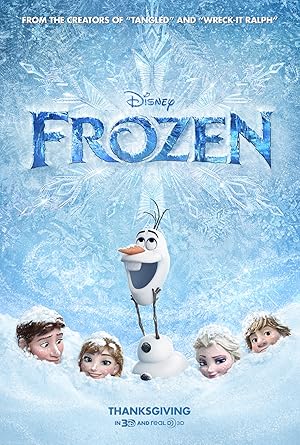
Frozen
Fearless optimist Anna teams up with rugged mountain man Kristoff and his loyal reindeer Sven and sets off on an epic journey to find her sister Elsa, whose icy powers have trapped the kingdom of Arendelle in eternal winter. Encountering Everest-like conditions, mystical trolls and a hilarious snowman named Olaf, Anna and Kristoff battle the elements in a race to save the kingdom. From the outside Elsa looks poised, regal and reserved, but in reality she lives in fear as she wrestles with a mighty secret: she was born with the power to create ice and snow. It's a beautiful ability, but also extremely dangerous. Haunted by the moment her magic nearly killed her younger sister Anna, Elsa has isolated herself, spending every waking minute trying to suppress her growing powers. Her mounting emotions trigger the magic, accidentally setting off an eternal winter that she can't stop. She fears she's becoming a monster and that no one, not even her sister, can help her.
Despite a major studio investment of $150.0M, Frozen became a box office phenomenon, earning $1274.2M worldwide—a remarkable 749% return. This commercial performance validated the ambitious narrative scope, confirming that audiences embrace distinctive approach even at blockbuster scale.
2 Oscars. 83 wins & 60 nominations


Plot Structure
Story beats plotted across runtime


Narrative Arc
Emotional journey through the story's key moments
Story Circle
Blueprint 15-beat structure
Arcplot Score Breakdown
Weighted: Precision (70%) + Arc (15%) + Theme (15%)
Frozen (2013) exemplifies carefully calibrated dramatic framework, characteristic of Jennifer Lee's storytelling approach. This structural analysis examines how the film's 15-point plot structure maps to proven narrative frameworks across 1 hour and 42 minutes. With an Arcplot score of 7.6, the film showcases strong structural fundamentals.
Characters
Cast & narrative archetypes

Elsa
Anna
Kristoff
Olaf
Hans
Main Cast & Characters
Elsa
Played by Idina Menzel
Queen of Arendelle with ice powers she struggles to control, isolates herself to protect others from her dangerous magic.
Anna
Played by Kristen Bell
Optimistic and fearless princess who embarks on a journey to save her sister and kingdom from eternal winter.
Kristoff
Played by Jonathan Groff
Rugged ice harvester raised by trolls who helps Anna on her quest and provides grounded, practical support.
Olaf
Played by Josh Gad
Innocent and cheerful snowman brought to life by Elsa's magic who dreams of experiencing summer.
Hans
Played by Santino Fontana
Charming prince from the Southern Isles who initially appears to be Anna's true love but reveals darker ambitions.
Structural Analysis
The Status Quo at 1 minutes (1% through the runtime) establishes Young Elsa and Anna play together joyfully using Elsa's ice magic, demonstrating their close sisterly bond. The kingdom of Arendelle is peaceful, and the girls are inseparable.. Significantly, this early placement immediately immerses viewers in the story world.
The inciting incident occurs at 12 minutes when The castle gates open for Elsa's coronation day, ending years of isolation. Anna sings "For the First Time in Forever," excited to meet people and potentially find romance. The disruption is the opening of the gates and the social world.. At 11% through the film, this Disruption aligns precisely with traditional story structure. This beat shifts the emotional landscape, launching the protagonist into the central conflict.
The First Threshold at 26 minutes marks the transition into Act II, occurring at 26% of the runtime. This shows the protagonist's commitment to Elsa's ice powers are publicly revealed during the confrontation with Anna. In fear and shame, Elsa flees Arendelle, accidentally freezing the entire kingdom in eternal winter as she runs. She crosses the fjord and heads into the mountains, choosing exile., moving from reaction to action.
At 49 minutes, the Midpoint arrives at 48% of the runtime—precisely centered, creating perfect narrative symmetry. Notably, this crucial beat Elsa accidentally strikes Anna in the heart with her ice magic during their argument. Elsa creates the giant snow monster Marshmallow to force them out. This is a false defeat - Anna thinks she just needs to get warm, but she's actually dying. The stakes dramatically raise., fundamentally raising what's at risk. The emotional intensity shifts, dividing the narrative into clear before-and-after phases.
The Collapse moment at 76 minutes (74% through) represents the emotional nadir. Here, Hans extinguishes all flames in the room and leaves Anna locked inside to freeze to death. He tells the dignitaries that Anna is dead (a lie) and that Elsa must be executed for treason. Anna is alone, freezing, and dying. Her dream of true love has died., shows the protagonist at their lowest point. This beat's placement in the final quarter sets up the climactic reversal.
The Second Threshold at 83 minutes initiates the final act resolution at 81% of the runtime. Anna sees Elsa in danger across the fjord as Hans raises his sword to kill her. In her final moment of life, Anna chooses to sacrifice herself to save Elsa instead of saving herself by kissing Kristoff. This decision synthesizes the film's theme: choosing familial love over romantic love., demonstrating the transformation achieved throughout the journey.
Emotional Journey
Frozen's emotional architecture traces a deliberate progression across 15 carefully calibrated beats.
Narrative Framework
This structural analysis employs a 15-point narrative structure framework that maps key story moments. By mapping Frozen against these established plot points, we can identify how Jennifer Lee utilizes or subverts traditional narrative conventions. The plot point approach reveals not only adherence to structural principles but also creative choices that distinguish Frozen within the animation genre.
Jennifer Lee's Structural Approach
Among the 2 Jennifer Lee films analyzed on Arcplot, the average structural score is 7.3, reflecting strong command of classical structure. Frozen represents one of the director's most structurally precise works. For comparative analysis, explore the complete Jennifer Lee filmography.
Comparative Analysis
Additional animation films include The Bad Guys, Puss in Boots and Violet Evergarden: Eternity and the Auto Memory Doll. For more Jennifer Lee analyses, see Frozen II.
Plot Points by Act
Act I
SetupStatus Quo
Young Elsa and Anna play together joyfully using Elsa's ice magic, demonstrating their close sisterly bond. The kingdom of Arendelle is peaceful, and the girls are inseparable.
Theme
The troll Grand Pabbie warns: "Fear will be your enemy." This establishes the film's central theme about how fear and isolation damage relationships, while love and acceptance heal.
Worldbuilding
After Elsa accidentally hurts Anna with her powers, their parents isolate Elsa. The castle gates close, Elsa wears gloves to suppress her magic, and the sisters grow apart. Years pass, parents die at sea, and Elsa prepares for coronation day while hiding her powers.
Disruption
The castle gates open for Elsa's coronation day, ending years of isolation. Anna sings "For the First Time in Forever," excited to meet people and potentially find romance. The disruption is the opening of the gates and the social world.
Resistance
Anna meets Hans and they share an instant connection, falling in love in one evening. Elsa struggles to maintain control during the coronation ceremony. When Anna announces her engagement to Hans, Elsa refuses to bless it, leading to an argument. Elsa's emotions spike and she can no longer control her powers.
Act II
ConfrontationFirst Threshold
Elsa's ice powers are publicly revealed during the confrontation with Anna. In fear and shame, Elsa flees Arendelle, accidentally freezing the entire kingdom in eternal winter as she runs. She crosses the fjord and heads into the mountains, choosing exile.
Mirror World
Anna meets Kristoff and his reindeer Sven at Oaken's trading post. Kristoff represents authenticity and honesty (contrasting Hans), and their relationship will teach Anna about true love versus infatuation. Anna purchases supplies and hires Kristoff to guide her up the North Mountain.
Premise
Elsa builds her ice palace and sings "Let It Go," embracing her powers for the first time. Anna and Kristoff journey through the winter landscape, encountering wolves and being saved by Sven. They meet Olaf, the magical snowman. Anna reaches Elsa's palace and tries to convince her to return, but Elsa refuses out of fear.
Midpoint
Elsa accidentally strikes Anna in the heart with her ice magic during their argument. Elsa creates the giant snow monster Marshmallow to force them out. This is a false defeat - Anna thinks she just needs to get warm, but she's actually dying. The stakes dramatically raise.
Opposition
Kristoff notices Anna's hair turning white and takes her to the trolls. Grand Pabbie reveals only "an act of true love" can save her. They rush back to Arendelle for Hans' kiss. Meanwhile, Hans and his men reach Elsa's palace; she fights to defend herself but is captured. Anna reaches Hans, but he reveals his villainous plot and abandons her to die.
Collapse
Hans extinguishes all flames in the room and leaves Anna locked inside to freeze to death. He tells the dignitaries that Anna is dead (a lie) and that Elsa must be executed for treason. Anna is alone, freezing, and dying. Her dream of true love has died.
Crisis
Anna is saved by Olaf, who lights a fire and helps her understand that Kristoff truly loves her. Elsa, imprisoned and believing Anna is dead (Hans' lie), breaks free in anguish, escaping into the blizzard. Anna realizes she needs to reach Kristoff for the kiss that will save her.
Act III
ResolutionSecond Threshold
Anna sees Elsa in danger across the fjord as Hans raises his sword to kill her. In her final moment of life, Anna chooses to sacrifice herself to save Elsa instead of saving herself by kissing Kristoff. This decision synthesizes the film's theme: choosing familial love over romantic love.
Synthesis
Anna freezes solid, blocking Hans' sword and saving Elsa. Elsa embraces her frozen sister and weeps. Anna's act of true love thaws her own frozen heart, bringing her back to life. Elsa realizes "love" is the key to controlling her powers. She ends the eternal winter, restores summer, creates a skating rink for the kingdom, and makes Olaf his own personal flurry. Hans is punished, Anna and Kristoff kiss, and the sisters are reunited.
Transformation
Elsa creates an ice-skating rink in the castle courtyard and the kingdom celebrates together. The castle gates are open, Elsa embraces her powers publicly, and the sisters skate together joyfully - mirroring the opening image but now with Elsa free, accepted, and connected to Anna and the kingdom.