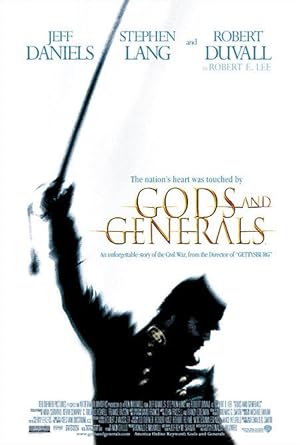
Gods and Generals
The rise and fall of confederate general Thomas "Stonewall" Jackson, as he meets with military success against the Union from 1861 to 1863, when he is accidentally killed by his own soldiers.
The film box office disappointment against its moderate budget of $56.0M, earning $12.9M globally (-77% loss). While initial box office returns were modest, the film has gained appreciation for its innovative storytelling within the biography genre.
1 win & 4 nominations


Plot Structure
Story beats plotted across runtime


Narrative Arc
Emotional journey through the story's key moments
Story Circle
Blueprint 15-beat structure
Arcplot Score Breakdown
Weighted: Precision (70%) + Arc (15%) + Theme (15%)
Gods and Generals (2003) exhibits meticulously timed narrative architecture, characteristic of Ronald F. Maxwell's storytelling approach. This structural analysis examines how the film's 15-point plot structure maps to proven narrative frameworks across 3 hours and 39 minutes. With an Arcplot score of 6.6, the film balances conventional beats with creative variation.
Characters
Cast & narrative archetypes

Thomas "Stonewall" Jackson
Robert E. Lee
Joshua Lawrence Chamberlain
James Longstreet
Winfield Scott Hancock
Anna Morrison Jackson
Fanny Chamberlain
Main Cast & Characters
Thomas "Stonewall" Jackson
Played by Stephen Lang
Deeply religious Confederate general known for his tactical brilliance and unwavering devotion to duty and God.
Robert E. Lee
Played by Robert Duvall
Commanding general of the Confederate Army, torn between loyalty to Virginia and his duty to the Union.
Joshua Lawrence Chamberlain
Played by Jeff Daniels
Union colonel and former professor who transforms from academic to warrior, driven by ideals of freedom and union.
James Longstreet
Played by Bruce Boxleitner
Confederate lieutenant general and Lee's "Old War Horse," pragmatic and often cautious in military strategy.
Winfield Scott Hancock
Played by Brian Mallon
Union general known for his superb military bearing and leadership at key battles.
Anna Morrison Jackson
Played by Kali Rocha
Stonewall Jackson's devoted wife, providing him emotional support and representing the home front.
Fanny Chamberlain
Played by Mira Sorvino
Joshua Chamberlain's wife, concerned for her husband's safety while supporting his service.
Structural Analysis
The Status Quo at 2 minutes (1% through the runtime) establishes Colonel Robert E. Lee at Arlington, living peacefully with his family before the nation's crisis. The world is intact, unified, and hopeful - a "before" image of harmony that will be shattered.. Notably, this early placement immediately immerses viewers in the story world.
The inciting incident occurs at 25 minutes when Virginia secedes from the Union. Lee resigns his U.S. Army commission, and Jackson receives orders to report to Richmond. The old world dies; the status quo is shattered by the irreversible choice of war.. At 11% through the film, this Disruption aligns precisely with traditional story structure. This beat shifts the emotional landscape, launching the protagonist into the central conflict.
The First Threshold at 55 minutes marks the transition into Act II, occurring at 25% of the runtime. This reveals the protagonist's commitment to The First Battle of Bull Run (Manassas). Jackson earns his "Stonewall" nickname by holding the line. Both armies cross into actual warfare - no longer debate or preparation, but blood and death. The mirror world of war has fully arrived., moving from reaction to action.
At 109 minutes, the Midpoint arrives at 50% of the runtime—precisely centered, creating perfect narrative symmetry. The analysis reveals that this crucial beat The Battle of Fredericksburg - a spectacular Confederate victory. Jackson and Lee's coordination is flawless; the Union is devastated. A false victory: the South celebrates, but this triumph brings them closer to ultimate destruction by prolonging the war., fundamentally raising what's at risk. The emotional intensity shifts, dividing the narrative into clear before-and-after phases.
The Collapse moment at 163 minutes (74% through) represents the emotional nadir. Here, The Battle of Chancellorsville. Despite another Confederate victory, Jackson is accidentally shot by his own men in the darkness. The whiff of death: the South's greatest general is mortally wounded at the moment of his greatest triumph., reveals the protagonist at their lowest point. This beat's placement in the final quarter sets up the climactic reversal.
The Second Threshold at 174 minutes initiates the final act resolution at 79% of the runtime. Jackson dies, whispering "Let us cross over the river and rest under the shade of the trees." His death transforms him from man to martyr, and the realization sets in: the Confederacy has lost something irreplaceable. The final act of loss begins., demonstrating the transformation achieved throughout the journey.
Emotional Journey
Gods and Generals's emotional architecture traces a deliberate progression across 15 carefully calibrated beats.
Narrative Framework
This structural analysis employs structural analysis methodology used to understand storytelling architecture. By mapping Gods and Generals against these established plot points, we can identify how Ronald F. Maxwell utilizes or subverts traditional narrative conventions. The plot point approach reveals not only adherence to structural principles but also creative choices that distinguish Gods and Generals within the biography genre.
Ronald F. Maxwell's Structural Approach
Among the 3 Ronald F. Maxwell films analyzed on Arcplot, the average structural score is 6.8, demonstrating varied approaches to story architecture. Gods and Generals takes a more unconventional approach compared to the director's typical style. For comparative analysis, explore the complete Ronald F. Maxwell filmography.
Comparative Analysis
Additional biography films include After Thomas, Taking Woodstock and The Fire Inside. For more Ronald F. Maxwell analyses, see Gettysburg, The Night the Lights Went Out in Georgia.
Plot Points by Act
Act I
SetupStatus Quo
Colonel Robert E. Lee at Arlington, living peacefully with his family before the nation's crisis. The world is intact, unified, and hopeful - a "before" image of harmony that will be shattered.
Theme
Lee discusses duty and conscience with his family, stating that he must follow Virginia despite his opposition to secession. The theme: when loyalty to state conflicts with loyalty to nation, men must answer to their deepest allegiance.
Worldbuilding
Introduction of the divided nation, 1861. Lee declines command of Union forces. Thomas Jackson teaches at VMI. Joshua Chamberlain prepares to leave Maine. The world establishes the personal costs of the coming war and the men who will fight it.
Disruption
Virginia secedes from the Union. Lee resigns his U.S. Army commission, and Jackson receives orders to report to Richmond. The old world dies; the status quo is shattered by the irreversible choice of war.
Resistance
Jackson drills his troops, transforming VMI cadets and volunteers into soldiers. Both sides prepare for battle, debate tactics, and steel themselves for the conflict. The protagonists resist the full horror of what's coming while preparing for it.
Act II
ConfrontationFirst Threshold
The First Battle of Bull Run (Manassas). Jackson earns his "Stonewall" nickname by holding the line. Both armies cross into actual warfare - no longer debate or preparation, but blood and death. The mirror world of war has fully arrived.
Mirror World
Jackson's tender relationship with his wife Anna is shown in depth. She represents faith, love, and the peaceful domestic world that gives meaning to his sacrifice - the thematic counterpoint to the brutality of war.
Premise
The promise of the premise: Civil War battles depicted with epic scope. Jackson's Valley Campaign, his brilliant tactical maneuvers, the camaraderie of soldiers, and the religious fervor that sustains them. This is what the audience came to see - the war itself.
Midpoint
The Battle of Fredericksburg - a spectacular Confederate victory. Jackson and Lee's coordination is flawless; the Union is devastated. A false victory: the South celebrates, but this triumph brings them closer to ultimate destruction by prolonging the war.
Opposition
Winter encampment and preparation for spring campaigns. Chamberlain witnesses the Union's resolve hardening. Jackson's men suffer but remain devoted. The pressure builds as both sides prepare for the decisive confrontations to come. Casualties mount.
Collapse
The Battle of Chancellorsville. Despite another Confederate victory, Jackson is accidentally shot by his own men in the darkness. The whiff of death: the South's greatest general is mortally wounded at the moment of his greatest triumph.
Crisis
Jackson's deathbed scene. He lingers for days, attended by Anna, delirious with fever and pneumonia. Lee and the army wait in anguish. The dark night of the soul as everyone processes that their irreplaceable leader is dying.
Act III
ResolutionSecond Threshold
Jackson dies, whispering "Let us cross over the river and rest under the shade of the trees." His death transforms him from man to martyr, and the realization sets in: the Confederacy has lost something irreplaceable. The final act of loss begins.
Synthesis
Jackson's funeral, mourning throughout the South, and Lee's preparation to move forward without his greatest lieutenant. The synthesis: duty, faith, and sacrifice are honored even in defeat. The cause will continue, but the cost is now fully understood.
Transformation
Lee stands alone, looking toward the future (Gettysburg), without Jackson. The closing image mirrors the opening: a general contemplating duty. But transformed - Lee is no longer hopeful but burdened, knowing the terrible cost and the battles yet to come.