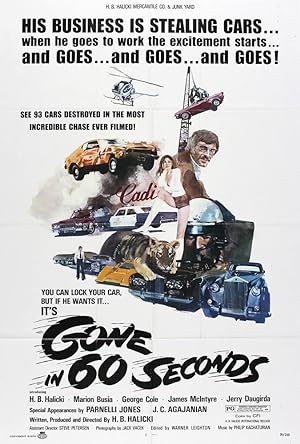
Gone in 60 Seconds
Insurance investigator Maindrian Pace and his team lead double-lives as unstoppable car thieves. When a South American drug lord pays Pace to steal 48 cars for him, all but one, a 1973 Ford Mustang, are in the bag. As Pace prepares to rip-off the fastback, codenamed "Eleanor", in Long Beach, he is unaware that his boss has tipped off the police after a business dispute. Detectives are waiting and pursue Pace through five cities as he desperately tries to get away.
Despite its tight budget of $1.0M, Gone in 60 Seconds became a runaway success, earning $40.0M worldwide—a remarkable 3900% return. The film's bold vision engaged audiences, showing that strong storytelling can transcend budget limitations.


Plot Structure
Story beats plotted across runtime


Narrative Arc
Emotional journey through the story's key moments
Story Circle
Blueprint 15-beat structure
Arcplot Score Breakdown
Weighted: Precision (70%) + Arc (15%) + Theme (15%)
Gone in 60 Seconds (1974) exemplifies deliberately positioned dramatic framework, characteristic of H.B. Halicki's storytelling approach. This structural analysis examines how the film's 15-point plot structure maps to proven narrative frameworks across 1 hour and 45 minutes. With an Arcplot score of 6.9, the film balances conventional beats with creative variation.
Characters
Cast & narrative archetypes

Maindrian Pace
Pumpkin Chase
Stanley Chase
Atlee Jackson
Detective Mayhew
Main Cast & Characters
Maindrian Pace
Played by H.B. Halicki
A master car thief who leads a sophisticated operation to steal 48 high-end vehicles in one night.
Pumpkin Chase
Played by Marion Busia
Maindrian's girlfriend and partner in the car theft operation.
Stanley Chase
Played by Jerry Daugirda
Pumpkin's brother and member of the car theft crew.
Atlee Jackson
Played by James McIntyre
A mechanic and key member of Maindrian's car theft team.
Detective Mayhew
Played by Ronald Halicki
A persistent police detective investigating the car theft ring.
Structural Analysis
The Status Quo at 1 minutes (1% through the runtime) establishes Maindrian Pace runs a successful chop shop and car theft operation in Southern California, living a double life as a respectable insurance investigator by day and master car thief by night.. Structural examination shows that this early placement immediately immerses viewers in the story world.
The inciting incident occurs at 12 minutes when Maindrian receives a massive order from a South American drug lord: steal 48 specific luxury and sports cars within five days for $400,000, the biggest job of his career.. At 12% through the film, this Disruption aligns precisely with traditional story structure. This beat shifts the emotional landscape, launching the protagonist into the central conflict.
The First Threshold at 26 minutes marks the transition into Act II, occurring at 25% of the runtime. This illustrates the protagonist's commitment to The operation officially begins as Maindrian and his crew start executing the plan, committing fully to stealing all 48 cars within the tight deadline., moving from reaction to action.
At 52 minutes, the Midpoint arrives at 50% of the runtime—precisely centered, creating perfect narrative symmetry. Of particular interest, this crucial beat Maindrian discovers that Eleanor, a yellow 1973 Ford Mustang Mach 1 and the final car on the list, has been unexpectedly moved, and worse, the VIN has been compromised, alerting the police to their operation., fundamentally raising what's at risk. The emotional intensity shifts, dividing the narrative into clear before-and-after phases.
The Collapse moment at 78 minutes (74% through) represents the emotional nadir. Here, Maindrian finally steals Eleanor but is immediately spotted by police, triggering a massive pursuit. His entire operation and freedom hang by a thread as the entire LAPD mobilizes against him., demonstrates the protagonist at their lowest point. This beat's placement in the final quarter sets up the climactic reversal.
The Second Threshold at 84 minutes initiates the final act resolution at 80% of the runtime. Maindrian realizes he must use every ounce of driving skill and knowledge of the streets to outlast the police. He commits fully to the escape, accepting the destruction and chaos required to survive., demonstrating the transformation achieved throughout the journey.
Emotional Journey
Gone in 60 Seconds's emotional architecture traces a deliberate progression across 15 carefully calibrated beats.
Narrative Framework
This structural analysis employs systematic plot point analysis that identifies crucial turning points. By mapping Gone in 60 Seconds against these established plot points, we can identify how H.B. Halicki utilizes or subverts traditional narrative conventions. The plot point approach reveals not only adherence to structural principles but also creative choices that distinguish Gone in 60 Seconds within the action genre.
Comparative Analysis
Additional action films include The Bad Guys, Puss in Boots and Venom: The Last Dance.
Plot Points by Act
Act I
SetupStatus Quo
Maindrian Pace runs a successful chop shop and car theft operation in Southern California, living a double life as a respectable insurance investigator by day and master car thief by night.
Theme
A colleague warns Maindrian that "the big jobs are what get you caught," foreshadowing the stakes of ambition and risk that will define the protagonist's journey.
Worldbuilding
Introduction to Maindrian's criminal enterprise, his crew, and the sophisticated operation they run. We see how they scout, steal, and process vehicles while maintaining legitimate business fronts.
Disruption
Maindrian receives a massive order from a South American drug lord: steal 48 specific luxury and sports cars within five days for $400,000, the biggest job of his career.
Resistance
Maindrian and his crew plan the elaborate heist, assembling the list of vehicles, scouting locations, and coordinating the logistics. They debate the risks but are drawn by the massive payoff.
Act II
ConfrontationFirst Threshold
The operation officially begins as Maindrian and his crew start executing the plan, committing fully to stealing all 48 cars within the tight deadline.
Mirror World
Introduction of Maindrian's relationship with Pumpkin Chase, his girlfriend who represents the normal life he could have, serving as emotional grounding against his criminal obsession.
Premise
The crew systematically steals cars across Southern California in a series of creative and audacious thefts. This is "the promise of the premise" - watching professional car thieves at work.
Midpoint
Maindrian discovers that Eleanor, a yellow 1973 Ford Mustang Mach 1 and the final car on the list, has been unexpectedly moved, and worse, the VIN has been compromised, alerting the police to their operation.
Opposition
The crew scrambles to find and steal Eleanor while evading increasingly aggressive police attention. Multiple attempts fail, and law enforcement closes in on their operation.
Collapse
Maindrian finally steals Eleanor but is immediately spotted by police, triggering a massive pursuit. His entire operation and freedom hang by a thread as the entire LAPD mobilizes against him.
Crisis
The famous 40-minute chase sequence begins. Maindrian is alone in Eleanor, fleeing through Long Beach and Carson with an ever-growing force of police in pursuit. Survival is all that matters.
Act III
ResolutionSecond Threshold
Maindrian realizes he must use every ounce of driving skill and knowledge of the streets to outlast the police. He commits fully to the escape, accepting the destruction and chaos required to survive.
Synthesis
The chase intensifies through city streets, highways, and industrial areas. Maindrian destroys dozens of police vehicles, crashes through obstacles, and pushes Eleanor to her limits, demonstrating the ultimate synthesis of driver and machine.
Transformation
Battered and barely functional, Eleanor limps to the delivery point where Maindrian completes the job. The car is destroyed but the mission succeeded, showing the cost of his obsession and skill.