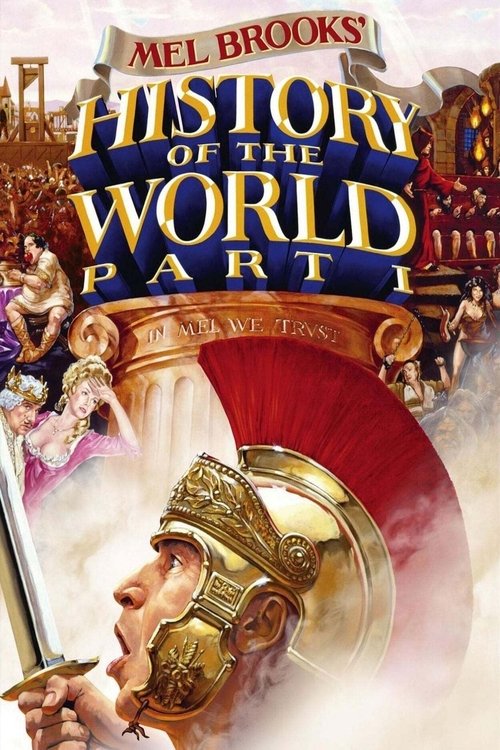
History of the World: Part I
An uproarious version of history that proves nothing is sacred – not even the Roman Empire, the French Revolution and the Spanish Inquisition.
Despite its modest budget of $11.0M, History of the World: Part I became a solid performer, earning $31.7M worldwide—a 188% return.
1 win & 1 nomination


Plot Structure
Story beats plotted across runtime


Narrative Arc
Emotional journey through the story's key moments
Story Circle
Blueprint 15-beat structure
Arcplot Score Breakdown
Weighted: Precision (70%) + Arc (15%) + Theme (15%)
History of the World: Part I (1981) exemplifies precise story structure, characteristic of Mel Brooks's storytelling approach. This structural analysis examines how the film's 15-point plot structure maps to proven narrative frameworks across 1 hour and 32 minutes. With an Arcplot score of 7.4, the film balances conventional beats with creative variation.
Characters
Cast & narrative archetypes

Moses
Comicus
Torquemada
King Louis XVI
Jacques
Empress Nympho
Mademoiselle Rimbaud
Josephus
Main Cast & Characters
Moses
Played by Mel Brooks
Jewish slave who becomes the reluctant deliverer of his people from Egyptian bondage
Comicus
Played by Mel Brooks
Stand-up philosopher in ancient Rome who becomes unwittingly involved in a plot against Caesar
Torquemada
Played by Mel Brooks
The fanatical Grand Inquisitor of the Spanish Inquisition who zealously prosecutes heretics
King Louis XVI
Played by Mel Brooks
The hedonistic and oblivious French king indulging in excess while revolution brews
Jacques
Played by Mel Brooks
A bold French revolutionary garçon who fights against the aristocracy and pursues love
Empress Nympho
Played by Madeline Kahn
The lustful and commanding Roman empress who becomes infatuated with Comicus
Mademoiselle Rimbaud
Played by Pamela Stephenson
A beautiful and spirited French aristocrat who falls for Jacques the garçon
Josephus
Played by Gregory Hines
Comicus' loyal agent and companion who helps navigate Roman society
Structural Analysis
The Status Quo at 1 minutes (1% through the runtime) establishes Opening narration establishes the comedic premise: a sweeping mockery of human history from the Stone Age forward, setting the irreverent tone.. Of particular interest, this early placement immediately immerses viewers in the story world.
The inciting incident occurs at 12 minutes when Transition to Roman Empire: Comicus the stand-up philosopher struggles in a society that doesn't appreciate him, facing potential execution—survival becomes the stakes.. At 13% through the film, this Disruption is delayed, allowing extended setup of the story world. This beat shifts the emotional landscape, launching the protagonist into the central conflict.
The First Threshold at 23 minutes marks the transition into Act II, occurring at 25% of the runtime. This demonstrates the protagonist's commitment to Comicus chooses to enter Caesar's palace for the command performance, fully committing to the dangerous world of Roman politics and spectacle., moving from reaction to action.
At 46 minutes, the Midpoint arrives at 50% of the runtime—precisely centered, creating perfect narrative symmetry. The analysis reveals that this crucial beat The assassination of Caesar and palace chaos—a false defeat where the fun ends and Comicus must flee for his life as Rome descends into violence., fundamentally raising what's at risk. The emotional intensity shifts, dividing the narrative into clear before-and-after phases.
The Collapse moment at 69 minutes (75% through) represents the emotional nadir. Here, Jacques and companions are captured and sentenced to guillotine—the whiff of death is literal as executions loom and all hope seems lost for the French peasants., reveals the protagonist at their lowest point. This beat's placement in the final quarter sets up the climactic reversal.
The Second Threshold at 74 minutes initiates the final act resolution at 80% of the runtime. Jacques and Josephus devise the escape plan using Bearnaise, synthesizing cunning with the help of allies—the realization that wit can overcome tyranny., demonstrating the transformation achieved throughout the journey.
Emotional Journey
History of the World: Part I's emotional architecture traces a deliberate progression across 15 carefully calibrated beats.
Narrative Framework
This structural analysis employs systematic plot point analysis that identifies crucial turning points. By mapping History of the World: Part I against these established plot points, we can identify how Mel Brooks utilizes or subverts traditional narrative conventions. The plot point approach reveals not only adherence to structural principles but also creative choices that distinguish History of the World: Part I within the comedy genre.
Mel Brooks's Structural Approach
Among the 8 Mel Brooks films analyzed on Arcplot, the average structural score is 7.1, reflecting strong command of classical structure. History of the World: Part I represents one of the director's most structurally precise works. For comparative analysis, explore the complete Mel Brooks filmography.
Comparative Analysis
Additional comedy films include The Bad Guys, Ella Enchanted and The Evening Star. For more Mel Brooks analyses, see High Anxiety, Spaceballs and Silent Movie.
Plot Points by Act
Act I
SetupStatus Quo
Opening narration establishes the comedic premise: a sweeping mockery of human history from the Stone Age forward, setting the irreverent tone.
Theme
In the Stone Age segment, primitive humans discover art, music, and critic—immediately establishing the theme: humanity's capacity for both creation and corruption has always coexisted.
Worldbuilding
Stone Age and Old Testament segments establish the episodic structure, introducing Moses and the tablets, showing how power, faith, and human absurdity shape civilization.
Disruption
Transition to Roman Empire: Comicus the stand-up philosopher struggles in a society that doesn't appreciate him, facing potential execution—survival becomes the stakes.
Resistance
Comicus debates whether to attend Caesar's palace, meets Josephus and other allies, learns the dangers of Roman court life, and prepares for the performance that could save or doom him.
Act II
ConfrontationFirst Threshold
Comicus chooses to enter Caesar's palace for the command performance, fully committing to the dangerous world of Roman politics and spectacle.
Mirror World
Comicus meets Empress Nympho and encounters the decadent mirror world of Roman excess, where loyalty, art, and integrity are all for sale—the thematic counterpoint to his struggling everyman status.
Premise
The "fun and games" of Roman debauchery: orgies, gladiators, palace intrigue, and comedic exploration of absolute power corrupting absolutely, delivering the satirical premise the audience came for.
Midpoint
The assassination of Caesar and palace chaos—a false defeat where the fun ends and Comicus must flee for his life as Rome descends into violence.
Opposition
Transition to Spanish Inquisition and French Revolution segments: oppression intensifies, the powerful close in on the powerless, and survival becomes increasingly difficult for common people against institutional tyranny.
Collapse
Jacques and companions are captured and sentenced to guillotine—the whiff of death is literal as executions loom and all hope seems lost for the French peasants.
Crisis
Imprisonment and dark night before execution: Jacques processes his fate, the absurdity of the revolution eating its own, wallowing in the certainty of death.
Act III
ResolutionSecond Threshold
Jacques and Josephus devise the escape plan using Bearnaise, synthesizing cunning with the help of allies—the realization that wit can overcome tyranny.
Synthesis
Execution of the elaborate escape from the Bastille, rescuing Mademoiselle Rimbaud, defeating the oppressors through cleverness rather than power—the final revolutionary act.
Transformation
The closing "Jews in Space" musical number: absurdist triumph showing that humor, creativity, and irreverence endure across all of history—transformation from oppressed to liberated through comedy itself.