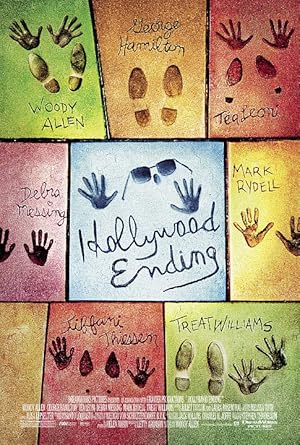
Hollywood Ending
Val Waxman is a film director who was once big in the 1970's and 1980's, but has now has been reduced to directing TV commercials. Finally, he gets an offer to make a big film. But, disaster strikes, when Val goes temporarily blind, due to paranoia. So, he and a few friends, try to cover up his disability, without the studio executives or the producers knowing that he is directing the film blind.
The film disappointed at the box office against its mid-range budget of $16.0M, earning $14.6M globally (-9% loss).


Plot Structure
Story beats plotted across runtime


Narrative Arc
Emotional journey through the story's key moments
Story Circle
Blueprint 15-beat structure
Arcplot Score Breakdown
Weighted: Precision (70%) + Arc (15%) + Theme (15%)
Hollywood Ending (2002) reveals strategically placed narrative design, characteristic of Woody Allen's storytelling approach. This structural analysis examines how the film's 15-point plot structure maps to proven narrative frameworks across 1 hour and 52 minutes. With an Arcplot score of 7.4, the film balances conventional beats with creative variation.
Characters
Cast & narrative archetypes

Val Waxman
Ellie
Hal Yeager
Lori
Al Hack
Tony Waxman
Main Cast & Characters
Val Waxman
Played by Woody Allen
A once-successful film director now reduced to shooting commercials who gets a comeback opportunity but goes psychosomatically blind.
Ellie
Played by Téa Leoni
Val's ex-wife and former collaborator, now engaged to the studio head, who convinces her fiancé to give Val another chance.
Hal Yeager
Played by Treat Williams
A powerful Hollywood studio executive engaged to Ellie who reluctantly hires Val to direct his major film.
Lori
Played by Debra Messing
Val's current airheaded girlfriend and agent who tries to manage his career and neuroses.
Al Hack
Played by Mark Rydell
Val's best friend and long-time cinematographer who becomes his eyes when Val goes blind.
Tony Waxman
Played by Isaac Mizrahi
Val's adult son trying to establish himself as an actor while dealing with his father's eccentricities.
Structural Analysis
The Status Quo at 1 minutes (1% through the runtime) establishes Val Waxman, a once-acclaimed director, is now reduced to directing deodorant commercials, bitter and desperate for respect in Hollywood.. Significantly, this early placement immediately immerses viewers in the story world.
The inciting incident occurs at 14 minutes when Ellie, now engaged to studio executive Hal, proposes that Hal give Val a chance to direct a major studio film in New York, offering Val his comeback opportunity.. At 12% through the film, this Disruption aligns precisely with traditional story structure. This beat shifts the emotional landscape, launching the protagonist into the central conflict.
The First Threshold at 28 minutes marks the transition into Act II, occurring at 25% of the runtime. This demonstrates the protagonist's commitment to Val actively chooses to accept the directing job, committing to the film despite his pride and anxiety, launching into the world of big-budget filmmaking., moving from reaction to action.
At 55 minutes, the Midpoint arrives at 49% of the runtime—precisely centered, creating perfect narrative symmetry. Of particular interest, this crucial beat False victory: Despite being blind, Val appears to be successfully directing the film with only his cinematographer knowing the truth, and the footage looks surprisingly good., fundamentally raising what's at risk. The emotional intensity shifts, dividing the narrative into clear before-and-after phases.
The Collapse moment at 83 minutes (74% through) represents the emotional nadir. Here, The film wraps but the studio screening is a disaster - American executives hate the film, declaring it unwatchable and Val's career officially dead., indicates the protagonist at their lowest point. This beat's placement in the final quarter sets up the climactic reversal.
The Second Threshold at 89 minutes initiates the final act resolution at 80% of the runtime. News arrives that the film is being hailed as a masterpiece at the Cannes Film Festival - the French critics love it, calling it brilliant avant-garde cinema., demonstrating the transformation achieved throughout the journey.
Emotional Journey
Hollywood Ending's emotional architecture traces a deliberate progression across 15 carefully calibrated beats.
Narrative Framework
This structural analysis employs structural analysis methodology used to understand storytelling architecture. By mapping Hollywood Ending against these established plot points, we can identify how Woody Allen utilizes or subverts traditional narrative conventions. The plot point approach reveals not only adherence to structural principles but also creative choices that distinguish Hollywood Ending within the comedy genre.
Woody Allen's Structural Approach
Among the 42 Woody Allen films analyzed on Arcplot, the average structural score is 7.0, demonstrating varied approaches to story architecture. Hollywood Ending represents one of the director's most structurally precise works. For comparative analysis, explore the complete Woody Allen filmography.
Comparative Analysis
Additional comedy films include The Bad Guys, Ella Enchanted and The Evening Star. For more Woody Allen analyses, see Everyone Says I Love You, Celebrity and Interiors.
Plot Points by Act
Act I
SetupStatus Quo
Val Waxman, a once-acclaimed director, is now reduced to directing deodorant commercials, bitter and desperate for respect in Hollywood.
Theme
Val's agent Al discusses how perception is everything in Hollywood - "It's not about reality, it's about what people believe" - establishing the theme of appearance versus reality.
Worldbuilding
Introduction to Val's world: his anxiety-ridden personality, hypochondria, failed marriage to Ellie, strained relationship with his agent, and his desperation to return to prestigious filmmaking.
Disruption
Ellie, now engaged to studio executive Hal, proposes that Hal give Val a chance to direct a major studio film in New York, offering Val his comeback opportunity.
Resistance
Val debates whether to take the job, wrestling with working for his ex-wife's new fiancé. He consults with Al, visits Ellie, and considers the humiliation versus the opportunity.
Act II
ConfrontationFirst Threshold
Val actively chooses to accept the directing job, committing to the film despite his pride and anxiety, launching into the world of big-budget filmmaking.
Mirror World
Val reconnects romantically with Ellie during pre-production, establishing the relationship that will reflect the theme of seeing clearly versus being blind to truth.
Premise
Val prepares for and begins filming, but develops psychosomatic blindness on the first day of shooting. He conceals his condition and directs the film while blind, creating absurd situations.
Midpoint
False victory: Despite being blind, Val appears to be successfully directing the film with only his cinematographer knowing the truth, and the footage looks surprisingly good.
Opposition
The production becomes increasingly chaotic. Studio executives grow suspicious, the crew becomes confused by Val's bizarre directing methods, and Hal pressures everyone as the budget balloons.
Collapse
The film wraps but the studio screening is a disaster - American executives hate the film, declaring it unwatchable and Val's career officially dead.
Crisis
Val faces the aftermath of his failure. His sight returns now that filming is over, but his career and relationship with Ellie appear finished. He contemplates his self-destructive patterns.
Act III
ResolutionSecond Threshold
News arrives that the film is being hailed as a masterpiece at the Cannes Film Festival - the French critics love it, calling it brilliant avant-garde cinema.
Synthesis
Val travels to Cannes for the triumphant premiere, reconciles with Ellie, and is celebrated as a visionary director. The film becomes an international art-house success.
Transformation
Val is feted at Cannes, acclaimed as a genius. He has succeeded not despite his blindness but because of it, ironically achieving greatness through his limitation. The final image shows him celebrated but aware of the absurdity.