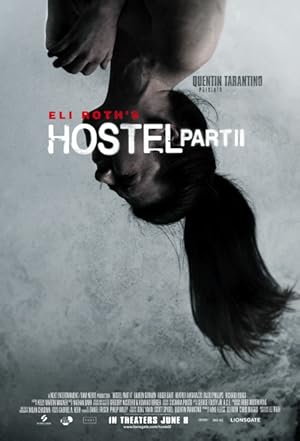
Hostel: Part II
Three female college students take a detour from their partying, enticed by a beautiful European woman who promises seclusion, safety, and maybe even romance. What they get is a living hell in which they are sold to the highest bidder, whose fondest wish is to kill them slowly. Hostel 2 also follows two American men who are willing to pay to join an exclusive club where a life will end at their hands--any way they like. It's a story of human monsters and the almighty dollar as only Eli Roth could tell it.
Despite its tight budget of $10.2M, Hostel: Part II became a commercial success, earning $35.7M worldwide—a 250% return. The film's bold vision attracted moviegoers, confirming that strong storytelling can transcend budget limitations.


Plot Structure
Story beats plotted across runtime


Narrative Arc
Emotional journey through the story's key moments
Story Circle
Blueprint 15-beat structure
Arcplot Score Breakdown
Weighted: Precision (70%) + Arc (15%) + Theme (15%)
Hostel: Part II (2007) exhibits precise dramatic framework, characteristic of Eli Roth's storytelling approach. This structural analysis examines how the film's 15-point plot structure maps to proven narrative frameworks across 1 hour and 33 minutes. With an Arcplot score of 7.1, the film balances conventional beats with creative variation.
Characters
Cast & narrative archetypes

Beth Salinger
Whitney
Lorna
Todd
Axelle
Stuart
Todd Jensen
Main Cast & Characters
Beth Salinger
Played by Lauren German
Art student traveling through Europe who becomes the cautious, resourceful survivor of the group
Whitney
Played by Bijou Phillips
Confident and adventurous art student who pursues excitement without caution
Lorna
Played by Heather Matarazzo
Reserved and naive member of the trio, easily manipulated and the first to fall victim
Todd
Played by Richard Burgi
Beth's boyfriend, initially hesitant about the trip and tries to dissuade her from going
Axelle
Played by Vera Jordanova
Charming European model who befriends the girls but harbors sinister ulterior motives
Stuart
Played by Roger Bart
Wealthy American businessman bidding on victims to satisfy his sadistic fantasies
Todd Jensen
Played by Richard Burgi
Stuart's more aggressive and confident business partner who relishes the violence
Structural Analysis
The Status Quo at 1 minutes (1% through the runtime) establishes Three American women (Beth, Whitney, and Lorna) enjoy an art class in Rome, living carefree lives as students abroad, unaware of the danger that awaits them.. Of particular interest, this early placement immediately immerses viewers in the story world.
The inciting incident occurs at 11 minutes when Axelle convinces the women to join her at a harvest festival in Slovakia, planting the seed that will lead them into mortal danger.. At 12% through the film, this Disruption aligns precisely with traditional story structure. This beat shifts the emotional landscape, launching the protagonist into the central conflict.
The First Threshold at 23 minutes marks the transition into Act II, occurring at 25% of the runtime. This shows the protagonist's commitment to The women arrive at the hostel in Slovakia, unknowingly entering the hunting ground where they have been sold to the highest bidders., moving from reaction to action.
At 46 minutes, the Midpoint arrives at 49% of the runtime—precisely centered, creating perfect narrative symmetry. Of particular interest, this crucial beat Beth is captured and wakes up chained in a dungeon chamber where Stuart is supposed to kill her, raising the stakes to maximum as she faces imminent death., fundamentally raising what's at risk. The emotional intensity shifts, dividing the narrative into clear before-and-after phases.
The Collapse moment at 69 minutes (74% through) represents the emotional nadir. Here, Beth discovers Whitney's mutilated body hanging upside down and is forced to mercy-kill her best friend, representing the death of innocence and hope., reveals the protagonist at their lowest point. This beat's placement in the final quarter sets up the climactic reversal.
The Second Threshold at 74 minutes initiates the final act resolution at 80% of the runtime. Beth purchases membership in the Elite Hunting Club using her inheritance, gaining protection and the right to kill, transforming from victim to hunter., demonstrating the transformation achieved throughout the journey.
Emotional Journey
Hostel: Part II's emotional architecture traces a deliberate progression across 15 carefully calibrated beats.
Narrative Framework
This structural analysis employs systematic plot point analysis that identifies crucial turning points. By mapping Hostel: Part II against these established plot points, we can identify how Eli Roth utilizes or subverts traditional narrative conventions. The plot point approach reveals not only adherence to structural principles but also creative choices that distinguish Hostel: Part II within the horror genre.
Eli Roth's Structural Approach
Among the 9 Eli Roth films analyzed on Arcplot, the average structural score is 7.0, demonstrating varied approaches to story architecture. Hostel: Part II represents one of the director's most structurally precise works. For comparative analysis, explore the complete Eli Roth filmography.
Comparative Analysis
Additional horror films include Thinner, A Nightmare on Elm Street and Mary Reilly. For more Eli Roth analyses, see The House with a Clock in Its Walls, Death Wish and Thanksgiving.
Plot Points by Act
Act I
SetupStatus Quo
Three American women (Beth, Whitney, and Lorna) enjoy an art class in Rome, living carefree lives as students abroad, unaware of the danger that awaits them.
Theme
A conversation about trust and vulnerability in relationships hints at the film's theme: the commodification of human life and the exploitation of trust.
Worldbuilding
The three women are established as distinct characters: Beth is wealthy and cautious, Whitney is adventurous and impulsive, Lorna is insecure. They explore Rome, visit spas, and meet a mysterious model named Axelle who befriends them.
Disruption
Axelle convinces the women to join her at a harvest festival in Slovakia, planting the seed that will lead them into mortal danger.
Resistance
The women debate whether to go to Slovakia. Whitney is enthusiastic, Beth is hesitant. They board a train where they meet Axelle again and are drugged. Meanwhile, two American businessmen (Todd and Stuart) are introduced bidding for victims at the Elite Hunting Club auction.
Act II
ConfrontationFirst Threshold
The women arrive at the hostel in Slovakia, unknowingly entering the hunting ground where they have been sold to the highest bidders.
Mirror World
Stuart, one of the bidders, is revealed to be hesitant and conflicted about the killing, contrasting with the aggressive Todd. This subplot explores the moral descent of ordinary men into murderers.
Premise
The women enjoy the hostel and local festivities, unaware they're being watched. Lorna is the first taken and brutally murdered by the sadistic Mrs. Bathory. Whitney is abducted next while Beth searches frantically for her friends, slowly realizing something is terribly wrong.
Midpoint
Beth is captured and wakes up chained in a dungeon chamber where Stuart is supposed to kill her, raising the stakes to maximum as she faces imminent death.
Opposition
Beth uses psychology to manipulate the hesitant Stuart, exploiting his weakness. She convinces him to help her escape. Meanwhile, Whitney endures horrific torture from Todd. The organization's power and reach become increasingly apparent.
Collapse
Beth discovers Whitney's mutilated body hanging upside down and is forced to mercy-kill her best friend, representing the death of innocence and hope.
Crisis
Beth processes the horror of what she's done and experienced, nearly broken by trauma but finding resolve in her rage and survival instinct.
Act III
ResolutionSecond Threshold
Beth purchases membership in the Elite Hunting Club using her inheritance, gaining protection and the right to kill, transforming from victim to hunter.
Synthesis
Beth systematically executes revenge: she lures Axelle to a secluded location, tortures her for information, then kills her. She confronts the organization's power structure and emerges victorious, having fully embraced violence.
Transformation
Beth sits alone on a train, seemingly safe but forever changed—traumatized, hardened, and corrupted by the violence she's experienced and perpetrated, a dark mirror of the carefree student from the opening.