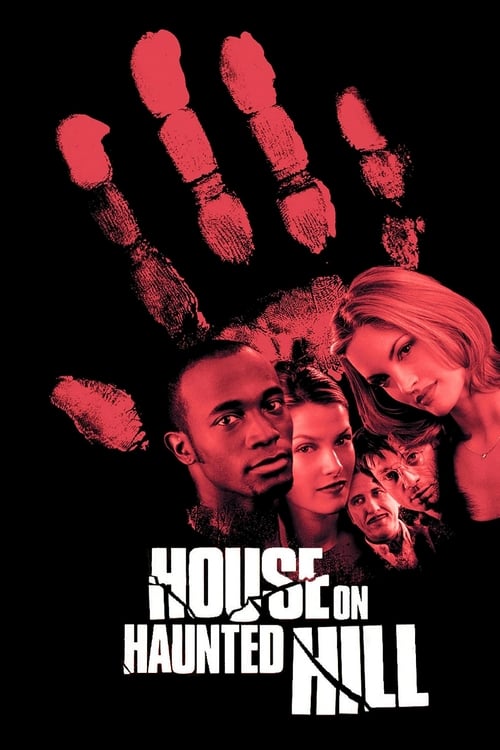
House on Haunted Hill
An amusement park mogul offers a random group of diverse people $1 million to spend the night in a decrepit former mental institution.
Working with a respectable budget of $37.0M, the film achieved a respectable showing with $40.8M in global revenue (+10% profit margin).
1 win & 4 nominations


Plot Structure
Story beats plotted across runtime


Narrative Arc
Emotional journey through the story's key moments
Story Circle
Blueprint 15-beat structure
Arcplot Score Breakdown
Weighted: Precision (70%) + Arc (15%) + Theme (15%)
House on Haunted Hill (1999) exemplifies strategically placed story structure, characteristic of William Malone's storytelling approach. This structural analysis examines how the film's 15-point plot structure maps to proven narrative frameworks across 1 hour and 33 minutes. With an Arcplot score of 7.3, the film balances conventional beats with creative variation.
Characters
Cast & narrative archetypes

Steven Price
Evelyn Stockard-Price
Sara Wolfe
Eddie Baker
Dr. Donald Blackburn
Melissa Marr
Watson Pritchett
Main Cast & Characters
Steven Price
Played by Geoffrey Rush
Eccentric amusement park mogul who invites five strangers to a haunted house for a million-dollar survival challenge. Manipulative and theatrical, with a twisted marriage.
Evelyn Stockard-Price
Played by Famke Janssen
Steven's calculating wife who matches his manipulation with her own schemes. Their toxic marriage fuels the deadly game within the house.
Sara Wolfe
Played by Ali Larter
Young assistant who becomes the reluctant hero. Resourceful and moral, she fights to survive and uncover the truth behind the house's horrors.
Eddie Baker
Played by Taye Diggs
Pragmatic cameraman and Sara's love interest. Skeptical of the supernatural, he uses logic and courage to navigate the deadly night.
Dr. Donald Blackburn
Played by Peter Gallagher
Psychiatrist obsessed with the house's dark history. His knowledge of the asylum's past makes him both valuable and vulnerable.
Melissa Marr
Played by Bridgette Wilson-Sampras
Former actress and one of the five guests. Initially self-absorbed, she becomes increasingly terrified as the supernatural events escalate.
Watson Pritchett
Played by Chris Kattan
The house owner and reluctant host who knows the building's deadly secrets. Cowardly but knowledgeable about the supernatural dangers within.
Structural Analysis
The Status Quo at 1 minutes (1% through the runtime) establishes Opening flashback to 1931 shows the Vannacutt Psychiatric Institute for the Criminally Insane in chaos as patients revolt, killing staff. Dr. Vannacutt triggers lockdown, trapping everyone inside. Establishes the house's dark history and malevolent presence.. The analysis reveals that this early placement immediately immerses viewers in the story world.
The inciting incident occurs at 10 minutes when The guest list mysteriously changes itself. Neither Steven nor Evelyn invited the five strangers who receive invitations: Sara, Eddie, Melissa, Dr. Blackburn, and Pritchett. The house itself has chosen the guests, disrupting their planned murder schemes.. At 11% through the film, this Disruption aligns precisely with traditional story structure. This beat shifts the emotional landscape, launching the protagonist into the central conflict.
The First Threshold at 22 minutes marks the transition into Act II, occurring at 23% of the runtime. This illustrates the protagonist's commitment to The house goes into automatic lockdown at midnight. Massive metal doors seal all exits, steel shutters cover windows. The guests are trapped inside with no escape until morning. Their choice to stay becomes irreversible., moving from reaction to action.
At 45 minutes, the Midpoint arrives at 49% of the runtime—precisely centered, creating perfect narrative symmetry. Significantly, this crucial beat Dr. Blackburn is killed—decapitated by invisible forces in the basement. The first actual death proves this isn't just Steven's elaborate game. The stakes become life and death. False defeat: they realize the supernatural threat is real and deadly., fundamentally raising what's at risk. The emotional intensity shifts, dividing the narrative into clear before-and-after phases.
The Collapse moment at 68 minutes (73% through) represents the emotional nadir. Here, Steven discovers Evelyn alive in the asylum's saturation chamber, preserved in water. He realizes she faked her death to frame him. But as he confronts her, the Darkness manifests fully—a massive, swirling entity of tortured souls. Pritchett is dragged away and killed. All hope seems lost., reveals the protagonist at their lowest point. This beat's placement in the final quarter sets up the climactic reversal.
The Second Threshold at 74 minutes initiates the final act resolution at 80% of the runtime. Steven realizes the Darkness feeds on evil and fear. He understands that Sara's innocence—her lack of greed and malice—might be their salvation. He sacrifices himself to save her, proving that genuine humanity can resist the house's corruption., demonstrating the transformation achieved throughout the journey.
Emotional Journey
House on Haunted Hill's emotional architecture traces a deliberate progression across 15 carefully calibrated beats.
Narrative Framework
This structural analysis employs systematic plot point analysis that identifies crucial turning points. By mapping House on Haunted Hill against these established plot points, we can identify how William Malone utilizes or subverts traditional narrative conventions. The plot point approach reveals not only adherence to structural principles but also creative choices that distinguish House on Haunted Hill within the horror genre.
Comparative Analysis
Additional horror films include Thinner, A Nightmare on Elm Street and Mary Reilly.
Plot Points by Act
Act I
SetupStatus Quo
Opening flashback to 1931 shows the Vannacutt Psychiatric Institute for the Criminally Insane in chaos as patients revolt, killing staff. Dr. Vannacutt triggers lockdown, trapping everyone inside. Establishes the house's dark history and malevolent presence.
Theme
Steven Price tells his wife Evelyn, "I'm in the business of fear," foreshadowing the central theme: manufactured terror versus genuine supernatural horror, and whether one can control evil or if it controls you.
Worldbuilding
Introduction to Steven Price, eccentric amusement park mogul who specializes in horror attractions, and his scheming wife Evelyn. Their toxic marriage is established—each plotting to kill the other. Evelyn plans a birthday party at the infamous Vannacutt asylum, now called House on Haunted Hill.
Disruption
The guest list mysteriously changes itself. Neither Steven nor Evelyn invited the five strangers who receive invitations: Sara, Eddie, Melissa, Dr. Blackburn, and Pritchett. The house itself has chosen the guests, disrupting their planned murder schemes.
Resistance
The five strangers arrive at the abandoned asylum. Pritchett, the building's owner, warns them about the house's evil. Steven explains the rules: survive the night in the locked house, win $1 million each. The guests debate whether to stay or leave before lockdown.
Act II
ConfrontationFirst Threshold
The house goes into automatic lockdown at midnight. Massive metal doors seal all exits, steel shutters cover windows. The guests are trapped inside with no escape until morning. Their choice to stay becomes irreversible.
Mirror World
Sara and Eddie begin to bond as they explore together. Sara, an innocent among cynics, represents the thematic counterpoint—genuine vulnerability versus manipulation. Their developing connection carries the emotional subplot.
Premise
The promise of the premise: a haunted house thriller delivers escalating supernatural encounters. Guests experience terrifying visions, ghostly apparitions, and unexplained phenomena. Steven's tricks are revealed, but real supernatural events occur that he didn't orchestrate. The group splits up to explore.
Midpoint
Dr. Blackburn is killed—decapitated by invisible forces in the basement. The first actual death proves this isn't just Steven's elaborate game. The stakes become life and death. False defeat: they realize the supernatural threat is real and deadly.
Opposition
Paranoia and terror intensify. Melissa is attacked and killed by spirits. The survivors turn on each other, suspecting murder conspiracies. Evelyn appears to be killed. The house's malevolent presence grows stronger, with the Darkness—the collected evil of Vannacutt's tortured souls—actively hunting them.
Collapse
Steven discovers Evelyn alive in the asylum's saturation chamber, preserved in water. He realizes she faked her death to frame him. But as he confronts her, the Darkness manifests fully—a massive, swirling entity of tortured souls. Pritchett is dragged away and killed. All hope seems lost.
Crisis
Steven and Sara flee through the asylum as the Darkness pursues them. Evelyn, consumed by greed and hatred, is confronted by Dr. Vannacutt's ghost. The house claims her soul. Steven and Sara face their darkest moment, trapped with no escape and the entity closing in.
Act III
ResolutionSecond Threshold
Steven realizes the Darkness feeds on evil and fear. He understands that Sara's innocence—her lack of greed and malice—might be their salvation. He sacrifices himself to save her, proving that genuine humanity can resist the house's corruption.
Synthesis
Steven holds back the Darkness, allowing Sara to reach the saturation chamber. At dawn, the lockdown releases. The house's power weakens with daylight. Sara escapes as Steven is consumed by the entity. Eddie, revealed to have survived, helps Sara leave the house.
Transformation
Sara and Eddie exit into daylight, traumatized survivors. The house stands silent behind them, its evil dormant but not destroyed. Mirrors the opening chaos but shows survival through innocence rather than control. The final image: the house still stands, waiting.