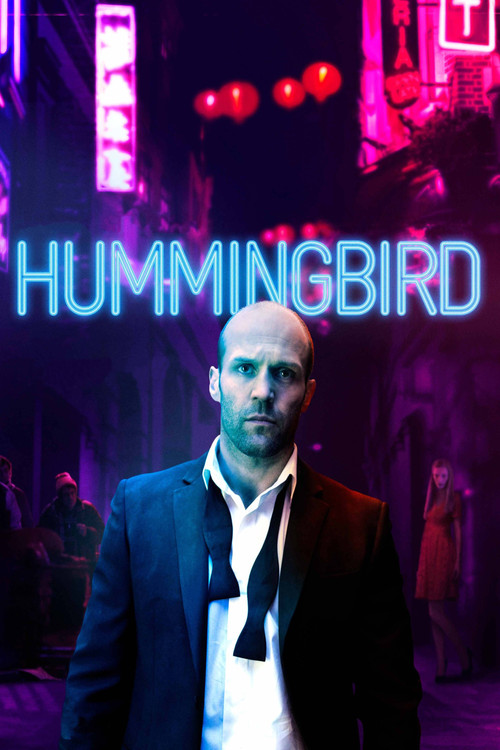
Hummingbird
The hummingbird dives and darts with great agility, representing fertility and joy. Huitzilopochtil is an expression of willpower, strength and survival carried forward through dance.
The film financial setback against its moderate budget of $20.0M, earning $8.4M globally (-58% loss). While initial box office returns were modest, the film has gained appreciation for its fresh perspective within the documentary genre.


Plot Structure
Story beats plotted across runtime


Narrative Arc
Emotional journey through the story's key moments
Story Circle
Blueprint 15-beat structure
Arcplot Score Breakdown
Weighted: Precision (70%) + Arc (15%) + Theme (15%)
Hummingbird (2013) showcases meticulously timed dramatic framework, characteristic of Steven Knight's storytelling approach. This structural analysis examines how the film's 15-point plot structure maps to proven narrative frameworks across 1 hour and 40 minutes. With an Arcplot score of 7.5, the film showcases strong structural fundamentals.
Characters
Cast & narrative archetypes

Joseph Smith / Joey Jones
Sister Cristina
Dawn
Damon
Main Cast & Characters
Joseph Smith / Joey Jones
Played by Jason Statham
A damaged ex-Special Forces soldier living homeless in London who assumes a new identity and seeks redemption while hunting those who hurt someone he cared about.
Sister Cristina
Played by Agata Buzek
A compassionate nun who runs a soup kitchen and forms a complex relationship with Joey, struggling between her vows and her feelings.
Dawn
Played by Vicky McClure
A vulnerable homeless woman and Joey's friend who becomes a victim of violence, catalyzing his quest for vengeance.
Damon
Played by Benedict Wong
A ruthless drug dealer and criminal who becomes Joey's employer and connection to London's underworld.
Structural Analysis
The Status Quo at 1 minutes (1% through the runtime) establishes Joey is homeless, living rough in London with Isabel, beaten and desperate, a fugitive from military court-martial running from his violent past.. Structural examination shows that this early placement immediately immerses viewers in the story world.
The inciting incident occurs at 12 minutes when Joey is chased by thugs and accidentally breaks into an upscale apartment where the owner is away, discovering a chance to escape his street life.. At 12% through the film, this Disruption aligns precisely with traditional story structure. This beat shifts the emotional landscape, launching the protagonist into the central conflict.
The First Threshold at 24 minutes marks the transition into Act II, occurring at 24% of the runtime. This shows the protagonist's commitment to Joey actively chooses to fully assume his new identity, getting a job as a bouncer at a Chinese restaurant and committing to this double life rather than returning to homelessness., moving from reaction to action.
At 49 minutes, the Midpoint arrives at 49% of the runtime—precisely centered, creating perfect narrative symmetry. Of particular interest, this crucial beat Joey discovers Isabel has been murdered while working as a prostitute, a false defeat that transforms his mission from rescue to revenge and raises the stakes of his violent double life., fundamentally raising what's at risk. The emotional intensity shifts, dividing the narrative into clear before-and-after phases.
The Collapse moment at 74 minutes (74% through) represents the emotional nadir. Here, Joey's double life collapses: the apartment owner returns, his assumed identity dies, Sister Cristina rejects him after learning the full extent of his violence, and he loses his chance at redemption., indicates the protagonist at their lowest point. This beat's placement in the final quarter sets up the climactic reversal.
The Second Threshold at 79 minutes initiates the final act resolution at 79% of the runtime. Joey chooses to complete his revenge mission and face the consequences, synthesizing his violent skills with a final moral purpose, accepting he cannot escape who he is but can control how he uses it., demonstrating the transformation achieved throughout the journey.
Emotional Journey
Hummingbird's emotional architecture traces a deliberate progression across 15 carefully calibrated beats.
Narrative Framework
This structural analysis employs a 15-point narrative structure framework that maps key story moments. By mapping Hummingbird against these established plot points, we can identify how Steven Knight utilizes or subverts traditional narrative conventions. The plot point approach reveals not only adherence to structural principles but also creative choices that distinguish Hummingbird within the documentary genre.
Steven Knight's Structural Approach
Among the 3 Steven Knight films analyzed on Arcplot, the average structural score is 7.1, reflecting strong command of classical structure. Hummingbird represents one of the director's most structurally precise works. For comparative analysis, explore the complete Steven Knight filmography.
Comparative Analysis
Additional documentary films include Black Butterflies, Bambi: A Tale of Life in the Woods and Eternal You. For more Steven Knight analyses, see Locke, Serenity.
Plot Points by Act
Act I
SetupStatus Quo
Joey is homeless, living rough in London with Isabel, beaten and desperate, a fugitive from military court-martial running from his violent past.
Theme
Sister Cristina speaks about redemption and second chances during her charity work, establishing the central theme of whether violent men can truly change.
Worldbuilding
Joey's life on the streets is established: his friendship with Isabel, survival through theft, encounters with Sister Cristina at the shelter, and the brutal attack that scatters the homeless encampment.
Disruption
Joey is chased by thugs and accidentally breaks into an upscale apartment where the owner is away, discovering a chance to escape his street life.
Resistance
Joey debates whether to stay in the apartment, explores this new world of comfort, assumes the identity of the absent owner, and begins to clean himself up while searching for Isabel on the streets.
Act II
ConfrontationFirst Threshold
Joey actively chooses to fully assume his new identity, getting a job as a bouncer at a Chinese restaurant and committing to this double life rather than returning to homelessness.
Mirror World
Joey reconnects with Sister Cristina, beginning a complex relationship that will challenge his moral journey and represent the possibility of genuine redemption versus violence.
Premise
Joey thrives in his new life: excelling as enforcer for the Chinese mafia, making money, living in luxury, searching for Isabel, growing closer to Sister Cristina, and enjoying the power his skills provide.
Midpoint
Joey discovers Isabel has been murdered while working as a prostitute, a false defeat that transforms his mission from rescue to revenge and raises the stakes of his violent double life.
Opposition
Joey descends into darkness: hunting Isabel's killers with increasing brutality, his relationship with Sister Cristina deepens but becomes strained by his violence, and his criminal connections intensify as his past catches up.
Collapse
Joey's double life collapses: the apartment owner returns, his assumed identity dies, Sister Cristina rejects him after learning the full extent of his violence, and he loses his chance at redemption.
Crisis
Joey faces his darkest moment, processing the loss of both his false life and his hope for redemption, confronting whether he is capable of being anything other than a weapon.
Act III
ResolutionSecond Threshold
Joey chooses to complete his revenge mission and face the consequences, synthesizing his violent skills with a final moral purpose, accepting he cannot escape who he is but can control how he uses it.
Synthesis
Joey executes his final mission: eliminates Isabel's killers, settles accounts with the Chinese mafia, and prepares to turn himself in to military authorities, choosing accountability over escape.
Transformation
Joey walks away into uncertainty, transformed not into a peaceful man but into one who accepts responsibility for his violence, mirroring the opening but now moving toward justice rather than running from it.