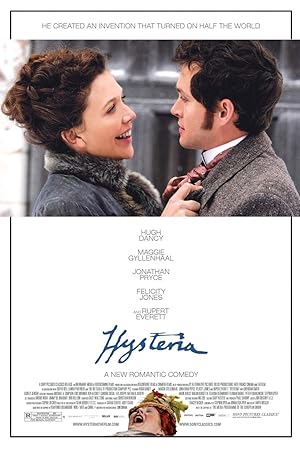
Hysteria
In 1880 pioneering doctor Mortimer Granville,sacked from various hospitals for challenging his superiors' out-moded methods,gets a job with Dr Dalrymple,who relieves female patients' frustrations - or hysteria - with pelvic massages which allow orgasm. The handsome young doctor attracts a large female clientele and gets engaged to Dalrymple's studious younger daughter Emily but after the constant massaging brings on a carpal injury he is sacked. Fortunately an enterprising inventor friend has come up with a power operated feather duster which will soon be transformed into a vibrator and make Mortimer a fortune. Along the way he also realises that his heart really lies with Emily's older sister Charlotte,an outspoken suffragette who runs a home for disadvantaged women in London's East End.
The film earned $9.5M at the global box office.


Plot Structure
Story beats plotted across runtime


Narrative Arc
Emotional journey through the story's key moments
Story Circle
Blueprint 15-beat structure
Arcplot Score Breakdown
Weighted: Precision (70%) + Arc (15%) + Theme (15%)
Hysteria (2011) reveals precise narrative architecture, characteristic of Tanya Wexler's storytelling approach. This structural analysis examines how the film's 15-point plot structure maps to proven narrative frameworks across 1 hour and 40 minutes. With an Arcplot score of 7.2, the film balances conventional beats with creative variation.
Characters
Cast & narrative archetypes

Dr. Mortimer Granville
Charlotte Dalrymple
Dr. Robert Dalrymple
Emily Dalrymple
Edmund St. John-Smythe
Main Cast & Characters
Dr. Mortimer Granville
Played by Hugh Dancy
An idealistic young doctor who challenges medical orthodoxy and accidentally invents the vibrator while treating "hysteria" patients.
Charlotte Dalrymple
Played by Maggie Gyllenhaal
A progressive, independent-minded woman who runs a settlement house for the poor and challenges Victorian social norms.
Dr. Robert Dalrymple
Played by Jonathan Pryce
A respected physician specializing in treating female hysteria through manual pelvic massage, mentor to Mortimer.
Emily Dalrymple
Played by Felicity Jones
The proper, conventional younger daughter of Dr. Dalrymple who initially pursues a courtship with Mortimer.
Edmund St. John-Smythe
Played by Rupert Everett
A wealthy, eccentric inventor and bon vivant who becomes Mortimer's friend and collaborator on the vibrator invention.
Structural Analysis
The Status Quo at 1 minutes (1% through the runtime) establishes Dr. Mortimer Granville practices modern medicine in 1880s London, believing in germ theory and progressive treatments. He is fired from yet another hospital position for challenging traditional medical practices, establishing his idealistic but professionally struggling status.. Notably, this early placement immediately immerses viewers in the story world.
The inciting incident occurs at 12 minutes when Mortimer is offered the position with Dr. Dalrymple, giving him financial stability and professional success for the first time. He enters a world of treating wealthy women's "hysteria" while beginning courtship with the conventional Emily.. At 12% through the film, this Disruption aligns precisely with traditional story structure. This beat shifts the emotional landscape, launching the protagonist into the central conflict.
The First Threshold at 24 minutes marks the transition into Act II, occurring at 24% of the runtime. This demonstrates the protagonist's commitment to Mortimer's hand cramps become so severe he can no longer perform treatments, threatening his livelihood and position. He is effectively fired from the practice. This forces him out of his comfortable trajectory with Emily and the established medical world., moving from reaction to action.
At 50 minutes, the Midpoint arrives at 50% of the runtime—precisely centered, creating perfect narrative symmetry. Significantly, this crucial beat Mortimer proposes to Emily and is accepted, seemingly securing his place in respectable society and the Dalrymple practice. This is a false victory - he has achieved conventional success but at the cost of his principles and true feelings. The stakes are raised as he must now choose between comfort and authenticity., fundamentally raising what's at risk. The emotional intensity shifts, dividing the narrative into clear before-and-after phases.
The Collapse moment at 73 minutes (73% through) represents the emotional nadir. Here, Charlotte is found guilty and faces sentencing. Mortimer fails to speak up in court to defend her, choosing safety and his engagement over his principles. She is sentenced, and their relationship appears dead. Mortimer has betrayed everything he believes in., illustrates the protagonist at their lowest point. This beat's placement in the final quarter sets up the climactic reversal.
The Second Threshold at 80 minutes initiates the final act resolution at 80% of the runtime. Mortimer breaks off his engagement to Emily and confronts Dr. Dalrymple about the truth of "hysteria" treatments - that they are addressing women's sexual and emotional neglect, not a disease. He chooses truth and passion over comfort and convention. He commits to fighting for Charlotte., demonstrating the transformation achieved throughout the journey.
Emotional Journey
Hysteria's emotional architecture traces a deliberate progression across 15 carefully calibrated beats.
Narrative Framework
This structural analysis employs a 15-point narrative structure framework that maps key story moments. By mapping Hysteria against these established plot points, we can identify how Tanya Wexler utilizes or subverts traditional narrative conventions. The plot point approach reveals not only adherence to structural principles but also creative choices that distinguish Hysteria within the biography genre.
Comparative Analysis
Additional biography films include After Thomas, Taking Woodstock and The Fire Inside.
Plot Points by Act
Act I
SetupStatus Quo
Dr. Mortimer Granville practices modern medicine in 1880s London, believing in germ theory and progressive treatments. He is fired from yet another hospital position for challenging traditional medical practices, establishing his idealistic but professionally struggling status.
Theme
Dr. Dalrymple (or Charlotte) suggests that progress requires challenging convention and that women's health and autonomy matter. The theme of recognizing what truly heals versus maintaining comfortable traditions is introduced.
Worldbuilding
Mortimer seeks employment and meets Dr. Dalrymple, who runs a successful practice treating "hysteria" in women through manual pelvic massage. We meet his two daughters: proper Emily and rebellious Charlotte who runs a settlement house for the poor. Mortimer is hired due to his skilled hands.
Disruption
Mortimer is offered the position with Dr. Dalrymple, giving him financial stability and professional success for the first time. He enters a world of treating wealthy women's "hysteria" while beginning courtship with the conventional Emily.
Resistance
Mortimer becomes successful at the practice, growing close to Emily while clashing with Charlotte over her work with the poor and her "radical" ideas about women's rights. He debates whether to conform to society's expectations or acknowledge the ethical problems he sees. His hand begins to cramp from the repetitive treatments.
Act II
ConfrontationFirst Threshold
Mortimer's hand cramps become so severe he can no longer perform treatments, threatening his livelihood and position. He is effectively fired from the practice. This forces him out of his comfortable trajectory with Emily and the established medical world.
Mirror World
Mortimer deepens his friendship with Edmund St. John-Smythe, a wealthy inventor and enthusiast of electricity. Edmund represents freedom, innovation, and challenging convention - the thematic opposite of the restrictive Victorian medical establishment. Their friendship will lead to the key invention.
Premise
Mortimer and Edmund experiment with electrical devices, leading to the invention of an electric massager that can treat hysteria effectively. Mortimer returns to practice with this revolutionary device, becoming wildly successful. The "promise of the premise" - the vibrator invention and its comic applications - plays out. Meanwhile, Charlotte's legal troubles intensify, and Mortimer is increasingly drawn to her passion despite his engagement to Emily.
Midpoint
Mortimer proposes to Emily and is accepted, seemingly securing his place in respectable society and the Dalrymple practice. This is a false victory - he has achieved conventional success but at the cost of his principles and true feelings. The stakes are raised as he must now choose between comfort and authenticity.
Opposition
Charlotte is arrested for her activism and faces serious legal consequences. Mortimer is torn between supporting her and maintaining his engagement to Emily. Dr. Dalrymple and Emily pressure him to abandon Charlotte. The vibrator business thrives but Mortimer feels increasingly hollow. His moral compromise becomes untenable as Charlotte faces trial.
Collapse
Charlotte is found guilty and faces sentencing. Mortimer fails to speak up in court to defend her, choosing safety and his engagement over his principles. She is sentenced, and their relationship appears dead. Mortimer has betrayed everything he believes in.
Crisis
Mortimer sits in dark contemplation of his choices. He realizes he cannot marry Emily and cannot continue living a lie. He processes that he has been treating a symptom (hysteria) while ignoring the disease (women's lack of autonomy and fulfillment). He must act on his true convictions.
Act III
ResolutionSecond Threshold
Mortimer breaks off his engagement to Emily and confronts Dr. Dalrymple about the truth of "hysteria" treatments - that they are addressing women's sexual and emotional neglect, not a disease. He chooses truth and passion over comfort and convention. He commits to fighting for Charlotte.
Synthesis
Mortimer uses his medical expertise and connections to help Charlotte's cause. He testifies or advocates for her release, combining his scientific knowledge with newfound moral courage. He publicly declares his feelings for Charlotte and his support for her work. The settlement house is saved, and Charlotte is freed.
Transformation
Mortimer and Charlotte are together, working as partners on her social reform projects. Unlike the opening where he was a struggling idealist alone, he is now a fulfilled idealist in partnership with someone who shares his values. He has integrated professional skill with personal integrity and found both love and purpose.