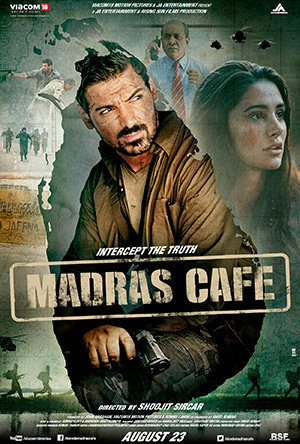
Madras Cafe
An Indian Intelligence agent (portrayed by John Abraham)[9] journeys into a war torn coastal island, to break a resolute rebel group. He deftly maneuvers his resources to make significant breakthroughs, amidst a scenario where the enemy has no face and the only counsel is 'Don't get caught.' At various junctions, he meets a charismatic and passionate journalist (portrayed by Nargis Fakhri) who is following her will to reflect the truth behind the civil war. The story unfolds as their quest for the truth reveals a deeper conspiracy, by a faceless enemy, united to seize a common nemesis - India.
Working with a modest budget of $5.4M, the film achieved a steady performer with $6.5M in global revenue (+20% profit margin).


Plot Structure
Story beats plotted across runtime


Narrative Arc
Emotional journey through the story's key moments
Story Circle
Blueprint 15-beat structure
Arcplot Score Breakdown
Weighted: Precision (70%) + Arc (15%) + Theme (15%)
Madras Cafe (2013) exemplifies precise narrative architecture, characteristic of Shoojit Sircar's storytelling approach. This structural analysis examines how the film's 15-point plot structure maps to proven narrative frameworks across 2 hours and 10 minutes. With an Arcplot score of 7.1, the film balances conventional beats with creative variation.
Characters
Cast & narrative archetypes

Major Vikram Singh
Jaya Sahni
Colonel Bala
Robin Dutt
Anna Bhaskaran
General
Main Cast & Characters
Major Vikram Singh
Played by John Abraham
An Indian intelligence officer tasked with breaking the nexus of arms and ammunition between Tamil separatists and international arms dealers in Sri Lanka.
Jaya Sahni
Played by Nargis Fakhri
A British war correspondent who becomes entangled in the dangerous world of espionage and helps Vikram uncover critical intelligence.
Colonel Bala
Played by Siddharth Basu
A ruthless and cunning leader of the Tamil separatist movement who will stop at nothing to achieve his goals.
Robin Dutt
Played by Rashi Khanna
A RAW operative and Vikram's handler who provides strategic guidance and support from New Delhi.
Anna Bhaskaran
Played by Prakash Belawadi
A Tamil militant leader and arms dealer operating in the conflict zone with complex motivations.
General
Played by Ajay Rathnam
A senior Indian military officer overseeing covert operations in Sri Lanka and directing RAW activities.
Structural Analysis
The Status Quo at 2 minutes (1% through the runtime) establishes Vikram Singh sits alone in a military office, a disciplined RAW agent awaiting his next assignment, operating in the shadows of intelligence work.. Notably, this early placement immediately immerses viewers in the story world.
The inciting incident occurs at 16 minutes when Vikram receives intelligence about a major LTTE operation being planned - an assassination plot that could destabilize the entire region and India's political landscape.. At 12% through the film, this Disruption aligns precisely with traditional story structure. This beat shifts the emotional landscape, launching the protagonist into the central conflict.
The First Threshold at 32 minutes marks the transition into Act II, occurring at 24% of the runtime. This shows the protagonist's commitment to Vikram makes the active choice to go deep into LTTE territory against orders, committing himself to stopping the assassination plot despite the personal and political risks., moving from reaction to action.
At 66 minutes, the Midpoint arrives at 50% of the runtime—precisely centered, creating perfect narrative symmetry. Of particular interest, this crucial beat Vikram discovers the full scope of the plot - the target is the former Indian Prime Minister Rajiv Gandhi - but realizes the conspiracy involves elements within Indian intelligence itself. False defeat: he has the truth but no one will believe him., fundamentally raising what's at risk. The emotional intensity shifts, dividing the narrative into clear before-and-after phases.
The Collapse moment at 96 minutes (74% through) represents the emotional nadir. Here, The assassination succeeds - Rajiv Gandhi is killed. Vikram's failure is complete. Jaya is also killed for knowing too much. Death is literal, and Vikram's mission ends in catastrophic failure., illustrates the protagonist at their lowest point. This beat's placement in the final quarter sets up the climactic reversal.
The Second Threshold at 105 minutes initiates the final act resolution at 80% of the runtime. Vikram synthesizes what he's learned: the system is corrupt, but he must document the truth for history. He chooses to testify and expose the conspiracy, knowing it will end his career., demonstrating the transformation achieved throughout the journey.
Emotional Journey
Madras Cafe's emotional architecture traces a deliberate progression across 15 carefully calibrated beats.
Narrative Framework
This structural analysis employs systematic plot point analysis that identifies crucial turning points. By mapping Madras Cafe against these established plot points, we can identify how Shoojit Sircar utilizes or subverts traditional narrative conventions. The plot point approach reveals not only adherence to structural principles but also creative choices that distinguish Madras Cafe within the action genre.
Comparative Analysis
Additional action films include The Bad Guys, Puss in Boots and Venom: The Last Dance.
Plot Points by Act
Act I
SetupStatus Quo
Vikram Singh sits alone in a military office, a disciplined RAW agent awaiting his next assignment, operating in the shadows of intelligence work.
Theme
A senior officer remarks that "in this game, the truth is always the first casualty" - establishing the film's exploration of moral compromise in intelligence operations.
Worldbuilding
Introduction to RAW operations in Sri Lanka, the LTTE conflict, Indian political involvement, and Vikram's role as an intelligence operative managing assets and gathering intel on the civil war.
Disruption
Vikram receives intelligence about a major LTTE operation being planned - an assassination plot that could destabilize the entire region and India's political landscape.
Resistance
Vikram debates whether to trust his sources, navigates bureaucratic resistance from his superiors, and establishes contact with journalist Jaya to understand the deeper political currents at play.
Act II
ConfrontationFirst Threshold
Vikram makes the active choice to go deep into LTTE territory against orders, committing himself to stopping the assassination plot despite the personal and political risks.
Mirror World
Vikram's relationship with journalist Jaya deepens - she represents the pursuit of truth and moral clarity, contrasting with his world of deception and compromise.
Premise
Vikram works undercover, gathering intelligence, meeting informants, navigating the dangerous world of LTTE operations, and piecing together the assassination conspiracy while avoiding detection.
Midpoint
Vikram discovers the full scope of the plot - the target is the former Indian Prime Minister Rajiv Gandhi - but realizes the conspiracy involves elements within Indian intelligence itself. False defeat: he has the truth but no one will believe him.
Opposition
Vikram faces active opposition from his own agency, political forces work against him, his sources are eliminated one by one, and the assassination plot accelerates toward execution.
Collapse
The assassination succeeds - Rajiv Gandhi is killed. Vikram's failure is complete. Jaya is also killed for knowing too much. Death is literal, and Vikram's mission ends in catastrophic failure.
Crisis
Vikram processes the devastation - the deaths, the political conspiracy, his own complicity in a system that sacrifices truth for expedience. He confronts the darkness of intelligence work.
Act III
ResolutionSecond Threshold
Vikram synthesizes what he's learned: the system is corrupt, but he must document the truth for history. He chooses to testify and expose the conspiracy, knowing it will end his career.
Synthesis
Vikram provides testimony to investigators, names are named, the conspiracy is documented. He accepts the consequences, resigns from RAW, and ensures the historical record reflects the truth.
Transformation
Vikram walks away from intelligence work, haunted but unbowed. Unlike the opening where he was a willing operative, he's now a man who chose truth over loyalty - transformed by moral reckoning.