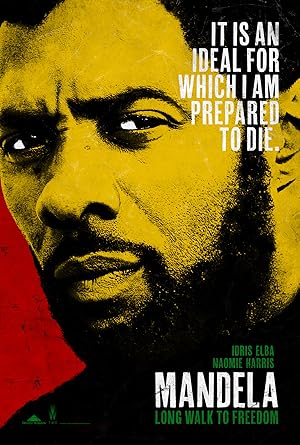
Mandela: Long Walk to Freedom
Nelson Mandela is a South African lawyer who joins the African National Congress in the 1940s when the law under the Apartheid system's brutal tyranny proves useless for his people. Forced to abandon peaceful protest for armed resistance after the Sharpeville Massacre, Mandela pays the price when he and his comrades are sentenced to life imprisonment for treason while his wife, Winnie, is abused by the authorities herself. Over the decades in chains, Mandela's spirit is unbowed as his struggle goes on in and beyond his captivity to become an international cause. However, as Winnie's determination hardens over the years into a violent ruthlessness, Nelson's own stature rises until he becomes the renowned leader of his movement. That status would be put to the test as his release nears and a way must be found to win a peaceful victory that will leave his country, and all its peoples, unstained.
The film underperformed commercially against its moderate budget of $35.0M, earning $28.0M globally (-20% loss).
Nominated for 1 Oscar. 13 wins & 36 nominations


Plot Structure
Story beats plotted across runtime


Narrative Arc
Emotional journey through the story's key moments
Story Circle
Blueprint 15-beat structure
Arcplot Score Breakdown
Weighted: Precision (70%) + Arc (15%) + Theme (15%)
Mandela: Long Walk to Freedom (2013) exemplifies precise narrative design, characteristic of Justin Chadwick's storytelling approach. This structural analysis examines how the film's 15-point plot structure maps to proven narrative frameworks across 2 hours and 21 minutes. With an Arcplot score of 7.1, the film balances conventional beats with creative variation.
Characters
Cast & narrative archetypes

Nelson Mandela
Winnie Mandela
Walter Sisulu
Oliver Tambo
James Gregory
Evelyn Mase
Ahmed Kathrada
Govan Mbeki
Main Cast & Characters
Nelson Mandela
Played by Idris Elba
Anti-apartheid revolutionary who transforms from militant activist to statesman, spending 27 years in prison before becoming South Africa's first Black president.
Winnie Mandela
Played by Naomie Harris
Nelson's second wife, a fierce activist who becomes radicalized during his imprisonment and struggles with violence and political extremism.
Walter Sisulu
Played by Tony Kgoroge
ANC leader and mentor who guides Mandela into activism and remains a steadfast ally throughout the struggle.
Oliver Tambo
Played by Riaad Moosa
Mandela's law partner and fellow ANC leader who leads the organization in exile during Mandela's imprisonment.
James Gregory
Played by Rolf Lassgård
Prison warder assigned to Mandela who develops mutual respect with him over decades of incarceration.
Evelyn Mase
Played by Terry Pheto
Mandela's first wife who divorces him as his political commitments increasingly overshadow family life.
Ahmed Kathrada
Played by Fana Mokoena
Fellow prisoner and lifelong friend who serves time with Mandela on Robben Island.
Govan Mbeki
Played by Deon Lotz
Veteran communist activist and intellectual imprisoned alongside Mandela, father of future president Thabo Mbeki.
Structural Analysis
The Status Quo at 2 minutes (1% through the runtime) establishes Young Nelson Mandela in rural Transkei, running freely through the hills during his boyhood initiation ceremony, representing his initial freedom and connection to tribal traditions before the struggle begins.. Of particular interest, this early placement immediately immerses viewers in the story world.
The inciting incident occurs at 17 minutes when The Sharpeville Massacre of 1960, where police open fire on peaceful protesters, killing 69 people. This atrocity forces Mandela to realize that non-violent resistance is no longer viable against the brutal apartheid regime.. At 12% through the film, this Disruption aligns precisely with traditional story structure. This beat shifts the emotional landscape, launching the protagonist into the central conflict.
The First Threshold at 34 minutes marks the transition into Act II, occurring at 24% of the runtime. This demonstrates the protagonist's commitment to Mandela is arrested at a roadblock in 1962 after returning from military training abroad. He chooses to use his trial as a platform to indict the apartheid system, transforming from activist to prisoner, entering the world of captivity that will define the next decades., moving from reaction to action.
At 71 minutes, the Midpoint arrives at 50% of the runtime—precisely centered, creating perfect narrative symmetry. Significantly, this crucial beat The Soweto Uprising of 1976 reaches Mandela in prison as young activists are massacred. He realizes the struggle has evolved without him, a new generation is fighting, and his imprisonment may outlast his life. This is a false defeat—he seems forgotten, yet the movement grows stronger., fundamentally raising what's at risk. The emotional intensity shifts, dividing the narrative into clear before-and-after phases.
The Collapse moment at 106 minutes (75% through) represents the emotional nadir. Here, Mandela learns that Winnie has been implicated in violent crimes, including the murder of a young activist. The woman he loved and the marriage he sacrificed everything for has been destroyed by the very struggle they dedicated their lives to. His personal life is shattered., demonstrates the protagonist at their lowest point. This beat's placement in the final quarter sets up the climactic reversal.
The Second Threshold at 113 minutes initiates the final act resolution at 80% of the runtime. F.W. De Klerk becomes President and signals real change is possible. Mandela realizes reconciliation, not revenge, is the path forward. He chooses to embrace negotiation and forgiveness, synthesizing his tribal values, political principles, and hard-won wisdom into a new vision for South Africa., demonstrating the transformation achieved throughout the journey.
Emotional Journey
Mandela: Long Walk to Freedom's emotional architecture traces a deliberate progression across 15 carefully calibrated beats.
Narrative Framework
This structural analysis employs a 15-point narrative structure framework that maps key story moments. By mapping Mandela: Long Walk to Freedom against these established plot points, we can identify how Justin Chadwick utilizes or subverts traditional narrative conventions. The plot point approach reveals not only adherence to structural principles but also creative choices that distinguish Mandela: Long Walk to Freedom within the biography genre.
Justin Chadwick's Structural Approach
Among the 3 Justin Chadwick films analyzed on Arcplot, the average structural score is 6.8, demonstrating varied approaches to story architecture. Mandela: Long Walk to Freedom represents one of the director's most structurally precise works. For comparative analysis, explore the complete Justin Chadwick filmography.
Comparative Analysis
Additional biography films include After Thomas, Taking Woodstock and The Fire Inside. For more Justin Chadwick analyses, see The Other Boleyn Girl, Tulip Fever.
Plot Points by Act
Act I
SetupStatus Quo
Young Nelson Mandela in rural Transkei, running freely through the hills during his boyhood initiation ceremony, representing his initial freedom and connection to tribal traditions before the struggle begins.
Theme
Mandela's tribal elder tells him during the initiation ceremony that "these young men are flowers of the nation" and warns about the false promise of education under white rule, stating the central theme about dignity, freedom, and the cost of liberation.
Worldbuilding
Establishing Mandela's journey from rural Transkei to Johannesburg in the 1940s, his work as a lawyer, the harsh realities of apartheid, his marriage to Evelyn, and his introduction to the ANC and political activism.
Disruption
The Sharpeville Massacre of 1960, where police open fire on peaceful protesters, killing 69 people. This atrocity forces Mandela to realize that non-violent resistance is no longer viable against the brutal apartheid regime.
Resistance
Mandela debates with ANC leaders about abandoning non-violence, forms the militant wing Umkhonto we Sizwe (MK), begins sabotage operations, divorces Evelyn, meets and falls in love with Winnie, and prepares for armed resistance despite internal opposition.
Act II
ConfrontationFirst Threshold
Mandela is arrested at a roadblock in 1962 after returning from military training abroad. He chooses to use his trial as a platform to indict the apartheid system, transforming from activist to prisoner, entering the world of captivity that will define the next decades.
Mirror World
Mandela is sentenced to life imprisonment at the Rivonia Trial in 1964 after his famous "I am prepared to die" speech. His relationship with Winnie becomes the mirror world representing love, sacrifice, and the personal cost of political commitment.
Premise
The brutal reality of Robben Island prison: hard labor in the limestone quarry, systematic dehumanization, fierce debates with guards and fellow prisoners, Mandela's growth as a leader even in captivity, and his deteriorating connection with Winnie and his family on the outside.
Midpoint
The Soweto Uprising of 1976 reaches Mandela in prison as young activists are massacred. He realizes the struggle has evolved without him, a new generation is fighting, and his imprisonment may outlast his life. This is a false defeat—he seems forgotten, yet the movement grows stronger.
Opposition
Years of grinding prison routine, Winnie's radicalization and descent into violent tactics on the outside, Mandela's increasing isolation from his family, secret negotiations with the government beginning, and the moral complexity of maintaining principle while the struggle intensifies.
Collapse
Mandela learns that Winnie has been implicated in violent crimes, including the murder of a young activist. The woman he loved and the marriage he sacrificed everything for has been destroyed by the very struggle they dedicated their lives to. His personal life is shattered.
Crisis
Mandela faces his darkest hour in prison: his marriage is ending, he's been imprisoned for over 25 years, apartheid still stands, and he must decide whether to continue secret negotiations with the government or remain defiant. He processes the personal cost of his choices.
Act III
ResolutionSecond Threshold
F.W. de Klerk becomes President and signals real change is possible. Mandela realizes reconciliation, not revenge, is the path forward. He chooses to embrace negotiation and forgiveness, synthesizing his tribal values, political principles, and hard-won wisdom into a new vision for South Africa.
Synthesis
Mandela is released from prison in 1990 after 27 years, navigates the delicate negotiations to end apartheid, manages violent factions on both sides, separates from Winnie, and leads South Africa to its first democratic election in 1994 where he becomes President.
Transformation
President Mandela stands before a packed stadium at his inauguration, the same man who ran freely as a boy in Transkei, now leading a free nation. He has transformed from warrior to prisoner to reconciler, embodying forgiveness and unity over vengeance.