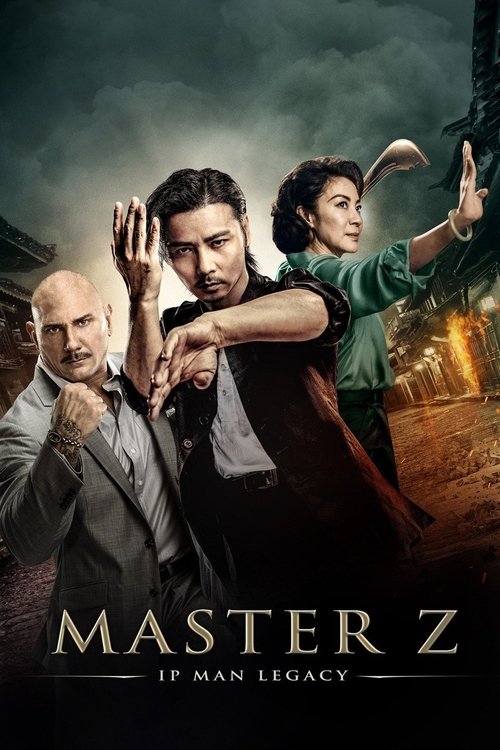
Master Z: Ip Man Legacy
Following his defeat by Master Ip, Cheung Tin Chi tries to make a life with his young son in Hong Kong, waiting tables at a bar that caters to expats. But it's not long before the mix of foreigners, money, and triad leaders draw him once again to the fight.
The film earned $21.8M at the global box office.


Plot Structure
Story beats plotted across runtime


Narrative Arc
Emotional journey through the story's key moments
Story Circle
Blueprint 15-beat structure
Arcplot Score Breakdown
Weighted: Precision (70%) + Arc (15%) + Theme (15%)
Master Z: Ip Man Legacy (2018) demonstrates precise story structure, characteristic of Yuen Woo-Ping's storytelling approach. This structural analysis examines how the film's 15-point plot structure maps to proven narrative frameworks across 1 hour and 47 minutes. With an Arcplot score of 7.4, the film balances conventional beats with creative variation.
Characters
Cast & narrative archetypes

Cheung Tin-chi
Tso Sai Kit
Julia
Niang
Fu
Cheung Fung
Owen Davidson
Main Cast & Characters
Cheung Tin-chi
Played by Max Zhang
Former Wing Chun master trying to live peacefully and raise his son after leaving martial arts behind
Tso Sai Kit
Played by Kevin Cheng
Ruthless drug lord who controls the Golden Triangle and uses violence to maintain his criminal empire
Julia
Played by Liu Yan
Courageous bar owner who stands up to criminal forces and becomes an ally to Tin-chi
Niang
Played by Michelle Yeoh
Tso Sai Kit's sister and enforcer, a skilled fighter torn between family loyalty and morality
Fu
Played by Chrissie Chau
Street-smart young woman working for Tso who befriends Tin-chi and questions her choices
Cheung Fung
Played by Nafeek Chan
Tin-chi's young son who represents his father's motivation to stay out of violence
Owen Davidson
Played by Dave Bautista
British police officer investigating the drug trade in Hong Kong
Structural Analysis
The Status Quo at 1 minutes (1% through the runtime) establishes Cheung Tin Chi runs a modest grocery store on Bar Street in Hong Kong, living a quiet life with his young son after his defeat by Ip Man. He has abandoned martial arts and keeps his head down, representing his fallen state after losing his identity as a Wing Chun master.. Significantly, this early placement immediately immerses viewers in the story world.
The inciting incident occurs at 14 minutes when Tin Chi witnesses Kwan's men harassing Julia and Nana. When they pursue the women into an alley and violence becomes imminent, Tin Chi is forced to intervene, revealing his martial arts abilities and setting him on a collision course with the criminal underworld.. At 13% through the film, this Disruption is delayed, allowing extended setup of the story world. This beat shifts the emotional landscape, launching the protagonist into the central conflict.
The First Threshold at 27 minutes marks the transition into Act II, occurring at 25% of the runtime. This illustrates the protagonist's commitment to When Kwan's thugs threaten the Bar Street merchants and specifically target Tin Chi's grocery store with his son inside, Tin Chi makes the active choice to fight back and protect his community rather than flee or submit. He commits to standing against the criminal syndicate., moving from reaction to action.
At 54 minutes, the Midpoint arrives at 50% of the runtime—precisely centered, creating perfect narrative symmetry. Structural examination shows that this crucial beat Tin Chi confronts and defeats Kwan in a dramatic rooftop battle, seemingly breaking the criminal organization's grip on Bar Street. This false victory makes it appear he has won, but it only enrages Owen Davidson who now views Tin Chi as a personal enemy requiring complete destruction., fundamentally raising what's at risk. The emotional intensity shifts, dividing the narrative into clear before-and-after phases.
The Collapse moment at 80 minutes (75% through) represents the emotional nadir. Here, Owen's men kidnap Tin Chi's son and Julia. Fu is severely beaten. Owen sets fire to Bar Street, destroying homes and businesses. Tin Chi is captured and beaten, seemingly powerless to protect anyone he cares about. The whiff of death is literal as the community he tried to save burns around him., reveals the protagonist at their lowest point. This beat's placement in the final quarter sets up the climactic reversal.
The Second Threshold at 86 minutes initiates the final act resolution at 80% of the runtime. Michelle Davidson, disgusted by her brother's cruelty, provides Tin Chi with information about where his son and Julia are being held. Tin Chi synthesizes his martial arts mastery with his newfound purpose - he is not just a fighter but a protector. He rises to confront Owen one final time., demonstrating the transformation achieved throughout the journey.
Emotional Journey
Master Z: Ip Man Legacy's emotional architecture traces a deliberate progression across 15 carefully calibrated beats.
Narrative Framework
This structural analysis employs structural analysis methodology used to understand storytelling architecture. By mapping Master Z: Ip Man Legacy against these established plot points, we can identify how Yuen Woo-Ping utilizes or subverts traditional narrative conventions. The plot point approach reveals not only adherence to structural principles but also creative choices that distinguish Master Z: Ip Man Legacy within the action genre.
Yuen Woo-Ping's Structural Approach
Among the 3 Yuen Woo-Ping films analyzed on Arcplot, the average structural score is 7.4, reflecting strong command of classical structure. Master Z: Ip Man Legacy represents one of the director's most structurally precise works. For comparative analysis, explore the complete Yuen Woo-Ping filmography.
Comparative Analysis
Additional action films include The Bad Guys, Puss in Boots and Venom: The Last Dance. For more Yuen Woo-Ping analyses, see Crouching Tiger, Hidden Dragon: Sword of Destiny, Drunken Master.
Plot Points by Act
Act I
SetupStatus Quo
Cheung Tin Chi runs a modest grocery store on Bar Street in Hong Kong, living a quiet life with his young son after his defeat by Ip Man. He has abandoned martial arts and keeps his head down, representing his fallen state after losing his identity as a Wing Chun master.
Theme
Fu, Tin Chi's friend and neighbor, remarks that a man cannot run from who he truly is forever - suggesting that one's true nature and skills must eventually be used for righteous purposes, not hidden away.
Worldbuilding
The seedy underworld of Bar Street is established: drug dealers, nightclub hostesses Julia and Nana, the corrupt police, and the presence of the foreign crime syndicate. Tin Chi's simple life with his son and his reluctance to fight are shown alongside the simmering tensions between local merchants and the criminal elements.
Disruption
Tin Chi witnesses Kwan's men harassing Julia and Nana. When they pursue the women into an alley and violence becomes imminent, Tin Chi is forced to intervene, revealing his martial arts abilities and setting him on a collision course with the criminal underworld.
Resistance
After the alley fight, Tin Chi tries to return to obscurity but finds it impossible. Julia thanks him and warns him about Kwan and the Davidson crime family. Tin Chi debates whether to get involved further, while Owen Davidson takes notice of this skilled fighter who humiliated his men.
Act II
ConfrontationFirst Threshold
When Kwan's thugs threaten the Bar Street merchants and specifically target Tin Chi's grocery store with his son inside, Tin Chi makes the active choice to fight back and protect his community rather than flee or submit. He commits to standing against the criminal syndicate.
Mirror World
Julia becomes Tin Chi's primary connection to the thematic B-story. As a woman trying to escape her past as a hostess and build a legitimate life, she mirrors Tin Chi's own struggle with identity. Their developing relationship and her courage inspire him to embrace who he really is.
Premise
Tin Chi unleashes his Wing Chun skills in spectacular fashion, taking on waves of gangsters. He forms alliances with the Bar Street community including Fu and the sisters. Owen Davidson becomes increasingly obsessed with destroying this interfering martial artist, while Tin Chi rediscovers the purpose his skills can serve.
Midpoint
Tin Chi confronts and defeats Kwan in a dramatic rooftop battle, seemingly breaking the criminal organization's grip on Bar Street. This false victory makes it appear he has won, but it only enrages Owen Davidson who now views Tin Chi as a personal enemy requiring complete destruction.
Opposition
Owen Davidson escalates his tactics brutally. He uses his police connections to frame Tin Chi, threatens his son, and employs more dangerous fighters. Nana is endangered. The community that supported Tin Chi is terrorized. Owen's sister Michelle tries to mediate but fails as Owen becomes increasingly unhinged.
Collapse
Owen's men kidnap Tin Chi's son and Julia. Fu is severely beaten. Owen sets fire to Bar Street, destroying homes and businesses. Tin Chi is captured and beaten, seemingly powerless to protect anyone he cares about. The whiff of death is literal as the community he tried to save burns around him.
Crisis
In his darkest moment, bloodied and seemingly defeated, Tin Chi must reconcile his desire for a peaceful life with the reality that his abilities carry responsibility. The burning streets reflect his inner turmoil as he processes the cost of both action and inaction.
Act III
ResolutionSecond Threshold
Michelle Davidson, disgusted by her brother's cruelty, provides Tin Chi with information about where his son and Julia are being held. Tin Chi synthesizes his martial arts mastery with his newfound purpose - he is not just a fighter but a protector. He rises to confront Owen one final time.
Synthesis
Tin Chi storms Owen's compound in a spectacular finale. He battles through waves of henchmen, rescues Julia and his son, and finally faces Owen Davidson in an intense one-on-one duel. Using his complete Wing Chun mastery and fighting for something greater than himself, Tin Chi defeats Owen decisively.
Transformation
Tin Chi stands with his son, Julia, and the rebuilt Bar Street community. Unlike the opening where he hid his identity and lived in defeat, he now embraces being a martial artist and protector. He has found purpose beyond winning or losing - his skills serve to protect the innocent. He is whole again.