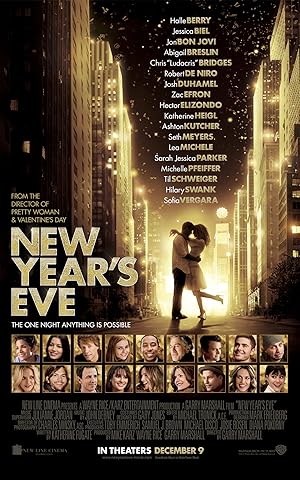
New Year's Eve
Set during New Year's Eve in New York city, this movie follows several people and how the day affects them. Kim is a single mother who still thinks of her daughter, Hailey as a child who wants to go out with a boy so that she could kiss him at midnight. Claire, who is in charge of the city's annual tradition, the ball drop on Times Square. And when something goes wrong she has to ask an electrician, who was fired, to come and fix it. Laura, a chef who is cooking the New year's Eve party for a record company who runs into Jensen, her ex who's a singer and performing at the party. While he tries to apologize for how things ended, she refuses to accept it. Ingrid, a woman who works at the record company, after having a near death experience, decides to quit her job and asks a young messenger, Paul to help her fulfill her resolutions. And at a hospital, Stan, a man who is in the final stages of cancer, only wishes to see the ball drop. Also Griffin and Tess, a couple who are expecting, want to be the ones who give birth first after New Year because of the available cash prize; but another couple is also about to give birth. Randy a man who's not exactly fond of the holiday because of something that happened, finds himself trapped in an elevator with a singer who is one of Jensen's back up singers when he performs at Times Square. And Sam, son of the owner of the record company, who is out of town and is trying to get back to the city so that he could give a speech at the party, but when he has an accident and since it's a holiday, his car can't be fixed so he hitches a ride with some people going to the city. But it seems he has another reason why he needs to get back.
Despite a respectable budget of $56.0M, New Year's Eve became a commercial success, earning $142.0M worldwide—a 154% return.
2 wins & 8 nominations


Plot Structure
Story beats plotted across runtime


Narrative Arc
Emotional journey through the story's key moments
Story Circle
Blueprint 15-beat structure
Arcplot Score Breakdown
Weighted: Precision (70%) + Arc (15%) + Theme (15%)
New Year's Eve (2011) reveals meticulously timed narrative design, characteristic of Garry Marshall's storytelling approach. This structural analysis examines how the film's 15-point plot structure maps to proven narrative frameworks across 1 hour and 58 minutes. With an Arcplot score of 6.9, the film balances conventional beats with creative variation.
Structural Analysis
The Status Quo at 1 minutes (1% through the runtime) establishes Opening montage of New York City preparing for New Year's Eve. Various characters wake up to December 31st in their ordinary lives: Claire (Hilary Swank) oversees Times Square preparations, Randy (Ashton Kutcher) hates New Year's, Ingrid (Michelle Pfeiffer) feels unfulfilled, and others face their daily routines before the big night.. Structural examination shows that this early placement immediately immerses viewers in the story world.
The inciting incident occurs at 14 minutes when Multiple disruptions occur simultaneously: the Times Square ball malfunctions (Claire's crisis), Randy and Elise get trapped in the elevator for hours, Ingrid fully commits to her resolution list by hiring Paul as her courier guide, and Jensen faces rejection at his comeback attempt. The status quo for all characters becomes impossible to maintain.. At 12% through the film, this Disruption aligns precisely with traditional story structure. This beat shifts the emotional landscape, launching the protagonist into the central conflict.
The First Threshold at 29 minutes marks the transition into Act II, occurring at 25% of the runtime. This shows the protagonist's commitment to Active choices to enter new worlds: Randy chooses to open up emotionally to Elise about his past pain; Ingrid fully commits to completing her resolutions with Paul's help; Kim decides to pursue reconciliation with Paul; Jensen commits to a genuine comeback; Laura embraces the chaos of New Year's Eve labor. Each character makes an irreversible decision to pursue change rather than safety., moving from reaction to action.
At 58 minutes, the Midpoint arrives at 50% of the runtime—precisely centered, creating perfect narrative symmetry. Notably, this crucial beat False victory at the halfway point: Randy and Elise share a deep connection and kiss in the elevator, believing they'll be together; Ingrid has completed many resolutions and feels alive; the ball repair seems promising; multiple couples seem to be finding their way. Stakes raise as time pressure intensifies - only hours until midnight. Everything seems to be working out, but the clock is ticking., fundamentally raising what's at risk. The emotional intensity shifts, dividing the narrative into clear before-and-after phases.
The Collapse moment at 87 minutes (73% through) represents the emotional nadir. Here, Multiple "deaths" occur: Sam dies in the hospital (literal death), representing the passage of time and mortality that hangs over all storylines; Randy retreats into his old pain, his hope of connection dying; the ball seems unfixable, threatening to kill Claire's career and New Year's itself; Ingrid's courage wavers. The darkest moment before midnight where all storylines face their lowest point., indicates the protagonist at their lowest point. This beat's placement in the final quarter sets up the climactic reversal.
The Second Threshold at 94 minutes initiates the final act resolution at 80% of the runtime. Synthesis and breakthrough: Elise finds Randy and explains her truth (she broke off her engagement for him); Claire discovers the unconventional solution to fix the ball; Ingrid finds courage through Paul's support; characters realize that taking the risk is worth it regardless of outcome. The thematic lesson - that hope and second chances require vulnerability - enables the final push toward midnight., demonstrating the transformation achieved throughout the journey.
Emotional Journey
New Year's Eve's emotional architecture traces a deliberate progression across 15 carefully calibrated beats.
Narrative Framework
This structural analysis employs systematic plot point analysis that identifies crucial turning points. By mapping New Year's Eve against these established plot points, we can identify how Garry Marshall utilizes or subverts traditional narrative conventions. The plot point approach reveals not only adherence to structural principles but also creative choices that distinguish New Year's Eve within the comedy genre.
Garry Marshall's Structural Approach
Among the 14 Garry Marshall films analyzed on Arcplot, the average structural score is 6.9, demonstrating varied approaches to story architecture. New Year's Eve takes a more unconventional approach compared to the director's typical style. For comparative analysis, explore the complete Garry Marshall filmography.
Comparative Analysis
Additional comedy films include The Bad Guys, Ella Enchanted and The Evening Star. For more Garry Marshall analyses, see Raising Helen, The Princess Diaries and Exit to Eden.
Plot Points by Act
Act I
SetupStatus Quo
Opening montage of New York City preparing for New Year's Eve. Various characters wake up to December 31st in their ordinary lives: Claire (Hilary Swank) oversees Times Square preparations, Randy (Ashton Kutcher) hates New Year's, Ingrid (Michelle Pfeiffer) feels unfulfilled, and others face their daily routines before the big night.
Theme
Ingrid's boss tells her "It's New Year's Eve - anything can happen." This casual line establishes the film's thematic core: the power of new beginnings and the possibility for transformation when we're willing to take chances.
Worldbuilding
Introduction of all ensemble storylines: Claire manages Times Square ball drop logistics; Ingrid quits her job to complete her New Year's resolutions; Randy is stuck in an elevator with Elise; Paul and Kim debate reconciliation; Sam is dying in the hospital while his nurse Aimee tries to fulfill his last wish; Laura is about to give birth and wants the Times Square prize; Tess and Griffin face young romance complications; and Jensen Records attempts a comeback performance.
Disruption
Multiple disruptions occur simultaneously: the Times Square ball malfunctions (Claire's crisis), Randy and Elise get trapped in the elevator for hours, Ingrid fully commits to her resolution list by hiring Paul as her courier guide, and Jensen faces rejection at his comeback attempt. The status quo for all characters becomes impossible to maintain.
Resistance
Characters resist and debate their situations: Randy resists connecting with Elise in the elevator; Paul debates helping Kim despite their separation; Ingrid hesitates before fully committing to adventure with Paul; Laura debates whether having the baby at midnight is worth the stress; Claire debates unconventional solutions to fix the ball. Multiple mentor figures appear - Paul guides Ingrid, Aimee guides Sam's daughter, and various characters encourage others to take risks.
Act II
ConfrontationFirst Threshold
Active choices to enter new worlds: Randy chooses to open up emotionally to Elise about his past pain; Ingrid fully commits to completing her resolutions with Paul's help; Kim decides to pursue reconciliation with Paul; Jensen commits to a genuine comeback; Laura embraces the chaos of New Year's Eve labor. Each character makes an irreversible decision to pursue change rather than safety.
Mirror World
The elevator relationship between Randy and Elise becomes the thematic heart. Randy, who has avoided New Year's Eve for a year due to heartbreak, meets Elise, who embodies hope and second chances. Their confined space forces authentic connection, mirroring the film's message that transformation requires vulnerability. This relationship carries the primary emotional and thematic weight.
Premise
The "promise of the premise" - New Year's Eve magic unfolds: Ingrid experiences adventures she's never had (karaoke, meeting rock stars); Randy and Elise grow closer sharing stories; Laura races toward her midnight delivery; Tess and Griffin navigate young love at the Times Square celebration; Claire frantically works to fix the ball; Paul and Kim reconnect through helping others; Sam watches the city from his hospital window. Multiple storylines interweave showing the promise of transformation.
Midpoint
False victory at the halfway point: Randy and Elise share a deep connection and kiss in the elevator, believing they'll be together; Ingrid has completed many resolutions and feels alive; the ball repair seems promising; multiple couples seem to be finding their way. Stakes raise as time pressure intensifies - only hours until midnight. Everything seems to be working out, but the clock is ticking.
Opposition
Pressure intensifies as midnight approaches: the ball repair fails repeatedly, increasing Claire's desperation; Randy and Elise are freed from the elevator but he discovers she's engaged and runs away hurt; Ingrid struggles with her final resolutions; Paul and Kim's reconciliation faces obstacles; Jensen's performance slot is threatened; Laura's delivery becomes complicated; Sam's time runs out. The antagonist (time itself, fear, past hurt) closes in on all characters.
Collapse
Multiple "deaths" occur: Sam dies in the hospital (literal death), representing the passage of time and mortality that hangs over all storylines; Randy retreats into his old pain, his hope of connection dying; the ball seems unfixable, threatening to kill Claire's career and New Year's itself; Ingrid's courage wavers. The darkest moment before midnight where all storylines face their lowest point.
Crisis
Dark night of the soul: characters process their losses and fears. Aimee comforts Sam's family in grief; Randy isolates himself in pain; Claire faces potential failure; Ingrid contemplates giving up on her final resolution (kissing a stranger at midnight). The emotional darkness before dawn, where characters sit with their fear before finding new resolve.
Act III
ResolutionSecond Threshold
Synthesis and breakthrough: Elise finds Randy and explains her truth (she broke off her engagement for him); Claire discovers the unconventional solution to fix the ball; Ingrid finds courage through Paul's support; characters realize that taking the risk is worth it regardless of outcome. The thematic lesson - that hope and second chances require vulnerability - enables the final push toward midnight.
Synthesis
Finale sequences: the ball is fixed and drops successfully; Randy and Elise reunite and kiss at midnight; Laura delivers her baby and wins the Times Square prize; Ingrid completes her resolutions including her midnight kiss with Paul; Paul and Kim reconcile; Tess and Griffin share their moment; Jensen performs successfully; all storylines resolve as the clock strikes midnight. The ensemble executes their final acts of courage.
Transformation
Closing montage mirrors the opening: New York City on January 1st at dawn. But everyone is transformed - Randy embraces New Year's Eve again with Elise, Ingrid has become adventurous, Paul and Kim are reunited, new life has begun with Laura's baby, and hope is restored. The city that began in routine darkness ends in the light of new beginnings, showing that second chances are real when we're brave enough to take them.