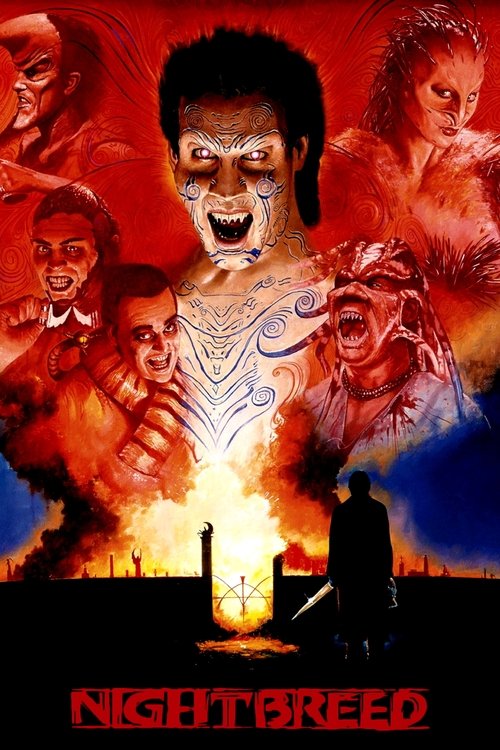
Nightbreed
A troubled young man is drawn to a mythical place called Midian where a variety of friendly monsters are hiding from humanity. Meanwhile, a sadistic serial killer is looking for a patsy.
The film underperformed commercially against its tight budget of $11.0M, earning $8.9M globally (-19% loss).
7 wins & 5 nominations


Plot Structure
Story beats plotted across runtime


Narrative Arc
Emotional journey through the story's key moments
Story Circle
Blueprint 15-beat structure
Arcplot Score Breakdown
Weighted: Precision (70%) + Arc (15%) + Theme (15%)
Nightbreed (1990) showcases carefully calibrated narrative design, characteristic of Clive Barker's storytelling approach. This structural analysis examines how the film's 11-point plot structure maps to proven narrative frameworks across 2 hours and 1 minutes. With an Arcplot score of 7.0, the film balances conventional beats with creative variation.
Characters
Cast & narrative archetypes

Aaron Boone
Dr. Philip K. Decker
Lori Winston
Lylesberg
Narcisse
Peloquin
Rachel
Captain Eigerman
Main Cast & Characters
Aaron Boone
Played by Craig Sheffer
A troubled young man plagued by nightmares of a mythical place called Midian, who discovers he is destined to become one of the Nightbreed, a tribe of monsters hiding from humanity.
Dr. Philip K. Decker
Played by David Cronenberg
Boone's psychiatrist who is secretly a serial killer known as the Mask, manipulating Boone while pursuing his own murderous agenda.
Lori Winston
Played by Anne Bobby
Boone's devoted girlfriend who refuses to give up on him and follows him into the world of Midian to save their love.
Lylesberg
Played by Doug Bradley
The wise and ancient leader of the Nightbreed who guards the laws and secrets of Midian with solemn duty.
Narcisse
Played by Hugh Ross
A mentally unstable man desperate to find Midian who tears off his own face to reveal his monstrous form beneath, serving as Boone's guide to the underground world.
Peloquin
Played by Oliver Parker
A fierce and suspicious Nightbreed warrior who bites Boone, transforming him, but remains distrustful of the newcomer throughout.
Rachel
Played by Catherine Chevalier
A gentle Nightbreed woman with porcupine-like quills who befriends Lori and represents the humanity within the monster community.
Captain Eigerman
Played by Charles Haid
A brutal and zealous police captain who leads the violent assault on Midian, driven by hatred and a desire to exterminate the Nightbreed.
Structural Analysis
The Status Quo at 1 minutes (1% through the runtime) establishes Boone experiences vivid nightmares of a mysterious underground city called Midian filled with monstrous creatures. He wakes disturbed beside his girlfriend Lori, revealing a man haunted by visions he doesn't understand.. The analysis reveals that this early placement immediately immerses viewers in the story world.
The inciting incident occurs at 15 minutes when Dr. Decker shows Boone crime scene photos and convinces him that he committed a series of brutal murders during blackouts. Boone's world shatters as he believes he is a monster and a serial killer.. At 12% through the film, this Disruption aligns precisely with traditional story structure. This beat shifts the emotional landscape, launching the protagonist into the central conflict.
The First Threshold at 30 minutes marks the transition into Act II, occurring at 25% of the runtime. This shows the protagonist's commitment to Boone chooses to travel to the cemetery at Midian to find the underground world of monsters. He actively decides to seek out the Nightbreed, believing he belongs among the damned., moving from reaction to action.
The Collapse moment at 91 minutes (75% through) represents the emotional nadir. Here, The armed mob led by Decker and Eigerman attacks Midian. The Nightbreed are slaughtered, their sacred underground home is invaded and destroyed. Lylesberg and many others die defending their people. Everything Boone found - community, acceptance, home - is being annihilated., illustrates the protagonist at their lowest point. This beat's placement in the final quarter sets up the climactic reversal.
The Synthesis at 97 minutes initiates the final act resolution at 80% of the runtime. The Berserkers and Nightbreed counterattack, driving back the human mob. Boone confronts and defeats Decker, unmasking the true monster. Lori chooses to become one of the Nightbreed. The surviving breed escape to find a new Midian., demonstrating the transformation achieved throughout the journey.
Emotional Journey
Nightbreed's emotional architecture traces a deliberate progression across 11 carefully calibrated beats.
Narrative Framework
This structural analysis employs proven narrative structure principles that track dramatic progression. By mapping Nightbreed against these established plot points, we can identify how Clive Barker utilizes or subverts traditional narrative conventions. The plot point approach reveals not only adherence to structural principles but also creative choices that distinguish Nightbreed within the horror genre.
Clive Barker's Structural Approach
Among the 3 Clive Barker films analyzed on Arcplot, the average structural score is 7.0, reflecting strong command of classical structure. Nightbreed exemplifies the director's characteristic narrative technique. For comparative analysis, explore the complete Clive Barker filmography.
Comparative Analysis
Additional horror films include Thinner, A Nightmare on Elm Street and Mary Reilly. For more Clive Barker analyses, see Lord of Illusions, Hellraiser.
Plot Points by Act
Act I
SetupStatus Quo
Boone experiences vivid nightmares of a mysterious underground city called Midian filled with monstrous creatures. He wakes disturbed beside his girlfriend Lori, revealing a man haunted by visions he doesn't understand.
Theme
Dr. Decker tells Boone that everyone wears masks to hide who they truly are inside. This establishes the film's central theme: the difference between appearance and true nature, and how society labels monsters.
Worldbuilding
The film establishes Boone's troubled mental state, his loving relationship with Lori, and his sessions with psychiatrist Dr. Decker. We learn Boone has been having recurring nightmares about Midian and fears he may be losing his grip on reality.
Disruption
Dr. Decker shows Boone crime scene photos and convinces him that he committed a series of brutal murders during blackouts. Boone's world shatters as he believes he is a monster and a serial killer.
Resistance
Boone flees in horror, attempting suicide and ending up in a psychiatric hospital. There he meets Narcisse, a fellow patient who speaks of Midian as a real place where monsters find sanctuary. Boone debates whether to seek out this refuge for the damned.
Act II
ConfrontationFirst Threshold
Boone chooses to travel to the cemetery at Midian to find the underground world of monsters. He actively decides to seek out the Nightbreed, believing he belongs among the damned.
Premise
Boone explores Midian and meets its inhabitants including Lylesberg, the prophet-leader. After being bitten by Peloquin and shot by police, Boone dies and is reborn as one of the Nightbreed. Lori searches desperately for him while Decker manipulates the authorities.
Opposition
Decker reveals himself as the true killer and manipulates the police and locals into believing Midian harbors dangerous criminals. He allies with the violent, bigoted police captain Eigerman. The Nightbreed face exposure and persecution as Decker orchestrates an assault on their sanctuary.
Collapse
The armed mob led by Decker and Eigerman attacks Midian. The Nightbreed are slaughtered, their sacred underground home is invaded and destroyed. Lylesberg and many others die defending their people. Everything Boone found - community, acceptance, home - is being annihilated.
Crisis
As Midian burns and the Nightbreed die around him, Boone must confront his failure to protect his new family. Lori is in danger, the sanctuary is destroyed, and the prophecy of Cabal as their savior seems to have failed.
Act III
ResolutionSynthesis
The Berserkers and Nightbreed counterattack, driving back the human mob. Boone confronts and defeats Decker, unmasking the true monster. Lori chooses to become one of the Nightbreed. The surviving breed escape to find a new Midian.