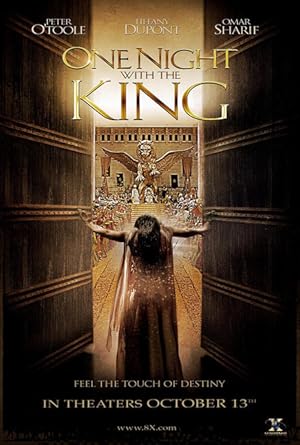
One Night with the King
The young Jewish girl, Hadassah, goes on to become the Biblical Esther, the Queen of Persia, who saves the Jewish nation from annihilation at the hands of its archenemy.
The film underperformed commercially against its moderate budget of $20.0M, earning $13.7M globally (-31% loss). While initial box office returns were modest, the film has gained appreciation for its bold vision within the biography genre.


Plot Structure
Story beats plotted across runtime


Narrative Arc
Emotional journey through the story's key moments
Story Circle
Blueprint 15-beat structure
Arcplot Score Breakdown
Weighted: Precision (70%) + Arc (15%) + Theme (15%)
One Night with the King (2006) showcases precise narrative design, characteristic of Michael O. Sajbel's storytelling approach. This structural analysis examines how the film's 15-point plot structure maps to proven narrative frameworks across 2 hours and 3 minutes. With an Arcplot score of 7.6, the film showcases strong structural fundamentals.
Characters
Cast & narrative archetypes

Hadassah / Queen Esther
King Xerxes
Haman
Mordecai
Jesse
Queen Vashti
Hegai
Memucan
Main Cast & Characters
Hadassah / Queen Esther
Played by Tiffany Dupont
A young Jewish orphan who becomes Queen of Persia and must risk her life to save her people from genocide.
King Xerxes
Played by Luke Goss
The powerful but lonely King of Persia who falls in love with Esther and must navigate court intrigue and deception.
Haman
Played by James Callis
The ambitious and vengeful prime minister who plots to exterminate all Jews in Persia to satisfy his hatred of Mordecai.
Mordecai
Played by John Rhys-Davies
Esther's devoted uncle and guardian who raised her after her parents' death and serves faithfully at the palace gate.
Jesse
Played by Tommy Lister Jr.
A young Jewish scribe who befriends Esther and represents the common people affected by Haman's decree.
Queen Vashti
Played by Jyoti Dogra
The former Queen of Persia whose refusal to obey Xerxes leads to her banishment and sets the story in motion.
Hegai
Played by Tommy Lister Jr.
The kind eunuch in charge of the king's harem who takes Esther under his protection and prepares her for the king.
Memucan
Played by John Noble
A Persian prince and advisor to King Xerxes who counsels him on matters of state and protocol.
Structural Analysis
The Status Quo at 2 minutes (1% through the runtime) establishes Young Hadassah lives peacefully with her family in the Jewish community, learning the story of her ancestors and her people's covenant with God.. The analysis reveals that this early placement immediately immerses viewers in the story world.
The inciting incident occurs at 15 minutes when The king's decree requires all eligible young women, including Hadassah, to be brought to the palace for the selection process. She must leave her home and community.. At 12% through the film, this Disruption aligns precisely with traditional story structure. This beat shifts the emotional landscape, launching the protagonist into the central conflict.
The First Threshold at 31 minutes marks the transition into Act II, occurring at 25% of the runtime. This reveals the protagonist's commitment to Hadassah makes the active choice to embrace her new identity as "Esther" and commit fully to winning the king's favor, accepting that she cannot return to her old life., moving from reaction to action.
At 62 minutes, the Midpoint arrives at 50% of the runtime—precisely centered, creating perfect narrative symmetry. Notably, this crucial beat Haman is promoted to second-in-command and begins his plot against the Jews after Mordecai refuses to bow to him. The stakes dramatically escalate from personal to genocidal, transforming Esther's story from romance to life-or-death mission., fundamentally raising what's at risk. The emotional intensity shifts, dividing the narrative into clear before-and-after phases.
The Collapse moment at 92 minutes (75% through) represents the emotional nadir. Here, Esther realizes that her people face complete destruction and she must risk everything, including her life and her relationship with Xerxes, by revealing her true identity. All her security and happiness as queen means nothing if her people die., reveals the protagonist at their lowest point. This beat's placement in the final quarter sets up the climactic reversal.
The Second Threshold at 99 minutes initiates the final act resolution at 80% of the runtime. Esther, armed with courage and a strategic plan, approaches the king unsummoned. He extends the golden scepter, sparing her life. She invites him and Haman to a banquet, synthesizing her learned political acumen with her moral purpose., demonstrating the transformation achieved throughout the journey.
Emotional Journey
One Night with the King's emotional architecture traces a deliberate progression across 15 carefully calibrated beats.
Narrative Framework
This structural analysis employs proven narrative structure principles that track dramatic progression. By mapping One Night with the King against these established plot points, we can identify how Michael O. Sajbel utilizes or subverts traditional narrative conventions. The plot point approach reveals not only adherence to structural principles but also creative choices that distinguish One Night with the King within the biography genre.
Comparative Analysis
Additional biography films include After Thomas, Taking Woodstock and The Fire Inside.
Plot Points by Act
Act I
SetupStatus Quo
Young Hadassah lives peacefully with her family in the Jewish community, learning the story of her ancestors and her people's covenant with God.
Theme
Mordecai tells Hadassah, "Perhaps you were born for such a time as this," establishing the theme of divine purpose and courage in the face of adversity.
Worldbuilding
Establishment of Persian Empire under King Xerxes, the Jewish diaspora living in Susa, Queen Vashti's defiance and banishment, and the search for a new queen. Hadassah grows into a beautiful young woman under Mordecai's care.
Disruption
The king's decree requires all eligible young women, including Hadassah, to be brought to the palace for the selection process. She must leave her home and community.
Resistance
Hadassah is taken to the palace and placed under Hegai's tutelage. Mordecai advises her to conceal her Jewish identity. She debates whether to embrace this new path or resist, receiving guidance on palace politics and the king's preferences.
Act II
ConfrontationFirst Threshold
Hadassah makes the active choice to embrace her new identity as "Esther" and commit fully to winning the king's favor, accepting that she cannot return to her old life.
Mirror World
Esther meets King Xerxes for the first time and they share an genuine connection based on honesty and mutual respect, introducing the romantic subplot that will carry the film's theme of truth versus deception.
Premise
Esther becomes queen and navigates palace life, deepening her relationship with Xerxes while concealing her identity. She learns statecraft, experiences the luxury and intrigue of the Persian court, and discovers the power she now wields.
Midpoint
Haman is promoted to second-in-command and begins his plot against the Jews after Mordecai refuses to bow to him. The stakes dramatically escalate from personal to genocidal, transforming Esther's story from romance to life-or-death mission.
Opposition
Haman manipulates Xerxes into signing the decree to annihilate all Jews. Esther learns of the edict and faces increasing pressure from Mordecai to intervene, while knowing that approaching the king unsummoned could mean death. The conspiracy deepens and time runs out.
Collapse
Esther realizes that her people face complete destruction and she must risk everything, including her life and her relationship with Xerxes, by revealing her true identity. All her security and happiness as queen means nothing if her people die.
Crisis
Esther fasts and prays, preparing herself for the likely outcome of death. She wrestles with fear and accepts her destiny, understanding that she was indeed born "for such a time as this."
Act III
ResolutionSecond Threshold
Esther, armed with courage and a strategic plan, approaches the king unsummoned. He extends the golden scepter, sparing her life. She invites him and Haman to a banquet, synthesizing her learned political acumen with her moral purpose.
Synthesis
At the banquet, Esther reveals her identity and Haman's plot. Xerxes has Haman executed and issues a new decree allowing the Jews to defend themselves. Esther uses everything she has learned about power, timing, and truth to save her people while maintaining her integrity and love.
Transformation
Esther, now fully embodying both her Jewish heritage and her role as queen, stands beside Xerxes as a transformed leader who has found her voice and purpose. She is no longer the hidden orphan but a savior of her people who changed history.