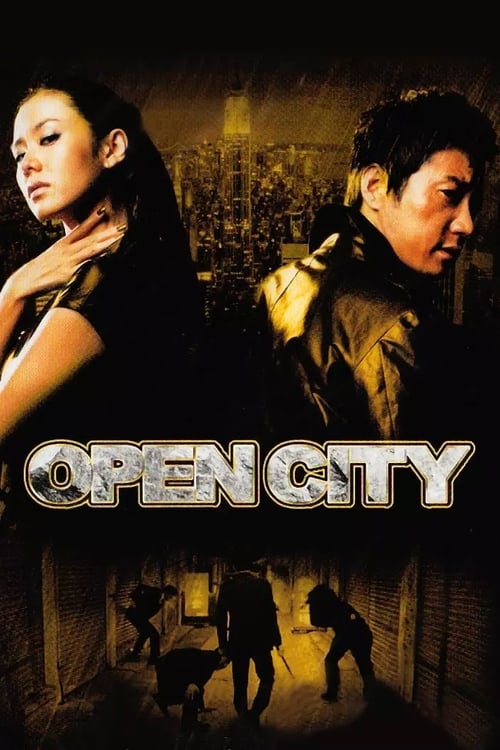
Open City
Jo Dae-yeong is a police officer investigating a pickpocket ring with ties to the Yakuza. One day he rescues Baek Jang-mi from danger, only to discover that she is the boss of the gang he has been tracking.
The film earned $11.1M at the global box office.
Plot Structure
Story beats plotted across runtime


Narrative Arc
Emotional journey through the story's key moments
Story Circle
Blueprint 15-beat structure
Arcplot Score Breakdown
Weighted: Precision (70%) + Arc (15%) + Theme (15%)
Open City (2008) exemplifies strategically placed narrative design, characteristic of Lee Sang-gi's storytelling approach. This structural analysis examines how the film's 15-point plot structure maps to proven narrative frameworks across 1 hour and 52 minutes. With an Arcplot score of 7.1, the film balances conventional beats with creative variation.
Characters
Cast & narrative archetypes

Choi Joong-hoon
Kim Dae-chul
Yoon Hee-soo
Park Sung-ki
Chairman Hwang
Min-jung
Main Cast & Characters
Choi Joong-hoon
Played by Lee Jung-jae
A Seoul prosecutor investigating corruption who becomes entangled in a dangerous game between organized crime and political power.
Kim Dae-chul
Played by Jung Joon-ho
A ruthless and ambitious gang boss seeking to expand his criminal empire by corrupting the political establishment.
Yoon Hee-soo
Played by Seo Woo
A determined journalist who aids the prosecutor while pursuing her own investigation into the city's corruption.
Park Sung-ki
Played by Oh Kwang-rok
A veteran detective caught between loyalty to his corrupt superiors and his sense of justice.
Chairman Hwang
Played by Kim Eung-soo
A powerful political figure secretly controlling both legal and criminal operations in the city.
Min-jung
Played by Park Jin-hee
Joong-hoon's wife who becomes increasingly concerned about the dangers her husband faces.
Structural Analysis
The Status Quo at 1 minutes (1% through the runtime) establishes The protagonist navigates their ordinary urban existence, establishing the baseline of their disconnected city life before change arrives.. Structural examination shows that this early placement immediately immerses viewers in the story world.
The inciting incident occurs at 13 minutes when An unexpected encounter or event fractures the protagonist's carefully maintained distance, forcing them to confront what they've been avoiding.. At 12% through the film, this Disruption aligns precisely with traditional story structure. This beat shifts the emotional landscape, launching the protagonist into the central conflict.
The First Threshold at 28 minutes marks the transition into Act II, occurring at 25% of the runtime. This reveals the protagonist's commitment to The protagonist makes an active choice to pursue a new path, committing to engage with others in ways they previously avoided., moving from reaction to action.
At 56 minutes, the Midpoint arrives at 50% of the runtime—precisely centered, creating perfect narrative symmetry. Notably, this crucial beat A false victory where connection seems fully achieved, but underlying tensions and unresolved patterns begin to surface beneath the surface., fundamentally raising what's at risk. The emotional intensity shifts, dividing the narrative into clear before-and-after phases.
The Collapse moment at 84 minutes (75% through) represents the emotional nadir. Here, The relationship or connection fractures completely, exposing the protagonist's deepest fear that authentic connection may be impossible in this urban landscape., indicates the protagonist at their lowest point. This beat's placement in the final quarter sets up the climactic reversal.
The Second Threshold at 90 minutes initiates the final act resolution at 80% of the runtime. A realization synthesizes earlier lessons: true connection requires both vulnerability and acceptance of the city's complex reality, not escape from it., demonstrating the transformation achieved throughout the journey.
Emotional Journey
Open City's emotional architecture traces a deliberate progression across 15 carefully calibrated beats.
Narrative Framework
This structural analysis employs proven narrative structure principles that track dramatic progression. By mapping Open City against these established plot points, we can identify how Lee Sang-gi utilizes or subverts traditional narrative conventions. The plot point approach reveals not only adherence to structural principles but also creative choices that distinguish Open City within the action genre.
Comparative Analysis
Additional action films include The Bad Guys, Puss in Boots and Venom: The Last Dance.
Plot Points by Act
Act I
SetupStatus Quo
The protagonist navigates their ordinary urban existence, establishing the baseline of their disconnected city life before change arrives.
Theme
A secondary character voices the film's central question about human connection and urban isolation in contemporary life.
Worldbuilding
Introduction to the urban landscape, key relationships, and the emotional distance that characterizes the protagonist's world and daily routines.
Disruption
An unexpected encounter or event fractures the protagonist's carefully maintained distance, forcing them to confront what they've been avoiding.
Resistance
The protagonist resists engagement with the new situation, debating whether to retreat into familiar patterns or risk genuine connection.
Act II
ConfrontationFirst Threshold
The protagonist makes an active choice to pursue a new path, committing to engage with others in ways they previously avoided.
Mirror World
A significant relationship or community connection emerges that embodies the alternative to isolation, showing what authentic engagement could mean.
Premise
The protagonist explores this new mode of being, experiencing moments of genuine connection while navigating the complexities of urban relationships.
Midpoint
A false victory where connection seems fully achieved, but underlying tensions and unresolved patterns begin to surface beneath the surface.
Opposition
The protagonist's old patterns and fears reassert themselves, external pressures mount, and the fragility of newfound connections becomes apparent.
Collapse
The relationship or connection fractures completely, exposing the protagonist's deepest fear that authentic connection may be impossible in this urban landscape.
Crisis
The protagonist confronts their role in the collapse, processing loss and wrestling with whether to retreat permanently or find a new way forward.
Act III
ResolutionSecond Threshold
A realization synthesizes earlier lessons: true connection requires both vulnerability and acceptance of the city's complex reality, not escape from it.
Synthesis
The protagonist takes action based on their new understanding, attempting reconciliation or new connection with clearer self-awareness and acceptance.
Transformation
A closing image mirrors the opening but reveals transformation: the protagonist now inhabits the same urban space with fundamentally altered capacity for connection.