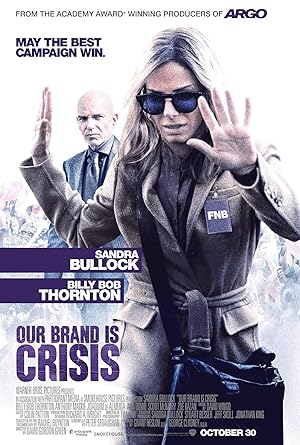
Our Brand Is Crisis
In 2002, Bolivian politician Pedro Gallo hires American James Carville's political consulting firm, Greenberg Carville Shrum, to help him win the 2002 Bolivian presidential election. GCS brings in Jane Bodine to manage the campaign in Bolivia. Battling her arch nemesis, the opposition's political consultant Pat Candy.
The film box office disappointment against its respectable budget of $28.0M, earning $7.0M globally (-75% loss). While initial box office returns were modest, the film has gained appreciation for its compelling narrative within the comedy genre.


Plot Structure
Story beats plotted across runtime


Narrative Arc
Emotional journey through the story's key moments
Story Circle
Blueprint 15-beat structure
Arcplot Score Breakdown
Weighted: Precision (70%) + Arc (15%) + Theme (15%)
Our Brand Is Crisis (2015) exemplifies strategically placed story structure, characteristic of David Gordon Green's storytelling approach. This structural analysis examines how the film's 15-point plot structure maps to proven narrative frameworks across 1 hour and 47 minutes. With an Arcplot score of 7.2, the film balances conventional beats with creative variation.
Characters
Cast & narrative archetypes

Jane Bodine
Pat Candy
Pedro Castillo
Ben
Nell
Buckley
Rich
Eddie
Main Cast & Characters
Jane Bodine
Played by Sandra Bullock
A brilliant but burnt-out political strategist coaxed out of retirement to help a failing Bolivian presidential candidate, haunted by past defeats and personal demons.
Pat Candy
Played by Billy Bob Thornton
Jane's longtime rival political consultant working for the opposing campaign, a slick and ruthless strategist who enjoys psychological warfare.
Pedro Castillo
Played by Joaquim de Almeida
The Bolivian presidential candidate Jane is hired to help, a former president seeking a comeback who struggles with his public image.
Ben
Played by Anthony Mackie
A young idealistic campaign worker who becomes Jane's protege and conscience, questioning the morality of their tactics.
Nell
Played by Ann Dowd
A sharp campaign team member who works alongside Jane, bringing research skills and steady support to the operation.
Buckley
Played by Scoot McNairy
A veteran campaign strategist on the team who provides experience and tactical support in the Bolivian election.
Rich
Played by Zoe Kazan
A media specialist on the campaign team who handles advertising and public relations strategies.
Eddie
Played by Reynaldo Pacheco
A young Bolivian volunteer who assists the campaign team and provides local insight and connections.
Structural Analysis
The Status Quo at 1 minutes (1% through the runtime) establishes Jane Bodine is isolated in her mountain home, depressed and withdrawn from the world after her breakdown. She watches TV in bed, disconnected from her former life as a top political strategist.. The analysis reveals that this early placement immediately immerses viewers in the story world.
The inciting incident occurs at 12 minutes when Jane learns that her nemesis Pat Candy is working for the opposition candidate in Bolivia. This personal rivalry pulls her out of retirement despite her reservations.. At 11% through the film, this Disruption aligns precisely with traditional story structure. This beat shifts the emotional landscape, launching the protagonist into the central conflict.
The First Threshold at 26 minutes marks the transition into Act II, occurring at 25% of the runtime. This shows the protagonist's commitment to Jane commits fully to the campaign after a humiliating encounter with Pat Candy. She decides to fight dirty and use her old ruthless tactics to win, crossing back into her former world., moving from reaction to action.
At 53 minutes, the Midpoint arrives at 50% of the runtime—precisely centered, creating perfect narrative symmetry. The analysis reveals that this crucial beat Castillo surges in the polls and takes the lead. Jane appears to be winning against Pat Candy. False victory - success comes through morally questionable means., fundamentally raising what's at risk. The emotional intensity shifts, dividing the narrative into clear before-and-after phases.
The Collapse moment at 79 minutes (74% through) represents the emotional nadir. Here, A protest turns violent, resulting in a demonstrator's death. Jane realizes her crisis-based fear campaign has real deadly consequences. Her victory strategy has destroyed lives., shows the protagonist at their lowest point. This beat's placement in the final quarter sets up the climactic reversal.
The Second Threshold at 85 minutes initiates the final act resolution at 79% of the runtime. Jane decides to see the campaign through to election day but resolves to face the consequences of her actions. She recognizes she cannot undo what she's done but can acknowledge the truth., demonstrating the transformation achieved throughout the journey.
Emotional Journey
Our Brand Is Crisis's emotional architecture traces a deliberate progression across 15 carefully calibrated beats.
Narrative Framework
This structural analysis employs proven narrative structure principles that track dramatic progression. By mapping Our Brand Is Crisis against these established plot points, we can identify how David Gordon Green utilizes or subverts traditional narrative conventions. The plot point approach reveals not only adherence to structural principles but also creative choices that distinguish Our Brand Is Crisis within the comedy genre.
David Gordon Green's Structural Approach
Among the 9 David Gordon Green films analyzed on Arcplot, the average structural score is 7.3, reflecting strong command of classical structure. Our Brand Is Crisis takes a more unconventional approach compared to the director's typical style. For comparative analysis, explore the complete David Gordon Green filmography.
Comparative Analysis
Additional comedy films include The Bad Guys, Ella Enchanted and The Evening Star. For more David Gordon Green analyses, see Nutcrackers, Halloween Kills and Halloween.
Plot Points by Act
Act I
SetupStatus Quo
Jane Bodine is isolated in her mountain home, depressed and withdrawn from the world after her breakdown. She watches TV in bed, disconnected from her former life as a top political strategist.
Theme
Ben says "This is what we do" when pitching Jane on the Bolivian campaign, establishing the theme of moral compromise in political consulting and whether winning justifies any means.
Worldbuilding
Jane's team arrives to recruit her. We learn about her legendary status as "Calamity Jane," her past rivalry with Pat Candy, her breakdown, and the desperate Bolivian presidential campaign that needs her expertise.
Disruption
Jane learns that her nemesis Pat Candy is working for the opposition candidate in Bolivia. This personal rivalry pulls her out of retirement despite her reservations.
Resistance
Jane debates whether to take the job, travels to Bolivia, suffers altitude sickness, and struggles with whether she can still compete. She assesses the failing campaign and her uninspiring candidate Castillo.
Act II
ConfrontationFirst Threshold
Jane commits fully to the campaign after a humiliating encounter with Pat Candy. She decides to fight dirty and use her old ruthless tactics to win, crossing back into her former world.
Mirror World
Eddie, the young idealistic team member, represents the moral conscience Jane has abandoned. His presence and questions about ethics create thematic tension about the cost of winning.
Premise
Jane deploys increasingly manipulative campaign tactics: creating a crisis narrative, staging photo ops, using negative advertising, and engaging in psychological warfare with Pat Candy. The campaign gains momentum through dirty tricks.
Midpoint
Castillo surges in the polls and takes the lead. Jane appears to be winning against Pat Candy. False victory - success comes through morally questionable means.
Opposition
The campaign becomes increasingly vicious. Pat Candy fights back with his own dirty tricks. Jane witnesses the real consequences of her manipulations on Bolivian society. Eddie challenges her ethics. Jane's methods become more extreme and morally compromised.
Collapse
A protest turns violent, resulting in a demonstrator's death. Jane realizes her crisis-based fear campaign has real deadly consequences. Her victory strategy has destroyed lives.
Crisis
Jane spirals emotionally, confronting the human cost of her win-at-all-costs approach. She questions whether defeating Pat Candy was worth the damage to democracy and human lives.
Act III
ResolutionSecond Threshold
Jane decides to see the campaign through to election day but resolves to face the consequences of her actions. She recognizes she cannot undo what she's done but can acknowledge the truth.
Synthesis
Election day arrives. Castillo wins. Jane confronts Castillo about his lies and manipulations. At the victory party, she publicly exposes the moral bankruptcy of the campaign in front of Pat Candy and the team.
Transformation
Jane walks away from the victory celebration and her old life, choosing conscience over winning. Unlike the opening, she's no longer hiding but consciously rejecting the game. She leaves Pat Candy and the hollow victory behind.