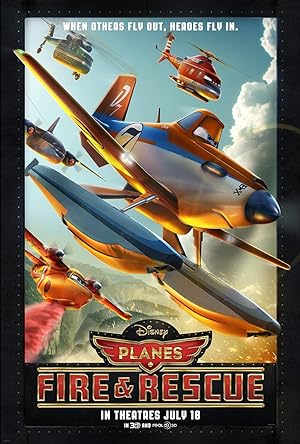
Planes: Fire & Rescue
When world-famous air racer Dusty learns that his engine is damaged and he may never race again, he must shift gears and is launched into the world of aerial firefighting. Dusty joins forces with veteran fire and rescue helicopter Blade Ranger and his team, a bunch of all-terrain vehicles known as The Smokejumpers. Together, the fearless team battles a massive wildfire, and Dusty learns what it takes to become a true hero.
Despite a mid-range budget of $50.0M, Planes: Fire & Rescue became a box office success, earning $151.2M worldwide—a 202% return.
Nominated for 1 BAFTA Award6 nominations


Plot Structure
Story beats plotted across runtime


Narrative Arc
Emotional journey through the story's key moments
Story Circle
Blueprint 15-beat structure
Arcplot Score Breakdown
Weighted: Precision (70%) + Arc (15%) + Theme (15%)
Planes: Fire & Rescue (2014) reveals precise narrative architecture, characteristic of Bobs Gannaway's storytelling approach. This structural analysis examines how the film's 15-point plot structure maps to proven narrative frameworks across 1 hour and 23 minutes. With an Arcplot score of 7.3, the film balances conventional beats with creative variation.
Characters
Cast & narrative archetypes

Dusty Crophopper
Blade Ranger
Lil' Dipper
Windlifter
Cad Spinner
Maru
Cabbie
Secretary of the Interior
Main Cast & Characters
Dusty Crophopper
Played by Dane Cook
A racing champion crop duster plane who must find a new purpose after his gearbox is damaged, leading him to train as an aerial firefighter.
Blade Ranger
Played by Ed Harris
A veteran fire and rescue helicopter who leads the Piston Peak Air Attack team. A former TV star with a tragic past that haunts him.
Lil' Dipper
Played by Julie Bowen
An enthusiastic super scooper plane and devoted member of the Air Attack team who idolizes Dusty and his racing career.
Windlifter
Played by Wes Studi
A heavy-lift helicopter with Native American spirituality who serves as a firefighter and shares wisdom through metaphorical stories.
Cad Spinner
Played by John Michael Higgins
The self-serving superintendent of Piston Peak National Park who prioritizes his lodge's grand reopening over visitor safety.
Maru
Played by Curtis Armstrong
The brilliant but unorthodox mechanic at Piston Peak who keeps the team's equipment running with creative solutions.
Cabbie
Played by Dale Dye
A veteran military transport plane who served in the Corn War and now helps transport supplies and personnel for the firefighting team.
Secretary of the Interior
Played by Fred Willard
A government official who oversees national parks and ultimately holds Cad Spinner accountable for his negligence.
Structural Analysis
The Status Quo at 1 minutes (1% through the runtime) establishes Dusty Crophopper is a world-famous air racing champion, celebrating victory and living his dream at the top of his game.. Of particular interest, this early placement immediately immerses viewers in the story world.
The inciting incident occurs at 9 minutes when Dusty's gearbox fails during a practice run, causing a crash. Dottie tells him his gearbox is damaged beyond repair and racing at high speeds could be fatal.. At 11% through the film, this Disruption aligns precisely with traditional story structure. This beat shifts the emotional landscape, launching the protagonist into the central conflict.
The First Threshold at 20 minutes marks the transition into Act II, occurring at 24% of the runtime. This shows the protagonist's commitment to Dusty makes the active choice to become a firefighter and travels to Piston Peak Air Attack base for training, leaving his old life behind., moving from reaction to action.
At 41 minutes, the Midpoint arrives at 49% of the runtime—precisely centered, creating perfect narrative symmetry. Notably, this crucial beat Dusty successfully completes his firefighter certification and earns his spot on the team. False victory - he thinks he's found his new purpose, but stakes are about to raise., fundamentally raising what's at risk. The emotional intensity shifts, dividing the narrative into clear before-and-after phases.
The Collapse moment at 62 minutes (75% through) represents the emotional nadir. Here, The lodge catches fire with guests trapped inside. Blade Ranger is injured trying to save Dusty, who froze up. Dusty blames himself for the disaster and quits, believing he's not cut out to be a firefighter., demonstrates the protagonist at their lowest point. This beat's placement in the final quarter sets up the climactic reversal.
The Second Threshold at 66 minutes initiates the final act resolution at 80% of the runtime. Dusty learns that his friends and town are in danger from a new fire. He discovers Blade's past as a TV star who became a real hero. Dusty realizes heroism isn't about being perfect, but about showing up when needed., demonstrating the transformation achieved throughout the journey.
Emotional Journey
Planes: Fire & Rescue's emotional architecture traces a deliberate progression across 15 carefully calibrated beats.
Narrative Framework
This structural analysis employs proven narrative structure principles that track dramatic progression. By mapping Planes: Fire & Rescue against these established plot points, we can identify how Bobs Gannaway utilizes or subverts traditional narrative conventions. The plot point approach reveals not only adherence to structural principles but also creative choices that distinguish Planes: Fire & Rescue within the animation genre.
Comparative Analysis
Additional animation films include The Bad Guys, Puss in Boots and Violet Evergarden: Eternity and the Auto Memory Doll.
Plot Points by Act
Act I
SetupStatus Quo
Dusty Crophopper is a world-famous air racing champion, celebrating victory and living his dream at the top of his game.
Theme
Dottie or another character mentions that sometimes life takes you in unexpected directions, or that there's more than one way to be a hero.
Worldbuilding
Dusty returns home to Propwash Junction, reconnects with friends, and we see his life as a champion racer. His world is built around speed and competition.
Disruption
Dusty's gearbox fails during a practice run, causing a crash. Dottie tells him his gearbox is damaged beyond repair and racing at high speeds could be fatal.
Resistance
Dusty struggles with his new limitations, tries to race anyway, and causes a fire at the airport. He learns the town needs a second firefighter to reopen, and debates what to do with his future.
Act II
ConfrontationFirst Threshold
Dusty makes the active choice to become a firefighter and travels to Piston Peak Air Attack base for training, leaving his old life behind.
Mirror World
Dusty meets Blade Ranger, the veteran firefighter who becomes his mentor, and Dipper, along with the rest of the firefighting team who represent a new kind of heroism.
Premise
Dusty trains as a firefighter, learns new skills, bonds with the team, and experiences the excitement and purpose of saving lives. The 'fun and games' of firefighting sequences.
Midpoint
Dusty successfully completes his firefighter certification and earns his spot on the team. False victory - he thinks he's found his new purpose, but stakes are about to raise.
Opposition
A major wildfire threatens the park. The superintendent's negligence creates danger. Dusty pushes himself beyond his limits, his gearbox issues worsen, and Blade Ranger's past trauma surfaces.
Collapse
The lodge catches fire with guests trapped inside. Blade Ranger is injured trying to save Dusty, who froze up. Dusty blames himself for the disaster and quits, believing he's not cut out to be a firefighter.
Crisis
Dusty returns home in shame and despair. He confronts the reality that he can't race and apparently can't be a firefighter either. His darkest moment of identity crisis.
Act III
ResolutionSecond Threshold
Dusty learns that his friends and town are in danger from a new fire. He discovers Blade's past as a TV star who became a real hero. Dusty realizes heroism isn't about being perfect, but about showing up when needed.
Synthesis
Dusty returns to Piston Peak and leads the firefighting effort. He combines his racing skills with his firefighting training, saves his friends, and rescues Blade Ranger, proving his worth as a firefighter.
Transformation
Dusty is now a certified firefighter working alongside his team at Propwash Junction, having found new purpose and identity. He's no longer defined by racing, but by service and heroism.