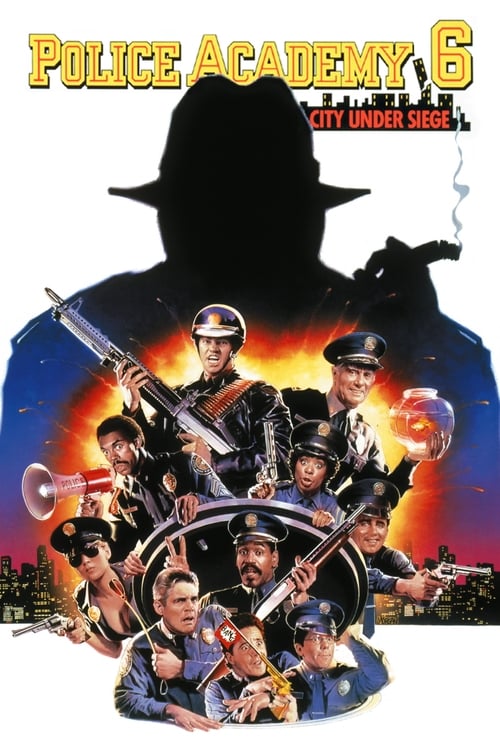
Police Academy 6: City Under Siege
Our favourite police men are called together to deal with a gang who rob banks and jewelers. Using their various talents as well as their extraordinary luck, the crooks stand no chance against our men and women in blue.
Despite a moderate budget of $15.0M, Police Academy 6: City Under Siege became a commercial success, earning $33.2M worldwide—a 121% return.


Plot Structure
Story beats plotted across runtime


Narrative Arc
Emotional journey through the story's key moments
Story Circle
Blueprint 15-beat structure
Arcplot Score Breakdown
Weighted: Precision (70%) + Arc (15%) + Theme (15%)
Police Academy 6: City Under Siege (1989) reveals precise narrative design, characteristic of Peter Bonerz's storytelling approach. This structural analysis examines how the film's 15-point plot structure maps to proven narrative frameworks across 1 hour and 24 minutes. With an Arcplot score of 7.1, the film balances conventional beats with creative variation.
Characters
Cast & narrative archetypes

Commandant Eric Lassard
Captain Thaddeus Harris
Sergeant Eugene Tackleberry
Sergeant Moses Hightower
Sergeant Larvell Jones
Sergeant Debbie Callahan
Sergeant Nick Lassard
Sergeant Fackler
Lieutenant Proctor
The Mastermind
Main Cast & Characters
Commandant Eric Lassard
Played by George Gaynes
The kind but absent-minded commander of the Police Academy graduates who leads his team to stop a crime wave.
Captain Thaddeus Harris
Played by G.W. Bailey
Ambitious and arrogant captain who wants Lassard's position but is forced to work alongside the Academy team.
Sergeant Eugene Tackleberry
Played by David Graf
Weapons-obsessed and militaristic officer who brings heavy firepower to every situation.
Sergeant Moses Hightower
Played by Bubba Smith
Gentle giant with immense physical strength who uses his power to protect his fellow officers.
Sergeant Larvell Jones
Played by Michael Winslow
Master of vocal sound effects and disguises who provides both comedy and crucial undercover support.
Sergeant Debbie Callahan
Played by Leslie Easterbrook
Tough and capable female officer who is skilled in hand-to-hand combat and firearms.
Sergeant Nick Lassard
Played by Matt McCoy
Commandant Lassard's nephew, a capable young officer who helps lead investigations.
Sergeant Fackler
Played by Bruce Mahler
Clumsy but well-meaning officer whose accidents often inadvertently help solve cases.
Lieutenant Proctor
Played by Lance Kinsey
Harris's dim-witted sycophantic assistant who follows orders without question.
The Mastermind
Played by Kenneth Mars
Mysterious criminal leader orchestrating a citywide crime wave from behind the scenes.
Structural Analysis
The Status Quo at 1 minutes (1% through the runtime) establishes The city is peaceful as Commandant Lassard gives a speech about community policing while the Police Academy graduates are serving as effective neighborhood officers.. Of particular interest, this early placement immediately immerses viewers in the story world.
The inciting incident occurs at 10 minutes when A mysterious crime wave begins with a series of sophisticated robberies that baffle the police department, making Lassard and his team look incompetent.. At 12% through the film, this Disruption aligns precisely with traditional story structure. This beat shifts the emotional landscape, launching the protagonist into the central conflict.
The First Threshold at 20 minutes marks the transition into Act II, occurring at 24% of the runtime. This illustrates the protagonist's commitment to Mahoney and the team commit to going undercover and using unconventional methods to infiltrate the criminal operation, despite Harris's objections and the risk to their careers., moving from reaction to action.
At 42 minutes, the Midpoint arrives at 50% of the runtime—precisely centered, creating perfect narrative symmetry. Notably, this crucial beat The team identifies the mastermind behind the robberies and his three criminal proteges, seemingly gaining the upper hand with a solid lead on their next target - a false victory as they don't realize the criminals are aware of the surveillance., fundamentally raising what's at risk. The emotional intensity shifts, dividing the narrative into clear before-and-after phases.
The Collapse moment at 63 minutes (75% through) represents the emotional nadir. Here, Lassard is suspended and Harris takes command of the precinct. The team is disbanded and reassigned to humiliating positions. Their mission appears dead, and Lassard's career and legacy are destroyed., indicates the protagonist at their lowest point. This beat's placement in the final quarter sets up the climactic reversal.
The Second Threshold at 67 minutes initiates the final act resolution at 80% of the runtime. The team discovers the mastermind's final target and realizes that their unique skills and loyalty to Lassard are exactly what's needed. They choose to act without official sanction, combining everything they've learned., demonstrating the transformation achieved throughout the journey.
Emotional Journey
Police Academy 6: City Under Siege's emotional architecture traces a deliberate progression across 15 carefully calibrated beats.
Narrative Framework
This structural analysis employs proven narrative structure principles that track dramatic progression. By mapping Police Academy 6: City Under Siege against these established plot points, we can identify how Peter Bonerz utilizes or subverts traditional narrative conventions. The plot point approach reveals not only adherence to structural principles but also creative choices that distinguish Police Academy 6: City Under Siege within the comedy genre.
Comparative Analysis
Additional comedy films include The Bad Guys, Ella Enchanted and The Evening Star.
Plot Points by Act
Act I
SetupStatus Quo
The city is peaceful as Commandant Lassard gives a speech about community policing while the Police Academy graduates are serving as effective neighborhood officers.
Theme
Captain Harris complains about Lassard's methods being outdated, suggesting that real police work requires more than community relations - introducing the theme of old-school heart versus bureaucratic ambition.
Worldbuilding
Introduction to the Police Academy team in their daily routines: Mahoney's street smarts, Jones's sound effects, Tackleberry's weapons enthusiasm, and Harris's scheming to take over Lassard's position.
Disruption
A mysterious crime wave begins with a series of sophisticated robberies that baffle the police department, making Lassard and his team look incompetent.
Resistance
The team investigates the robberies while Harris uses the crime wave to undermine Lassard. The Mayor pressures Lassard to solve the case or face replacement. The team debates how to approach the seemingly impossible case.
Act II
ConfrontationFirst Threshold
Mahoney and the team commit to going undercover and using unconventional methods to infiltrate the criminal operation, despite Harris's objections and the risk to their careers.
Mirror World
The team discovers that the criminals are using a genius who creates elaborate gadgets and disguises, mirroring the Police Academy's own reliance on unique talents and teamwork rather than conventional methods.
Premise
The fun of watching the Police Academy team use their signature skills in creative ways: Jones's sound effects for surveillance, Tackleberry's weapons knowledge, Callahan's strength, and Mahoney's street smarts to track the criminal mastermind.
Midpoint
The team identifies the mastermind behind the robberies and his three criminal proteges, seemingly gaining the upper hand with a solid lead on their next target - a false victory as they don't realize the criminals are aware of the surveillance.
Opposition
The criminals stay one step ahead, turning the tables on the Police Academy team. Harris intensifies his campaign to remove Lassard. The stakeouts fail, the team is humiliated, and the Mayor's patience runs out.
Collapse
Lassard is suspended and Harris takes command of the precinct. The team is disbanded and reassigned to humiliating positions. Their mission appears dead, and Lassard's career and legacy are destroyed.
Crisis
The team struggles with defeat and separation. Mahoney questions whether their unconventional methods were foolish. They must decide whether to accept their fate or fight back without authority or support.
Act III
ResolutionSecond Threshold
The team discovers the mastermind's final target and realizes that their unique skills and loyalty to Lassard are exactly what's needed. They choose to act without official sanction, combining everything they've learned.
Synthesis
The climactic operation where each team member uses their signature ability in perfect coordination to outsmart the criminals, save the city, and expose the mastermind, vindicating Lassard's philosophy of valuing individual talents.
Transformation
Lassard is reinstated with honors, Harris is demoted, and the team is celebrated. The final image shows them together, confident and validated - transformed from underdogs into proven heroes whose unconventional methods are now respected.