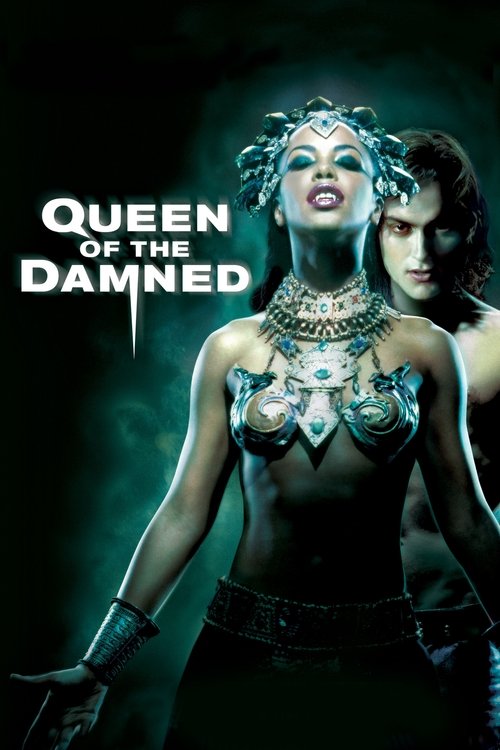
Queen of the Damned
Vampire Lestat awakens from his slumber and becomes a rock star. But chaos strikes when his music awakens Akasha, the vampire queen, who may not rest until she makes Lestat her new king.
Working with a respectable budget of $35.0M, the film achieved a steady performer with $45.5M in global revenue (+30% profit margin).


Plot Structure
Story beats plotted across runtime


Narrative Arc
Emotional journey through the story's key moments
Story Circle
Blueprint 15-beat structure
Arcplot Score Breakdown
Weighted: Precision (70%) + Arc (15%) + Theme (15%)
Queen of the Damned (2002) exemplifies meticulously timed plot construction, characteristic of Michael Rymer's storytelling approach. This structural analysis examines how the film's 15-point plot structure maps to proven narrative frameworks across 1 hour and 41 minutes. With an Arcplot score of 6.9, the film balances conventional beats with creative variation.
Characters
Cast & narrative archetypes

Lestat de Lioncourt
Akasha
Jesse Reeves
Marius de Romanus
Maharet
David Talbot
Main Cast & Characters
Lestat de Lioncourt
Played by Stuart Townsend
An ancient vampire who awakens in modern times and becomes a rock star to announce his existence to the world.
Akasha
Played by Aaliyah
The first vampire and Queen of the Damned who awakens after millennia and seeks to rule the world with Lestat.
Jesse Reeves
Played by Marguerite Moreau
A paranormal investigator from the Talamasca who becomes obsessed with Lestat and discovers her connection to vampires.
Marius de Romanus
Played by Vincent Pérez
An ancient vampire and Lestat's mentor who warns him about the dangers of awakening Akasha.
Maharet
Played by Lena Olin
An ancient vampire and Jesse's ancestor who has protected her bloodline for centuries.
David Talbot
Played by Paul McGann
A Talamasca scholar and Jesse's mentor who guides her investigation into vampires.
Structural Analysis
The Status Quo at 1 minutes (1% through the runtime) establishes Lestat lies dormant in his coffin, a vampire who has slept for decades, withdrawn from the world in self-imposed isolation beneath a crumbling mansion.. The analysis reveals that this early placement immediately immerses viewers in the story world.
The inciting incident occurs at 13 minutes when Lestat awakens in the modern era, drawn from his coffin by the sound of a rock band rehearsing above him, discovering a loud vibrant world utterly different from the one he left.. At 13% through the film, this Disruption is delayed, allowing extended setup of the story world. This beat shifts the emotional landscape, launching the protagonist into the central conflict.
The First Threshold at 26 minutes marks the transition into Act II, occurring at 25% of the runtime. This shows the protagonist's commitment to Lestat fully commits to his public persona as a rock star vampire, announcing a massive Death Valley concert despite warnings from other vampires, choosing spectacle and revelation over safety and tradition., moving from reaction to action.
At 51 minutes, the Midpoint arrives at 50% of the runtime—precisely centered, creating perfect narrative symmetry. Significantly, this crucial beat Akasha fully awakens and immediately begins slaughtering the vampire council members, revealing her plan to destroy all vampires except Lestat and remake the world with herself as goddess, raising the stakes catastrophically., fundamentally raising what's at risk. The emotional intensity shifts, dividing the narrative into clear before-and-after phases.
The Collapse moment at 76 minutes (76% through) represents the emotional nadir. Here, Akasha kills Jesse in front of Lestat to eliminate his connection to humanity, forcing him to either turn Jesse into a vampire or let her die, while demonstrating the cost of Akasha's vision of a perfect world built on mass murder., demonstrates the protagonist at their lowest point. This beat's placement in the final quarter sets up the climactic reversal.
The Second Threshold at 81 minutes initiates the final act resolution at 80% of the runtime. Lestat rejects Akasha and chooses to stand with the other vampires and Jesse against her, synthesizing his love of life and spectacle with the recognition that true living requires rejecting godhood and accepting limits., demonstrating the transformation achieved throughout the journey.
Emotional Journey
Queen of the Damned's emotional architecture traces a deliberate progression across 15 carefully calibrated beats.
Narrative Framework
This structural analysis employs proven narrative structure principles that track dramatic progression. By mapping Queen of the Damned against these established plot points, we can identify how Michael Rymer utilizes or subverts traditional narrative conventions. The plot point approach reveals not only adherence to structural principles but also creative choices that distinguish Queen of the Damned within the fantasy genre.
Michael Rymer's Structural Approach
Among the 2 Michael Rymer films analyzed on Arcplot, the average structural score is 6.8, demonstrating varied approaches to story architecture. Queen of the Damned represents one of the director's most structurally precise works. For comparative analysis, explore the complete Michael Rymer filmography.
Comparative Analysis
Additional fantasy films include Thinner, Ella Enchanted and Conan the Barbarian. For more Michael Rymer analyses, see In Too Deep.
Plot Points by Act
Act I
SetupStatus Quo
Lestat lies dormant in his coffin, a vampire who has slept for decades, withdrawn from the world in self-imposed isolation beneath a crumbling mansion.
Theme
Marius tells young Lestat, "There is nothing for you here, only death," establishing the film's central theme: the choice between eternal emptiness and the risk of truly living.
Worldbuilding
Flashbacks reveal Lestat's origin: his encounter with Marius, becoming a vampire in 1788, learning about the ancient vampire world, and meeting the silent Queen Akasha before choosing to withdraw from immortality's boredom.
Disruption
Lestat awakens in the modern era, drawn from his coffin by the sound of a rock band rehearsing above him, discovering a loud vibrant world utterly different from the one he left.
Resistance
Lestat explores the modern world, encounters the rock band, seizes the opportunity to become their frontman, and begins composing music that reveals vampire secrets, while the vampire council debates how to handle his recklessness.
Act II
ConfrontationFirst Threshold
Lestat fully commits to his public persona as a rock star vampire, announcing a massive Death Valley concert despite warnings from other vampires, choosing spectacle and revelation over safety and tradition.
Mirror World
Jesse Reeves, a researcher from the Talamasca paranormal organization, becomes fascinated with Lestat and begins investigating him, representing mortal curiosity and the film's exploration of the boundary between human and vampire existence.
Premise
Lestat rises to rock stardom while Jesse investigates his true nature. Lestat's music awakens Akasha from her millennia-long slumber. The vampire world watches in horror as their secrets are exposed and their ancient queen begins to stir.
Midpoint
Akasha fully awakens and immediately begins slaughtering the vampire council members, revealing her plan to destroy all vampires except Lestat and remake the world with herself as goddess, raising the stakes catastrophically.
Opposition
Akasha seduces Lestat into joining her apocalyptic vision, granting him unprecedented power. Jesse discovers her own vampire ancestry and becomes entangled with Lestat. The remaining vampires, led by Marius and Maharet, desperately seek a way to stop Akasha's genocide.
Collapse
Akasha kills Jesse in front of Lestat to eliminate his connection to humanity, forcing him to either turn Jesse into a vampire or let her die, while demonstrating the cost of Akasha's vision of a perfect world built on mass murder.
Crisis
Lestat makes Jesse a vampire to save her life, then confronts the horror of what Akasha truly is: not a goddess but a destroyer who will murder millions. He wrestles with his complicity in awakening her and his intoxication with the power she offered.
Act III
ResolutionSecond Threshold
Lestat rejects Akasha and chooses to stand with the other vampires and Jesse against her, synthesizing his love of life and spectacle with the recognition that true living requires rejecting godhood and accepting limits.
Synthesis
The vampires unite against Akasha in a final confrontation. Maharet, Akasha's sister, destroys the queen by consuming her heart and spirit, ending the threat. Lestat and Jesse emerge as partners, having found meaning in connection rather than power.
Transformation
Lestat and Jesse stand together on a rooftop overlooking the city at dawn, no longer isolated but connected, having chosen passionate engagement with existence over either godlike power or living death, transformed by love and purpose.