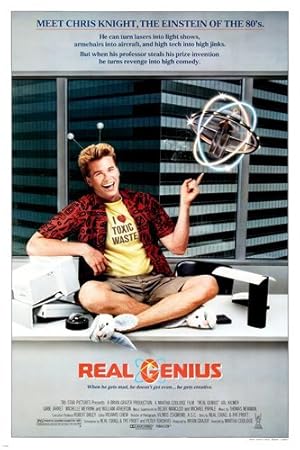
Real Genius
Mitch Taylor is one of the youngest students ever accepted to a university known for its programs for geniuses. He partners up with his roommate, science club legend Chris Knight, on a project to develop a high-powered laser. Together with their hyperkinetic friends, they employ their intellects in the pursuit of bigger blasts, practical jokes, and a deeper understanding of what real genius means. When they find out that their professor intends to turn their work over to the military for use as a weapon, they decide to get even.
Working with a limited budget of $8.0M, the film achieved a modest success with $13.0M in global revenue (+62% profit margin).
2 wins & 2 nominations


Plot Structure
Story beats plotted across runtime


Narrative Arc
Emotional journey through the story's key moments
Story Circle
Blueprint 15-beat structure
Arcplot Score Breakdown
Weighted: Precision (70%) + Arc (15%) + Theme (15%)
Real Genius (1985) showcases carefully calibrated dramatic framework, characteristic of Martha Coolidge's storytelling approach. This structural analysis examines how the film's 15-point plot structure maps to proven narrative frameworks across 1 hour and 46 minutes. With an Arcplot score of 7.0, the film balances conventional beats with creative variation.
Characters
Cast & narrative archetypes

Mitch Taylor
Chris Knight
Jordan Cochran
Professor Jerry Hathaway
Kent Torokvei
Susan Decker
Lazlo Hollyfeld
Main Cast & Characters
Mitch Taylor
Played by Gabriel Jarret
A 15-year-old genius recruited to Pacific Tech who struggles to balance academic pressure with personal growth and fun.
Chris Knight
Played by Val Kilmer
A brilliant but irreverent senior student who mentors Mitch and embodies the free-spirited rebellion against academic exploitation.
Jordan Cochran
Played by Michelle Meyrink
A hyperkinetic student who lives in a closet and becomes Mitch's friend, bringing comic relief and surprising ingenuity.
Professor Jerry Hathaway
Played by William Atherton
A manipulative professor who exploits his students' research for a secret military laser weapon project.
Kent Torokvei
Played by Robert Prescott
An ambitious, competitive student who brown-noses Professor Hathaway and serves as Chris and Mitch's rival.
Susan Decker
Played by Deborah Foreman
A smart, grounded graduate student who becomes Chris's love interest and challenges his avoidance of commitment.
Lazlo Hollyfeld
Played by Jonathan Gries
A legendary former student who now lives in the steam tunnels, having cracked under pressure years ago.
Structural Analysis
The Status Quo at 1 minutes (1% through the runtime) establishes Fifteen-year-old Mitch Taylor is a brilliant but socially isolated high school student taking a timed entrance exam in a university lecture hall, displaying his exceptional intelligence but complete disconnection from normal teenage life.. Significantly, this early placement immediately immerses viewers in the story world.
The inciting incident occurs at 13 minutes when Mitch discovers that the five-megawatt laser they're building is actually being developed as a weapon for the military, not for peaceful purposes as claimed. His idealistic view of pure science is shattered.. At 12% through the film, this Disruption aligns precisely with traditional story structure. This beat shifts the emotional landscape, launching the protagonist into the central conflict.
The First Threshold at 26 minutes marks the transition into Act II, occurring at 25% of the runtime. This indicates the protagonist's commitment to Mitch chooses to embrace the creative chaos of Pacific Tech culture, joining Chris in pranks and parties. He stops being just a brain and starts being a person, actively deciding to experience college life beyond just academics., moving from reaction to action.
At 53 minutes, the Midpoint arrives at 50% of the runtime—precisely centered, creating perfect narrative symmetry. Structural examination shows that this crucial beat The team successfully achieves five megawatts and the laser works perfectly. False victory: they've succeeded technically, but this success brings them closer to completing a weapon. The stakes are raised when they realize what they've actually accomplished., fundamentally raising what's at risk. The emotional intensity shifts, dividing the narrative into clear before-and-after phases.
The Collapse moment at 78 minutes (73% through) represents the emotional nadir. Here, Lazlo Hollyfeld is discovered living in the steam tunnels, a former prodigy completely destroyed by Hathaway's exploitation. He represents the "death" of what Chris and Mitch could become—genius consumed and discarded. Chris hits rock bottom, realizing he's been used., shows the protagonist at their lowest point. This beat's placement in the final quarter sets up the climactic reversal.
The Second Threshold at 84 minutes initiates the final act resolution at 79% of the runtime. The team discovers that Hathaway is using a CIA operative named Major Carnagle to test the laser by assassinating a real person. This revelation galvanizes them into action—they synthesize their technical genius with their moral awakening and decide to sabotage the project., demonstrating the transformation achieved throughout the journey.
Emotional Journey
Real Genius's emotional architecture traces a deliberate progression across 15 carefully calibrated beats.
Narrative Framework
This structural analysis employs systematic plot point analysis that identifies crucial turning points. By mapping Real Genius against these established plot points, we can identify how Martha Coolidge utilizes or subverts traditional narrative conventions. The plot point approach reveals not only adherence to structural principles but also creative choices that distinguish Real Genius within the comedy genre.
Martha Coolidge's Structural Approach
Among the 6 Martha Coolidge films analyzed on Arcplot, the average structural score is 7.1, reflecting strong command of classical structure. Real Genius takes a more unconventional approach compared to the director's typical style. For comparative analysis, explore the complete Martha Coolidge filmography.
Comparative Analysis
Additional comedy films include The Bad Guys, Ella Enchanted and The Evening Star. For more Martha Coolidge analyses, see Three Wishes, Material Girls and Angie.
Plot Points by Act
Act I
SetupStatus Quo
Fifteen-year-old Mitch Taylor is a brilliant but socially isolated high school student taking a timed entrance exam in a university lecture hall, displaying his exceptional intelligence but complete disconnection from normal teenage life.
Theme
Chris Knight tells Mitch, "If you think that because you're fifteen and a prodigy, you're going to have fun here, you're totally wrong." The theme: balancing genius with humanity, intellect with joy, ambition with ethics.
Worldbuilding
Mitch arrives at Pacific Tech, meets his brilliant but burnt-out roommate Chris Knight, and is introduced to Professor Hathaway's laser project. We see the competitive academic environment, the pressure-cooker atmosphere, and the eccentric student culture.
Disruption
Mitch discovers that the five-megawatt laser they're building is actually being developed as a weapon for the military, not for peaceful purposes as claimed. His idealistic view of pure science is shattered.
Resistance
Mitch debates whether to stay focused on the work or question its purpose. Chris tries to teach him to loosen up and have fun, introducing him to the social side of genius life. Mitch struggles between being the perfect student and being a real person.
Act II
ConfrontationFirst Threshold
Mitch chooses to embrace the creative chaos of Pacific Tech culture, joining Chris in pranks and parties. He stops being just a brain and starts being a person, actively deciding to experience college life beyond just academics.
Mirror World
Jordan, a hyperkinetic genius girl, enters the story and represents the perfect balance Mitch needs to learn: she's brilliant but also passionate, ethical, and alive. She becomes the embodiment of the film's theme.
Premise
The "fun and games" of genius life: elaborate pranks, parties in the hallways, ice skating in the dorm, Chris's escalating war with Kent, and Mitch's growing confidence. Meanwhile, they continue working on the laser, pushing toward the five-megawatt goal.
Midpoint
The team successfully achieves five megawatts and the laser works perfectly. False victory: they've succeeded technically, but this success brings them closer to completing a weapon. The stakes are raised when they realize what they've actually accomplished.
Opposition
Hathaway pushes harder for final testing. Chris grows increasingly disillusioned and burned out. Mitch discovers Chris has been secretly living in the steam tunnels, revealed as psychologically broken by years of exploitation. The conspiracy deepens as they learn about the weapon's true purpose.
Collapse
Lazlo Hollyfeld is discovered living in the steam tunnels, a former prodigy completely destroyed by Hathaway's exploitation. He represents the "death" of what Chris and Mitch could become—genius consumed and discarded. Chris hits rock bottom, realizing he's been used.
Crisis
Chris and Mitch sit in darkness, processing the horror of what they've built and who they've built it for. They face the moral crisis: they've created a weapon that will kill people. The dark night of reckoning with their complicity.
Act III
ResolutionSecond Threshold
The team discovers that Hathaway is using a CIA operative named Major Carnagle to test the laser by assassinating a real person. This revelation galvanizes them into action—they synthesize their technical genius with their moral awakening and decide to sabotage the project.
Synthesis
The team executes an elaborate plan to sabotage the laser demonstration, redirect the beam to Hathaway's house, and fill it with popcorn using their knowledge of physics and resonant frequencies. They take down the corrupt system using the very genius that was being exploited.
Transformation
Mitch and Chris drive away from Pacific Tech in a car filled with their friends, heading to the beach. Unlike the isolated genius in the opening, Mitch is now integrated—brilliant but also ethical, connected, and fully human. They've won by refusing to be used.