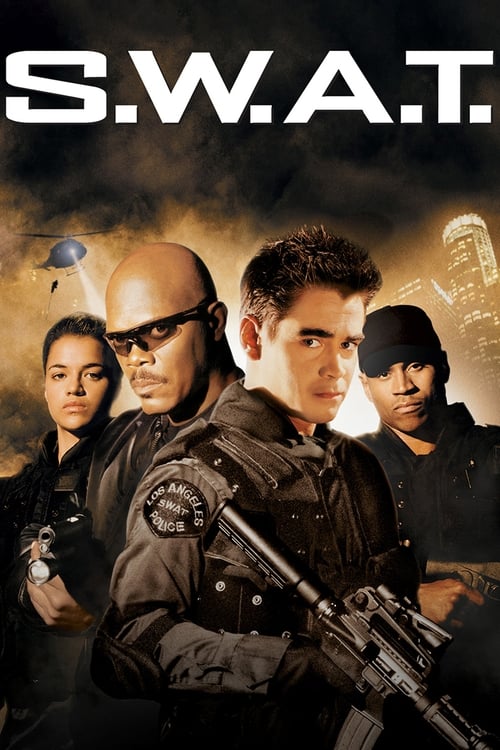
S.W.A.T.
Hondo Harrelson recruits Jim Street to join an elite unit of the Los Angeles Police Department. Together they seek out more members, including tough Deke Kay and single mom Chris Sanchez. The team's first big assignment is to escort crime boss Alex Montel to prison. It seems routine, but when Montel offers a huge reward to anyone who can break him free, criminals of various stripes step up for the prize.
Despite a considerable budget of $80.0M, S.W.A.T. became a solid performer, earning $207.7M worldwide—a 160% return.
5 wins & 5 nominations


Plot Structure
Story beats plotted across runtime


Narrative Arc
Emotional journey through the story's key moments
Story Circle
Blueprint 15-beat structure
Arcplot Score Breakdown
Weighted: Precision (70%) + Arc (15%) + Theme (15%)
S.W.A.T. (2003) demonstrates strategically placed story structure, characteristic of Clark Johnson's storytelling approach. This structural analysis examines how the film's 15-point plot structure maps to proven narrative frameworks across 1 hour and 57 minutes. With an Arcplot score of 7.0, the film balances conventional beats with creative variation.
Characters
Cast & narrative archetypes

Jim Street
Dan 'Hondo' Harrelson
Chris Sanchez
Deacon 'Deke' Kaye
Michael Boxer
T.J. McCabe
Alex Montel
Main Cast & Characters
Jim Street
Played by Colin Farrell
A skilled LAPD officer demoted to the gun cage who gets a second chance to join an elite S.W.A.T. team.
Dan 'Hondo' Harrelson
Played by Samuel L. Jackson
A veteran LAPD sergeant tasked with building and leading a new S.W.A.T. team from scratch.
Chris Sanchez
Played by Michelle Rodriguez
The sole female member of the new S.W.A.T. team, a tough and capable officer proving herself in a male-dominated field.
Deacon 'Deke' Kaye
Played by LL Cool J
A family man and experienced S.W.A.T. officer who brings stability and wisdom to the team.
Michael Boxer
Played by Brian Van Holt
A hot-headed officer and Street's former partner whose ego leads to their demotion.
T.J. McCabe
Played by Josh Charles
A tough, athletic member of Hondo's new S.W.A.T. team who brings raw skill and determination.
Alex Montel
Played by Olivier Martinez
A wealthy French drug lord who offers $100 million to anyone who can free him from police custody.
Structural Analysis
The Status Quo at 1 minutes (1% through the runtime) establishes LAPD S.W.A.T. Team under Jim Street and Brian Gamble executes a high-stakes hostage rescue. They're elite, confident, and at the top of their game as partners.. Of particular interest, this early placement immediately immerses viewers in the story world.
The inciting incident occurs at 13 minutes when Street and Gamble are broken up as partners and kicked off S.W.A.T. Gamble quits in anger; Street accepts demotion to the gun cage, his elite career seemingly over.. At 11% through the film, this Disruption aligns precisely with traditional story structure. This beat shifts the emotional landscape, launching the protagonist into the central conflict.
The First Threshold at 29 minutes marks the transition into Act II, occurring at 25% of the runtime. This indicates the protagonist's commitment to Street commits to Hondo's new S.W.A.T. Team, choosing to rebuild his career under new leadership rather than stay safe in obscurity., moving from reaction to action.
At 59 minutes, the Midpoint arrives at 50% of the runtime—precisely centered, creating perfect narrative symmetry. Structural examination shows that this crucial beat False victory turns to false defeat: The team successfully captures drug lord Alex Montel, but he immediately offers $100 million to anyone who can free him. The stakes explode as every criminal in LA targets the team., fundamentally raising what's at risk. The emotional intensity shifts, dividing the narrative into clear before-and-after phases.
The Collapse moment at 87 minutes (75% through) represents the emotional nadir. Here, Gamble's crew successfully extracts Montel from police custody. Street's past literally comes back to destroy his present. A team member is seriously wounded. All seems lost., demonstrates the protagonist at their lowest point. This beat's placement in the final quarter sets up the climactic reversal.
The Second Threshold at 93 minutes initiates the final act resolution at 80% of the runtime. Intelligence reveals Montel's escape route to the airport. Street synthesizes his old skills with his new team values. The team commits to an all-or-nothing interception, unified in purpose., demonstrating the transformation achieved throughout the journey.
Emotional Journey
S.W.A.T.'s emotional architecture traces a deliberate progression across 15 carefully calibrated beats.
Narrative Framework
This structural analysis employs systematic plot point analysis that identifies crucial turning points. By mapping S.W.A.T. against these established plot points, we can identify how Clark Johnson utilizes or subverts traditional narrative conventions. The plot point approach reveals not only adherence to structural principles but also creative choices that distinguish S.W.A.T. within the action genre.
Clark Johnson's Structural Approach
Among the 2 Clark Johnson films analyzed on Arcplot, the average structural score is 7.3, reflecting strong command of classical structure. S.W.A.T. takes a more unconventional approach compared to the director's typical style. For comparative analysis, explore the complete Clark Johnson filmography.
Comparative Analysis
Additional action films include The Bad Guys, Puss in Boots and Venom: The Last Dance. For more Clark Johnson analyses, see The Sentinel.
Plot Points by Act
Act I
SetupStatus Quo
LAPD S.W.A.T. team under Jim Street and Brian Gamble executes a high-stakes hostage rescue. They're elite, confident, and at the top of their game as partners.
Theme
Captain Fuller tells Street: "It's not about individuals. S.W.A.T. is about the team." The central question: Will you sacrifice personal glory for the greater good?
Worldbuilding
Establishment of S.W.A.T. culture, Street and Gamble's partnership, and the LAPD hierarchy. The opening rescue goes wrong when Gamble disobeys orders, shooting a hostage-taker and injuring a hostage. Both partners are demoted.
Disruption
Street and Gamble are broken up as partners and kicked off S.W.A.T. Gamble quits in anger; Street accepts demotion to the gun cage, his elite career seemingly over.
Resistance
Six months later, Street languishes in the gun cage. Hondo Harrelson, a former S.W.A.T. legend, returns to rebuild the unit. Street debates whether to accept Hondo's offer to try out for the new team, risking more failure.
Act II
ConfrontationFirst Threshold
Street commits to Hondo's new S.W.A.T. team, choosing to rebuild his career under new leadership rather than stay safe in obscurity.
Mirror World
Chris Sanchez, a tough female officer, joins the team. She represents the theme of proving yourself through teamwork rather than ego, becoming Street's mirror and potential romantic interest.
Premise
Training montage and team-building as Hondo molds five officers into a cohesive S.W.A.T. unit. The promise of the premise: watching elite tactical training, camaraderie forming, and the team proving themselves through escalating challenges and their first missions together.
Midpoint
False victory turns to false defeat: The team successfully captures drug lord Alex Montel, but he immediately offers $100 million to anyone who can free him. The stakes explode as every criminal in LA targets the team.
Opposition
Pressure intensifies as criminals attack the S.W.A.T. convoy. Gamble resurfaces, now working with a crew attempting to free Montel. Street's loyalty is tested between his old partner and his new team. Multiple attacks escalate the danger.
Collapse
Gamble's crew successfully extracts Montel from police custody. Street's past literally comes back to destroy his present. A team member is seriously wounded. All seems lost.
Crisis
The team regroups in darkness. Street faces his demons about Gamble. Hondo contemplates failure. They must decide whether to give up or find a way forward despite being outgunned and outmaneuvered.
Act III
ResolutionSecond Threshold
Intelligence reveals Montel's escape route to the airport. Street synthesizes his old skills with his new team values. The team commits to an all-or-nothing interception, unified in purpose.
Synthesis
The finale: S.W.A.T. pursues Montel and Gamble through LA to a climactic confrontation on a private jet bridge. Street faces Gamble, choosing team over personal loyalty. Coordinated tactical action stops the escape and recaptures Montel.
Transformation
The team stands together, unified and victorious. Street has transformed from a glory-seeking individual into a true team player. They walk away as brothers and sisters in arms, the new S.W.A.T. proven and redeemed.