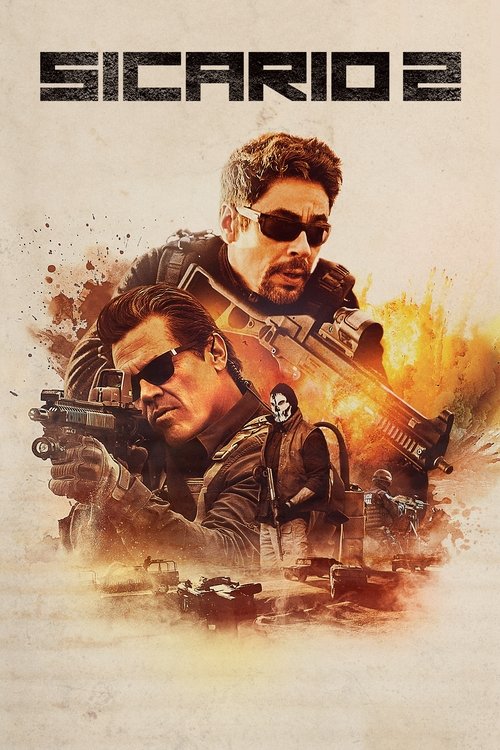
Sicario: Day of the Soldado
Agent Matt Graver teams up with operative Alejandro Gillick to prevent Mexican drug cartels from smuggling terrorists across the United States border.
Despite a moderate budget of $35.0M, Sicario: Day of the Soldado became a solid performer, earning $75.8M worldwide—a 117% return.
1 win & 8 nominations


Plot Structure
Story beats plotted across runtime


Narrative Arc
Emotional journey through the story's key moments
Story Circle
Blueprint 15-beat structure
Arcplot Score Breakdown
Weighted: Precision (70%) + Arc (15%) + Theme (15%)
Sicario: Day of the Soldado (2018) demonstrates strategically placed dramatic framework, characteristic of Stefano Sollima's storytelling approach. This structural analysis examines how the film's 15-point plot structure maps to proven narrative frameworks across 2 hours and 2 minutes. With an Arcplot score of 7.0, the film balances conventional beats with creative variation.
Characters
Cast & narrative archetypes

Alejandro Gillick
Matt Graver
Isabel Reyes
Miguel Hernández
Cynthia Foards
Gallo
Main Cast & Characters
Alejandro Gillick
Played by Benicio del Toro
Former prosecutor turned deadly assassin seeking revenge against drug cartels. Operates in moral gray zones while executing black ops missions.
Matt Graver
Played by Josh Brolin
CIA paramilitary operative who orchestrates covert operations against cartels. Pragmatic and ruthless in pursuing American interests.
Isabel Reyes
Played by Isabela Merced
Teenage daughter of a cartel kingpin who becomes a pawn in a black ops mission. Transforms from privileged teenager to survivor.
Miguel Hernández
Played by Elijah Rodriguez
Young coyote (human smuggler) working for cartels at the Texas-Mexico border. Drawn deeper into violence and moral compromise.
Cynthia Foards
Played by Catherine Keener
Secretary of Defense who authorizes the covert mission to destabilize cartels. Represents institutional authority and political calculation.
Gallo
Played by Manuel Garcia-Rulfo
Brutal cartel enforcer and human trafficker who operates along the border. Represents the violence of the cartel system.
Structural Analysis
The Status Quo at 1 minutes (1% through the runtime) establishes A suicide bomber detonates in a Kansas City grocery store, killing 15 people. This establishes the brutal reality of cross-border terrorism that will drive the film's black ops mission.. Of particular interest, this early placement immediately immerses viewers in the story world.
The inciting incident occurs at 15 minutes when The mission is greenlit: kidnap Isabel Reyes, daughter of cartel boss Carlos Reyes, to spark a war between Mexican cartels. This sets the entire plot in motion.. At 12% through the film, this Disruption aligns precisely with traditional story structure. This beat shifts the emotional landscape, launching the protagonist into the central conflict.
The First Threshold at 32 minutes marks the transition into Act II, occurring at 26% of the runtime. This indicates the protagonist's commitment to The team executes the kidnapping of Isabel in Mexico City, making it look like a rival cartel operation. The mission is now active and irreversible, launching Act 2., moving from reaction to action.
At 61 minutes, the Midpoint arrives at 50% of the runtime—precisely centered, creating perfect narrative symmetry. Significantly, this crucial beat The mission is abruptly terminated by Washington. Mexican police attacked the convoy, and with one of the attackers being a Mexican Federal officer, the political optics become untenable. Matt is ordered to erase all evidence, including killing Isabel., fundamentally raising what's at risk. The emotional intensity shifts, dividing the narrative into clear before-and-after phases.
The Collapse moment at 90 minutes (74% through) represents the emotional nadir. Here, Alejandro is shot in the face by a corrupt Mexican police officer and left for dead in the desert. This is his lowest point, apparently killed while trying to protect Isabel, his mission of redemption seemingly ended., demonstrates the protagonist at their lowest point. This beat's placement in the final quarter sets up the climactic reversal.
The Second Threshold at 97 minutes initiates the final act resolution at 79% of the runtime. Alejandro tracks down Isabel, now safely home. He realizes what he must do: eliminate the witness and complete a darker mission of revenge against the cartel structure, synthesizing his assassin skills with his protective instinct turned to vengeance., demonstrating the transformation achieved throughout the journey.
Emotional Journey
Sicario: Day of the Soldado's emotional architecture traces a deliberate progression across 15 carefully calibrated beats.
Narrative Framework
This structural analysis employs structural analysis methodology used to understand storytelling architecture. By mapping Sicario: Day of the Soldado against these established plot points, we can identify how Stefano Sollima utilizes or subverts traditional narrative conventions. The plot point approach reveals not only adherence to structural principles but also creative choices that distinguish Sicario: Day of the Soldado within the action genre.
Comparative Analysis
Additional action films include The Bad Guys, Puss in Boots and Venom: The Last Dance.
Plot Points by Act
Act I
SetupStatus Quo
A suicide bomber detonates in a Kansas City grocery store, killing 15 people. This establishes the brutal reality of cross-border terrorism that will drive the film's black ops mission.
Theme
Secretary of Defense James Riley tells Matt Graver: "You're going to help us start a war." The theme of manufactured conflict and the moral ambiguity of fighting dirty to achieve strategic goals is established.
Worldbuilding
The world of covert operations against cartels is established. We see Matt Graver pitch his plan to kidnap the daughter of a cartel kingpin to trigger inter-cartel war, and Alejandro is recruited back into service.
Disruption
The mission is greenlit: kidnap Isabel Reyes, daughter of cartel boss Carlos Reyes, to spark a war between Mexican cartels. This sets the entire plot in motion.
Resistance
The team assembles and plans the kidnapping operation. Alejandro observes Isabel at her private school in Mexico City. The team debates tactics and prepares for the extraction, establishing the operational dynamics.
Act II
ConfrontationFirst Threshold
The team executes the kidnapping of Isabel in Mexico City, making it look like a rival cartel operation. The mission is now active and irreversible, launching Act 2.
Mirror World
Alejandro begins interacting with the kidnapped Isabel, who doesn't know her captors' true identities. This relationship becomes the emotional core that will challenge Alejandro's mission and reconnect him to his humanity.
Premise
The team transports Isabel toward the US border while maintaining the ruse. A parallel story follows Miguel, a young smuggler, crossing paths with the operation. The plan appears to be working as cartels react to the apparent kidnapping.
Midpoint
The mission is abruptly terminated by Washington. Mexican police attacked the convoy, and with one of the attackers being a Mexican Federal officer, the political optics become untenable. Matt is ordered to erase all evidence, including killing Isabel.
Opposition
Alejandro refuses to kill Isabel and goes rogue to return her to Mexico. Matt's team hunts Alejandro. Alejandro and Isabel are betrayed, attacked, and separated. Miguel is recruited by cartel enforcers. All sides close in.
Collapse
Alejandro is shot in the face by a corrupt Mexican police officer and left for dead in the desert. This is his lowest point, apparently killed while trying to protect Isabel, his mission of redemption seemingly ended.
Crisis
Alejandro survives and recovers from his facial wound. Isabel is returned to her family. Miguel is pressured to join the cartel. Alejandro processes his failure and near-death, preparing for his final move.
Act III
ResolutionSecond Threshold
Alejandro tracks down Isabel, now safely home. He realizes what he must do: eliminate the witness and complete a darker mission of revenge against the cartel structure, synthesizing his assassin skills with his protective instinct turned to vengeance.
Synthesis
Alejandro confronts Isabel in her home to kill her, but ultimately cannot. Instead, he forces Miguel, the young smuggler, to shoot him to gain cartel credibility, sparing the boy while engineering his own survival. All threads resolve in moral ambiguity.
Transformation
Miguel has shot Alejandro and walks away, now initiated into the cartel world. Alejandro lies wounded but alive, having chosen mercy over murder. Both characters are irrevocably changed, trapped in cycles of violence, embodying the film's theme that the war creates only more soldiers.