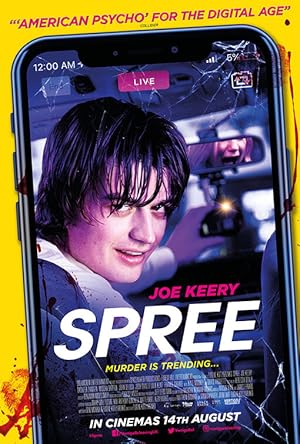
Spree
Thirsty for a following, Kurt Kunkle is a rideshare driver who has figured out a deadly plan to go viral.
The film earned $44K at the global box office.


Plot Structure
Story beats plotted across runtime


Narrative Arc
Emotional journey through the story's key moments
Story Circle
Blueprint 15-beat structure
Arcplot Score Breakdown
Weighted: Precision (70%) + Arc (15%) + Theme (15%)
Spree (2020) reveals carefully calibrated dramatic framework, characteristic of Eugene Kotlyarenko's storytelling approach. This structural analysis examines how the film's 15-point plot structure maps to proven narrative frameworks across 1 hour and 33 minutes. With an Arcplot score of 7.1, the film balances conventional beats with creative variation.
Characters
Cast & narrative archetypes

Kurt Kunkle
Jessie Adams
Bobby Basecamp
Kris Kunkle
London
uNo
Main Cast & Characters
Kurt Kunkle
Played by Joe Keery
A rideshare driver desperate for social media fame who livestreams murders to gain followers.
Jessie Adams
Played by Sasheer Zamata
A successful comedian and social media influencer who becomes Kurt's target and eventual adversary.
Bobby Basecamp
Played by Josh Ovalle
A popular social media influencer and Kurt's childhood friend who has achieved the fame Kurt desperately wants.
Kris Kunkle
Played by David Arquette
Kurt's father who is concerned about his son's obsession with internet fame.
London
Played by Mischa Barton
A young passenger who takes multiple rides with Kurt and becomes one of his victims.
uNo
Played by Frankie Grande
A racist and aggressive passenger who becomes one of Kurt's first victims.
Structural Analysis
The Status Quo at 1 minutes (1% through the runtime) establishes Kurt Kunkle sits in his childhood bedroom surrounded by recording equipment, desperately trying to gain followers on social media. He's a rideshare driver with virtually no online presence despite years of effort, embodying the pathetic state of influencer-obsessed desperation.. Of particular interest, this early placement immediately immerses viewers in the story world.
The inciting incident occurs at 12 minutes when Kurt picks up his first passengers and executes his plan, offering them poisoned water. When they drink it and die, he commits his first murders on livestream. The ordinary rideshare shift becomes a killing spree, broadcast to an audience of virtually zero viewers.. At 13% through the film, this Disruption is delayed, allowing extended setup of the story world. This beat shifts the emotional landscape, launching the protagonist into the central conflict.
The First Threshold at 24 minutes marks the transition into Act II, occurring at 26% of the runtime. This shows the protagonist's commitment to Kurt picks up Jessie Adams, a stand-up comedian with a genuine following who represents everything he wants. He actively chooses to make her part of his plan, shifting from random victims to targeting someone who could give him the attention he craves. The stakes escalate., moving from reaction to action.
At 47 minutes, the Midpoint arrives at 50% of the runtime—precisely centered, creating perfect narrative symmetry. Significantly, this crucial beat Kurt's livestream finally goes viral after particularly shocking murders. His follower count explodes, giving him the validation he's always craved. False victory: he's achieved his goal of fame, but it's built entirely on atrocity. The attention only fuels his delusion and escalates his violence., fundamentally raising what's at risk. The emotional intensity shifts, dividing the narrative into clear before-and-after phases.
The Collapse moment at 70 minutes (76% through) represents the emotional nadir. Here, Kurt murders Bobby Basecamp, the influencer he idolized, in a desperate bid for more views and validation. This symbolic death of his aspirational figure represents the complete moral collapse and the death of any remaining humanity. He's fully consumed by the algorithm., demonstrates the protagonist at their lowest point. This beat's placement in the final quarter sets up the climactic reversal.
The Second Threshold at 75 minutes initiates the final act resolution at 81% of the runtime. Kurt fully embraces his identity as a viral killer and decides to orchestrate his final confrontation with Jessie Adams. He synthesizes everything he's learned about generating engagement and plans the ultimate livestream finale. No redemption, only escalation., demonstrating the transformation achieved throughout the journey.
Emotional Journey
Spree's emotional architecture traces a deliberate progression across 15 carefully calibrated beats.
Narrative Framework
This structural analysis employs systematic plot point analysis that identifies crucial turning points. By mapping Spree against these established plot points, we can identify how Eugene Kotlyarenko utilizes or subverts traditional narrative conventions. The plot point approach reveals not only adherence to structural principles but also creative choices that distinguish Spree within the comedy genre.
Comparative Analysis
Additional comedy films include The Bad Guys, Ella Enchanted and The Evening Star.
Plot Points by Act
Act I
SetupStatus Quo
Kurt Kunkle sits in his childhood bedroom surrounded by recording equipment, desperately trying to gain followers on social media. He's a rideshare driver with virtually no online presence despite years of effort, embodying the pathetic state of influencer-obsessed desperation.
Theme
Bobby Basecamp, Kurt's childhood acquaintance turned successful influencer, casually dismisses Kurt's attempts at connection, highlighting the film's theme: the dehumanizing pursuit of viral fame and the moral emptiness of social media celebrity culture.
Worldbuilding
Kurt prepares his elaborate livestream setup, "The Lesson," rigging his rideshare car with cameras and poisoned water bottles. We see his delusional confidence, his invisible online presence, and the shallow influencer ecosystem he desperately wants to join.
Disruption
Kurt picks up his first passengers and executes his plan, offering them poisoned water. When they drink it and die, he commits his first murders on livestream. The ordinary rideshare shift becomes a killing spree, broadcast to an audience of virtually zero viewers.
Resistance
Kurt continues picking up passengers and killing them, refining his methodology while maintaining his cheerful livestream persona. He encounters various victims and navigates the mechanics of murder while checking obsessively for viewer count increases, which remain negligible.
Act II
ConfrontationFirst Threshold
Kurt picks up Jessie Adams, a stand-up comedian with a genuine following who represents everything he wants. He actively chooses to make her part of his plan, shifting from random victims to targeting someone who could give him the attention he craves. The stakes escalate.
Mirror World
Jessie Adams represents the thematic counterpoint to Kurt: she has followers but is authentically herself, using comedy to critique the same toxic culture Kurt embodies. Her genuine talent and dismissive attitude toward Kurt mirror his own emptiness and desperation.
Premise
Kurt's killing spree continues with increasing boldness and creativity. The "promise of the premise" delivers: a darkly satirical livestreamed murder rampage where Kurt performs for the camera, desperate for validation. His viewer count slowly begins to tick upward as the violence escalates.
Midpoint
Kurt's livestream finally goes viral after particularly shocking murders. His follower count explodes, giving him the validation he's always craved. False victory: he's achieved his goal of fame, but it's built entirely on atrocity. The attention only fuels his delusion and escalates his violence.
Opposition
Kurt's spree intensifies as he hunts for Jessie Adams to kill her on camera and increase his status further. Police begin investigating. Witnesses and survivors complicate his plan. His family and Bobby become targets. The walls close in as his fame grows alongside the body count.
Collapse
Kurt murders Bobby Basecamp, the influencer he idolized, in a desperate bid for more views and validation. This symbolic death of his aspirational figure represents the complete moral collapse and the death of any remaining humanity. He's fully consumed by the algorithm.
Crisis
Kurt processes the aftermath of Bobby's murder while continuing to perform for his audience. The darkness of what he's become settles in, but rather than redemption, he doubles down. His crisis is a twisted commitment to the performance, to maintaining the engagement at any cost.
Act III
ResolutionSecond Threshold
Kurt fully embraces his identity as a viral killer and decides to orchestrate his final confrontation with Jessie Adams. He synthesizes everything he's learned about generating engagement and plans the ultimate livestream finale. No redemption, only escalation.
Synthesis
The finale confrontation between Kurt and Jessie plays out as a livestreamed spectacle. Kurt attempts to kill Jessie for maximum viral impact, but she fights back. The chase and struggle become content, with viewers watching and commenting in real-time. Jessie ultimately kills Kurt in self-defense, captured on camera.
Transformation
Kurt lies dead, his murder captured and shared virally across social media. The closing image shows his death being consumed as content, his final wish granted in the most tragic way. Jessie is traumatized but alive. The system that created Kurt continues unchanged, a dark transformation that reveals no one truly wins.