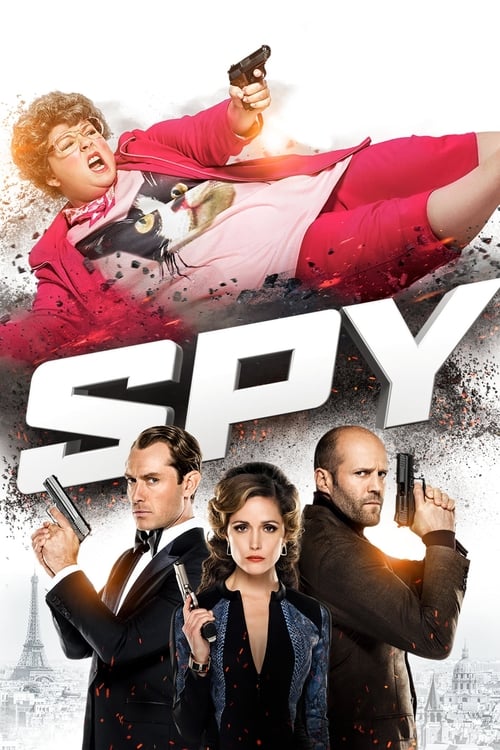
Spy
A desk-bound CIA analyst volunteers to go undercover to infiltrate the world of a deadly arms dealer, and prevent diabolical global disaster.
Despite a moderate budget of $65.0M, Spy became a commercial success, earning $235.7M worldwide—a 263% return.
6 wins & 31 nominations


Plot Structure
Story beats plotted across runtime


Narrative Arc
Emotional journey through the story's key moments
Story Circle
Blueprint 15-beat structure
Arcplot Score Breakdown
Weighted: Precision (70%) + Arc (15%) + Theme (15%)
Spy (2015) exhibits meticulously timed plot construction, characteristic of Paul Feig's storytelling approach. This structural analysis examines how the film's 15-point plot structure maps to proven narrative frameworks across 2 hours. With an Arcplot score of 7.3, the film balances conventional beats with creative variation.
Characters
Cast & narrative archetypes

Susan Cooper
Rick Ford
Rayna Boyanov
Bradley Fine
Nancy B. Artingstall
Aldo
Elaine Crocker
Main Cast & Characters
Susan Cooper
Played by Melissa McCarthy
A desk-bound CIA analyst who volunteers to go undercover when her partner is compromised and all active agents are exposed.
Rick Ford
Played by Jason Statham
A rogue, egotistical former CIA agent who constantly brags about his dangerous exploits and goes off-book.
Rayna Boyanov
Played by Rose Byrne
A ruthless arms dealer seeking to sell a nuclear weapon, the primary antagonist of the film.
Bradley Fine
Played by Jude Law
Susan's smooth, charismatic partner and crush who guides her through missions from the field.
Nancy B. Artingstall
Played by Miranda Hart
Susan's fellow CIA analyst and best friend who provides tech support and encouragement.
Aldo
Played by Peter Serafinowicz
An incompetent Italian secret agent who becomes an unlikely ally to Susan in the field.
Elaine Crocker
Played by Allison Janney
The CIA director who reluctantly approves Susan's undercover mission.
Structural Analysis
The Status Quo at 1 minutes (1% through the runtime) establishes Susan Cooper works as a CIA analyst in the basement, providing remote support to field agent Bradley Fine. She is capable but invisible, living vicariously through his missions while eating cupcakes at her desk surrounded by rodent droppings.. Significantly, this early placement immediately immerses viewers in the story world.
The inciting incident occurs at 15 minutes when Bradley Fine is killed during a mission when nuclear arms dealer Rayna Boyanov reveals she has the identities of all active CIA agents. Fine accidentally triggers a bomb. Susan witnesses his death through the video feed, devastated.. At 12% through the film, this Disruption aligns precisely with traditional story structure. This beat shifts the emotional landscape, launching the protagonist into the central conflict.
The First Threshold at 31 minutes marks the transition into Act II, occurring at 26% of the runtime. This reveals the protagonist's commitment to Susan actively chooses to accept the mission to Paris, leaving her basement desk behind. She commits to becoming a field agent despite being given a frumpy cover identity and ridiculous disguises, stepping into the world of espionage she's only observed from afar., moving from reaction to action.
At 60 minutes, the Midpoint arrives at 50% of the runtime—precisely centered, creating perfect narrative symmetry. Significantly, this crucial beat False victory: Susan successfully gets close to Rayna by saving her life during an assassination attempt in a Budapest nightclub. Rayna begins to trust Susan (as "Amber Valentine"), and Susan is invited into Rayna's inner circle. The stakes raise as Susan goes deeper undercover., fundamentally raising what's at risk. The emotional intensity shifts, dividing the narrative into clear before-and-after phases.
The Collapse moment at 90 minutes (75% through) represents the emotional nadir. Here, Susan is betrayed by Fine, her mentor and crush, who reveals he faked his death and has been working with Rayna to steal the nuclear bomb. Her entire mission appears to have failed, the bomb is missing, and the man she trusted most is the enemy. Everything she believed was a lie., indicates the protagonist at their lowest point. This beat's placement in the final quarter sets up the climactic reversal.
The Second Threshold at 96 minutes initiates the final act resolution at 80% of the runtime. Susan synthesizes her analyst skills with her newfound field experience. She deduces the bomb's location, realizes Fine's plan, and chooses to trust herself completely. She stops waiting for validation from others and takes command, coordinating with Nancy and even the bumbling Ford., demonstrating the transformation achieved throughout the journey.
Emotional Journey
Spy's emotional architecture traces a deliberate progression across 15 carefully calibrated beats.
Narrative Framework
This structural analysis employs systematic plot point analysis that identifies crucial turning points. By mapping Spy against these established plot points, we can identify how Paul Feig utilizes or subverts traditional narrative conventions. The plot point approach reveals not only adherence to structural principles but also creative choices that distinguish Spy within the action genre.
Paul Feig's Structural Approach
Among the 7 Paul Feig films analyzed on Arcplot, the average structural score is 7.2, reflecting strong command of classical structure. Spy represents one of the director's most structurally precise works. For comparative analysis, explore the complete Paul Feig filmography.
Comparative Analysis
Additional action films include The Bad Guys, Puss in Boots and Venom: The Last Dance. For more Paul Feig analyses, see Jackpot!, Ghostbusters and Unaccompanied Minors.
Plot Points by Act
Act I
SetupStatus Quo
Susan Cooper works as a CIA analyst in the basement, providing remote support to field agent Bradley Fine. She is capable but invisible, living vicariously through his missions while eating cupcakes at her desk surrounded by rodent droppings.
Theme
After a successful mission, a colleague tells Susan, "You're more than just support." The theme of self-worth and recognizing one's own capabilities is established—Susan must learn she's capable of more than she believes.
Worldbuilding
Introduction to CIA operations, Susan's unrequited crush on Bradley Fine, the basement analyst team, and the contrast between glamorous field agents and overlooked support staff. Establishes Susan's competence paired with her lack of confidence and recognition.
Disruption
Bradley Fine is killed during a mission when nuclear arms dealer Rayna Boyanov reveals she has the identities of all active CIA agents. Fine accidentally triggers a bomb. Susan witnesses his death through the video feed, devastated.
Resistance
Susan grieves Fine's death but realizes she's the only agent whose identity is unknown to Rayna. She volunteers for a tracking mission despite CIA Director Crocker's doubts. Arrogant agent Rick Ford protests and quits. Susan debates whether she's truly capable of fieldwork.
Act II
ConfrontationFirst Threshold
Susan actively chooses to accept the mission to Paris, leaving her basement desk behind. She commits to becoming a field agent despite being given a frumpy cover identity and ridiculous disguises, stepping into the world of espionage she's only observed from afar.
Mirror World
Susan meets Aldo, an Italian contact, and begins forming connections in the field. More significantly, her interactions with fellow agent Nancy and antagonist Rayna become thematic mirrors—Nancy represents loyal friendship, while Rayna embodies the confidence Susan lacks.
Premise
The "fun and games" of Susan as a spy: she exceeds expectations in Paris, survives an attack in her hotel room, tracks Rayna to Budapest, handles combat situations with surprising skill, and navigates the glamorous yet dangerous world of international espionage while dealing with rogue agent Rick Ford's interference.
Midpoint
False victory: Susan successfully gets close to Rayna by saving her life during an assassination attempt in a Budapest nightclub. Rayna begins to trust Susan (as "Amber Valentine"), and Susan is invited into Rayna's inner circle. The stakes raise as Susan goes deeper undercover.
Opposition
Susan discovers widespread corruption—her mentor Fine is alive and working with Rayna, CIA leadership may be compromised, and Rick Ford's bumbling interference keeps endangering the mission. The conspiracy deepens, trust erodes, and Susan must operate increasingly alone as enemies close in from all sides.
Collapse
Susan is betrayed by Fine, her mentor and crush, who reveals he faked his death and has been working with Rayna to steal the nuclear bomb. Her entire mission appears to have failed, the bomb is missing, and the man she trusted most is the enemy. Everything she believed was a lie.
Crisis
Susan processes the betrayal and faces her dark night. She confronts her own self-doubt and the realization that she's been underestimated and deceived. However, she also recognizes that she's proven herself capable—she survived this long through her own skills, not Fine's protection.
Act III
ResolutionSecond Threshold
Susan synthesizes her analyst skills with her newfound field experience. She deduces the bomb's location, realizes Fine's plan, and chooses to trust herself completely. She stops waiting for validation from others and takes command, coordinating with Nancy and even the bumbling Ford.
Synthesis
The finale aboard a private plane and at the buyer's location. Susan infiltrates the arms deal, outmaneuvers Fine and Rayna, fights multiple adversaries with skill and confidence, recovers the nuclear bomb, and saves the day using both her intelligence and her combat abilities. Ford accidentally helps. The mission succeeds.
Transformation
Susan is celebrated at CIA headquarters as a hero, no longer invisible or dismissed. She's offered a promotion and respect from her peers. The final image shows her confident, valued, and recognized—transformed from the basement analyst eating cupcakes to a capable agent who knows her worth.